
Every exchange support team knows the ticket. It starts with "Where is my crypto?" A customer copies a deposit address, pastes it into their wallet, misses a character or picks the wrong network, and the funds never arrive. Onchain transfers can't be reversed, so there's no chargeback and no one to call. The customer still blames the exchange.
Another warning banner won't fix it. Taking the address out of the customer's hands will. With WalletConnect, customers connect the wallet they already use, prove they're in control of it with one click, and fund or withdraw without pasting a single address.
This guide covers why manual transfers fail, what MiCA now expects from exchanges, and how WalletConnect fixes pay-ins and payouts in one flow.
Get money on your platform
Every exchange's revenue starts with a deposit. Spreads, fees, and trading volume all depend on money arriving, and arriving fast. Deposits aren't a back-office step. They're the top of your funnel.
The money is already onchain and ready to move. The WalletConnect Network powered $155.9B in USDC volume in H1 2026 alone, across institutional platforms and everyday wallets (USDC on the WalletConnect Network: H1 2026 in Review). The companies winning this market already build on WalletConnect to bring that capital in.
Your customers already trust the connection, too:
- Retail wallets use WalletConnect every day to trade on DEXs and connect to 80,000+ apps. Funding your exchange is the same tap they already know.
- Institutional wallets use WalletConnect to move funds from custody to the providers and platforms they work with, with every transaction approved under their own policies. For them, it's how money leaves custody with trust intact.
So the fastest way to get money on your platform is to meet those wallets where they already are. No address to copy, no new app, and no "Where is my crypto?" ticket afterwards.
Platforms that serve retail traders and institutional desks need one way in for both. See Stablecoin Deposits for CFD and Perpetuals Platforms: One Integration for Every Type of Capital, and the full network numbers in WalletConnect's H1 2026 Network Volume.
Instant crypto deposits: why speed decides where traders fund
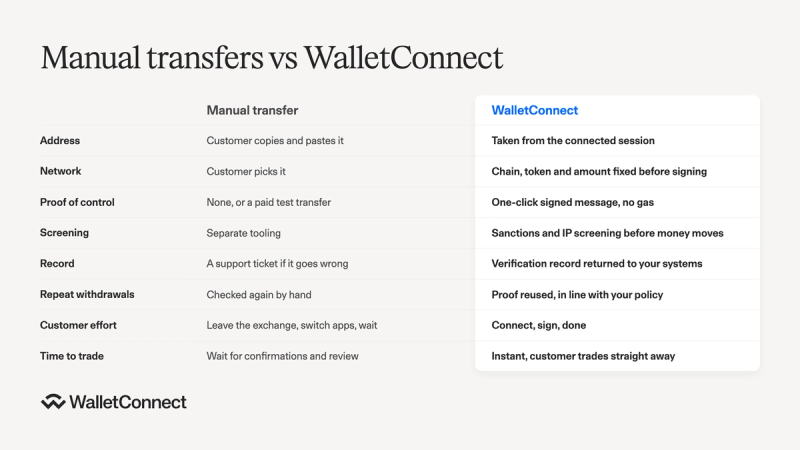
With a manual transfer, the customer sends funds and then waits. The deposit has to confirm onchain and clear the exchange's own checks before it shows in their balance. That can mean minutes on a pending screen, and longer on a busy network or when a deposit gets flagged for review. Every minute is a chance for the trade they came to make to move on without them.
With WalletConnect, deposits are instant. Chain, token, and amount are fixed before the customer signs; confirmation comes straight back, and stablecoin settlement lands in seconds, so you credit the account automatically.
Your customers will love it. They connect, sign, and start moving and trading on your platform straight away. No pending screen, no refreshing their balance, no support chat.
Why do crypto deposits and withdrawals go to the wrong address?
On most exchanges, the customer is still the integration. To move funds, they have to:
- Copy a deposit address from the exchange and paste it into a separate wallet app
- Pick the network themselves, often from a long dropdown of chains that look alike
- Paste their own wallet address into a withdrawal form, then confirm it by eye
Every step is a chance for something to go wrong:
- Typos and truncation. One missing or swapped character sends funds to an address no one controls.
- Wrong network. The address is right, but the chain isn't. The funds land somewhere the exchange may not be able to reach.
- Clipboard malware. Malicious software swaps the copied address for an attacker's. The customer pastes it without noticing.
- Address poisoning. Attackers send tiny transfers from lookalike addresses, so a customer copying from their history picks the wrong one.
When it goes wrong, the ticket, the investigation and the reputational hit all land with the exchange. Even when funds are recoverable, the recovery is manual, slow and expensive to staff.
Most of these failures never show up in your dashboard. A failed deposit leaves no record, only a ticket, as we cover in Failed crypto deposits leave no record. Here is what to measure instead.
Why are manual crypto deposits so slow?
Traders fund when a market moves. A manual deposit means leaving the exchange, opening a wallet, copying, pasting, picking a network, confirming and waiting for the deposit to credit, while the moment passes. Every extra step is a place to drop off, and a trader who misses a move once will fund somewhere faster next time.
Withdrawals have the same problem in reverse. The exchange holds funds while it checks a destination it has no way to verify. Ops teams review flagged withdrawals by hand, customers chase support for an update, and the payout that should take seconds takes hours.
More deposit and withdrawal pain points exchanges live with
Wrong addresses and slow transfers are the headline problems. They're not the only ones:
- Missing memos and tags. Some chains need a memo or destination tag on deposits to shared addresses. Leave it off and the funds land but can't be matched to an account. With WalletConnect, the destination and payment data come from the exchange, so there's nothing for the customer to forget.
- Wrong token, wrong chain. A customer sends a token your deposit address doesn't support. Smart routing accepts any token on any chain, and you receive the token you chose.
- No gas to send. A customer holds stablecoins but none of the native token needed for gas, so they can't deposit at all. Gas is sponsored by default, so they deposit what they hold.
- Unmatched deposits. Funds arrive with no clean link to an account, and someone reconciles them by hand. Every WalletConnect deposit comes with clear payment data, so you credit automatically.
- Withdrawal disputes. A customer says a withdrawal never arrived, or went to the wrong wallet. With a signed proof of control on file, you can show the funds went to a wallet they proved they controlled.
- Card and bank funding friction. Card declines, chargebacks, and slow bank transfers lose customers before they trade. Stablecoin deposits from 700+ wallets and major exchange accounts settle instantly and finally, with no chargebacks.
- Support load. Every one of these ends up as a ticket. Fewer manual steps mean fewer tickets, and fewer "Where is my crypto?" chats.
Why can't the exchange verify the wallet today?
A wallet address is a string of characters. It carries no name, no owner, and no proof of who's in control of it. When a customer pastes one in, the exchange is taking their word for it.
That creates three gaps:
- No proof of control. The exchange can't confirm the customer controls the wallet sending the deposit or receiving the withdrawal.
- No link to the customer. Funds arrive from an address the exchange has never seen, with nothing tying them to an account.
- No record. If a regulator or auditor asks how the wallet was checked, there's nothing to show.
Under MiCA, those gaps are now a compliance problem as well as an operational one.
What does MiCA require for self-hosted wallet transfers?
The MiCA transitional period ended on 1 July 2026. Every exchange serving EU customers now needs CASP authorisation, and the obligations that come with it are fully in force.
Alongside MiCA, the Transfer of Funds Regulation applies the Travel Rule to crypto transfers. For transfers above EUR 1,000 to or from a self-hosted wallet, the exchange has to assess whether its customer owns or controls that wallet. Self-declaration alone generally isn't enough. Regulators expect technical proof, such as a message signed by the wallet or a small test transfer.
That makes the address-only model hard to defend. We cover the regulation in detail in Self-Hosted Wallet Verification Requirements, and why verification underpins safe money movement in Verify the Wallet: Trust Both Ways in Stablecoin Money Movement.
How WalletConnect fixes deposits and withdrawals for exchanges
WalletConnect puts Wallet Verification and money movement in one flow, across 700+ wallets. The customer never types or pastes an address. The exchange gets proof of control and a record before any money moves.
Deposits
- The customer chooses to fund and connects the wallet they already use, without leaving the exchange.
- They sign one message to prove they're in control of it. The message names the exchange and the purpose, so the customer knows exactly what they're approving. No funds move, and no gas is needed to sign.
- Chain, token, and amount are fixed before anyone signs. The destination comes from the exchange, so there's no address to copy and no network to pick.
- Sanctions and IP screening run before money moves, and the outcome is enforced automatically.
- The deposit arrives with clear payment data, so the exchange credits the customer automatically, with no manual reconciliation.
Withdrawals
- The customer connects the wallet they want to be paid to.
- They sign once. The receiving address comes from the connected session, with no manual entry.
- The exchange gets a verification record back: the signature as proof of control, plus timestamp, chain, and session details.
- Screening runs and the funds go to a wallet the customer has proved they control.
- The proof can be reused for later withdrawals to the same address, in line with your risk policy, so repeat withdrawals stay fast.
Deposits run on Account Top-ups & Deposits. Verification runs on Wallet Verification. Customers can also fund straight from major exchange accounts, and payouts go out through WalletConnect Payments.
What does the verification record include?
Every verification returns a record to your systems, captured at signing:
- The signature, as proof of control
- Timestamp and chain
- Domain, URI, and nonce
- Session ID, connection status, and whether the session was reused
- Metadata about the connected wallet
That record is what turns a check you performed into a check you can evidence. It stays in your systems, under your retention policy, ready for an auditor or a regulator.
For what manual wallet checks really cost an ops team, see Wallet Verification: Replacing the Manual Check.
Why not use a Satoshi test?
Some exchanges prove control by asking the customer to send a small test amount from their wallet. It works, but it costs the customer a fee, adds a wait for the test to confirm and still depends on a pasted address. It also adds a second transfer to reconcile.
A signed message proves the same thing in one click, with no funds moving and no gas to pay. More in What Is a Satoshi Test?
Where does wallet verification sit in an exchange's flow?
Verification fits at the steps where wallet control matters:
- First deposit from a new wallet: verify once, then fund from the same session.
- Adding a withdrawal address: verify when the customer links the wallet, before the first payout.
- Withdrawals above your threshold: require a verified wallet for transfers that trigger MiCA's ownership assessment.
- Re-verification: run it again when your risk policy says so, for example, after a long gap or a change in risk score.
You set the policy. WalletConnect runs the check and returns the proof.
Built on infrastructure exchanges already use
WalletConnect has connected wallets, apps and institutions since 2018. The network reaches 900M+ users across 700+ wallets and all major blockchains, and it's SOC 2 Type II, independently audited on a recurring basis. Wallet Verification starts with EVM and Solana wallets.
Because most of your customers' wallets already support WalletConnect, there's nothing new for them to install. They connect the wallet they already have.
FAQ
Does wallet verification slow deposits down? No. It's one signature inside the same flow, and a verified wallet can be reused.
Is wallet verification the same as KYC? No. It proves control of a wallet and works alongside your KYC, not instead of it.
Do customers need gas to verify? No. Signing a message isn't a transaction, so nothing moves onchain.
Can customers still deposit from another exchange account? Yes. Account Top-ups & Deposits accept funding from major exchange accounts as well as self-hosted wallets.
Do we have to use WalletConnect for deposits to use Wallet Verification? No. Wallet Verification works as its own product and can sit inside the deposit and withdrawal flows you already run.
Fewer failed transfers, faster funding, proof on file
Wrong-address sends, slow manual transfers and unverifiable wallets come from the same place: customers doing the integration by hand. WalletConnect takes the address out of the flow, proves who's in control of the wallet and hands your compliance team a record it can evidence, in one step.
Money lands on your platform instantly, and customers start trading straight away. Watch the "Where is my crypto?" tickets dwindle. Your MiCA evidence is on file before the money moves.
See how Wallet Verification fits your deposit and withdrawal flows, or explore the Trading solution.
WalletConnect is a technical service provider, not a law firm. This article is not legal advice, and you remain responsible for your own regulatory obligations.