
How does USDC, the world's largest regulated stablecoin, move across the WalletConnect Network? This article looks at where and how USDC is actually used onchain. With $155.9B moved across more than a million transactions in 2026 alone, USDC has become the connective tissue of the onchain economy.
Two stories in one: institutional scale and organic breadth
The headline number of $155.9B in Total Network Volume (TNV) is striking, but the composition behind it is just as interesting. USDC volume flows through a set of institutional custody wallets and retail wallets. This is a powerful signal in its own right: institutions moving serious size are choosing to settle in USDC over the WalletConnect Network and users are transacting daily in USDC.
Even excluding institutional flow, the network metrics are strong: $6.94 billion in USDC volume across 1.06 million transactions. The network isn't just carrying a few institutional transfers, but also over a million everyday USDC transactions from self-custodial users around the world.
USDC on the network is, above all, a DeFi asset
USDC volume goes overwhelmingly into decentralized finance.
Institutional money movement and retail activity in DeFi account for $149.79B in USDC moved across the network.
Prediction markets and AI agents came second at $4.51B, followed by interoperability at $929M and wallets and custody at $444M. Payments and onboarding was also a key category with $197M in USDC TNV.
The takeaway is that USDC is the asset that users and institutions move, trade, and bridge.
Why are everyday users and institutions alike using USDC?
In the European Economic Area (EEA), USDC is issued by Circle Internet Financial Europe SAS, an e-money institution authorized by France's ACPR, as an e-money token under the EU's Markets in Crypto-Assets (MiCA) regulation — subject to MiCA's safeguarding, white-paper disclosure, and at-par redemption requirements.
That same emphasis on safety carries through to how USDC is backed: USDC is 100% backed by highly liquid cash and cash-equivalent assets, with holdings that equal or exceed the amount in circulation, is redeemable 1:1 for US dollars and is attested to monthly.
In July 2026, Circle received approval from the U.S. Office of the Comptroller of the Currency to establish First National Digital Currency Bank, N.A., a national trust bank operating under the name Circle National Trust. This converted the conditional approval granted in December 2025 into a final approval. The move brings Circle National Trust under direct federal oversight by the OCC, the primary regulator for national banks and national trust banks, beginning with fiduciary digital asset custody services for Circle and its affiliates and with reserve management planned as a future capability of the trust bank.
The GENIUS Act, signed into law on July 18, 2025, creates a federal framework requiring stablecoin issuers to hold reserves in safe assets and comply with banking-style regulations. When it takes effect in January 2027, it will give stablecoin holders a statutory priority claim to an issuer's required reserves ahead of other creditors.
That clarity is already translating into growth. Visa is now live with their pilot, deploying stablecoin capabilities via Visa Direct in 195 countries, settling in USDC.USDC supply grew to roughly $78 billion by Q1 2026, driven by institutional demand for regulated assets.
Together, MiCA compliance in Europe and a federally chartered trust bank in the U.S. give everyday users a stablecoin issued and overseen under comprehensive regulatory frameworks that closely resemble those governing traditional financial institutions.
The wallets powering USDC activity
More than $155.9 billion USDC moved through wallets like Fireblocks, MetaMask, Trust Wallet, Tangem, SafePal, and Uniswap Wallet in H1 2026. Binance Wallet, Ledger Live, OKX Wallet, Bitget Wallet, and TokenPocket round out the top ten.
A stablecoin with global reach
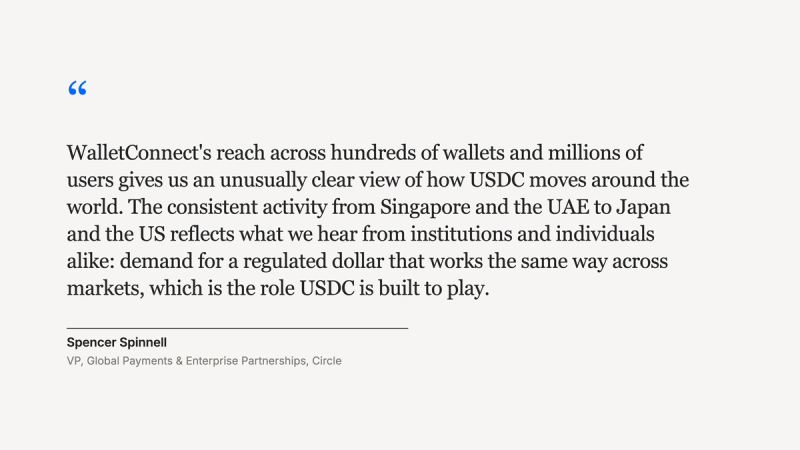
USDC activity on the network spans major regions worldwide. The US leads by volume with $143 billion, followed by Singapore ($4.61B), Japan ($539M), the UAE ($468M), and Hong Kong ($441M) — a top five that correlates with a map of the world's most active digital-asset hubs.
Volume and transaction counts tell different stories here too. The United States also leads in transaction count (129,729), but Japan is close behind (114,854) despite representing a tiny fraction of total volume (0.35%). This is evidence of a large, active retail base transacting in smaller amounts. France (52,246) and Germany (48,413) round out the transaction-count leaders, reinforcing that these are geographies with deep retail USDC adoption even where average ticket sizes are modest. Singapore, the UAE, and Hong Kong, by contrast, show far fewer transactions relative to their volume, implying institutional activity rather than everyday retail use.
Where USDC lives: the multichain picture
Ethereum Mainnet remains USDC's center of gravity by value, carrying $149.51 billion in volume.
Arbitrum One is a strong second at $3.29 billion, confirming its role as the network's DeFi stronghold - Arbitrum has spent the cycle appealing to native DeFi users, and that liquidity and trading activity is what's fueling its USDC volume.
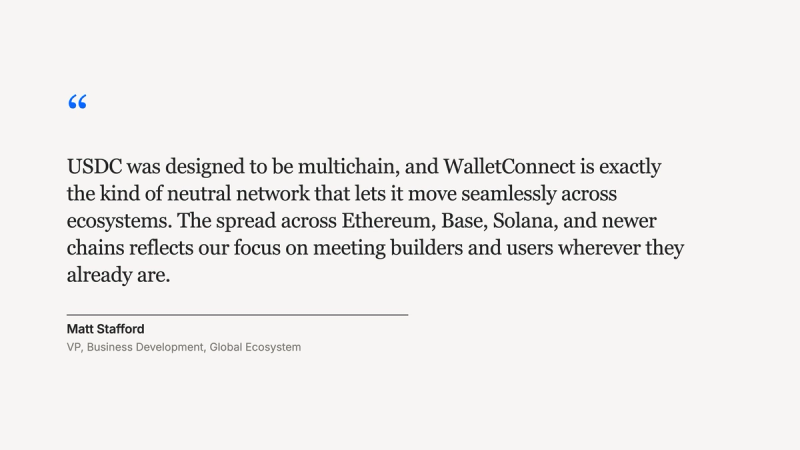
Solana's $1.32 billion across nearly 80,000 transactions shows USDC's multichain reach extends well beyond the EVM, and newer chains like Monad are already registering meaningful flow.
Base boasts 366,864 transactions, leading every chain in USDC transaction count. This high transaction count reflects smaller average transfer sizes on Base than on other chains.
Polygon’s story is shaped by payments infrastructure, with $108M in TNV. Polygon has been evolving from a scaling solution into a global payments infrastructure company focused on moving money entirely on-chain, built around its "Open Money Stack" connecting wallets, compliance, and payment rails. Visa, Meta, Mastercard, and Franklin Templeton have all tapped into that infrastructure, and that institutional payment-rail activity is what's driving Polygon's USDC volume.
The majority stablecoin
Finally, how does USDC stack up against the broader stablecoin volume on the network? It's the majority asset on both counts: 56.1% of all headline stablecoin volume ($155.9B of $277.9B) and 51.4% of non-institutional, or organic, stablecoin volume ($6.94B of $13.51B).
In organic flow, USDC sits at nearly the same amount as all other stablecoins combined - including sUSDS and USDT - meaning one in every two organic stablecoin dollars moving across the WalletConnect Network is a USDC dollar!
WalletConnect powering USDC’s movement
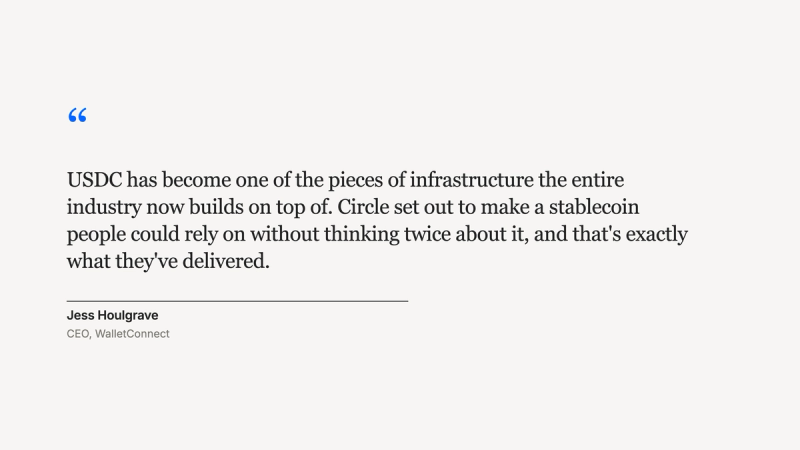
WalletConnect is a neutral, open network connecting millions of users, thousands of institutions, hundreds of wallets, and hundreds of chains. It is exactly the infrastructure a multi-chain asset like USDC needs to move seamlessly across Ethereum, Base, Polygon, and beyond.
In 2025 alone, the network processed over $400 billion in volume with 119% year-over-year growth, and is already embedded in fintech stacks like Stripe, Coinbase Commerce, and MoonPay, giving USDC reach well beyond crypto-native apps.
WalletConnect Pay and stablecoin payments
72% of payment volume across the WalletConnect Network is now in stablecoins, with USDC at the center. On Base, WalletConnect Pay processed over $2.5 billion in Q1 2026 alone, on a chain where USDC makes up over $4.2 billion of its $4.725 billion stablecoin supply. WalletConnect Pay's first live deployment, with Moneda, launched on Base.
The bottom line
The H1 2026 data paints a consistent picture. USDC on the WalletConnect Network is trusted by custody platforms moving nine-figure sums as well individual users with millions of transactions spanning MetaMask users in Japan, Ledger users in Singapore, and Base users across the world.
It is overwhelmingly used in DeFi today, with stablecoin payments still early days, and that gap is precisely where the next wave of growth lies. As onchain payments infrastructure matures, the rails, the wallets, and the users are already in place.
Methodology for volume figures and transaction data: Figures cover H1 2026 (data from Jan 1 2026 onward).
Stablecoin classification per DefiLlama-derived flag (>$25M market cap, snapshot 2026-02-15).
Circle Ventures, an affiliate of Circle Internet Financial, LLC, has invested in WalletConnect.
USDC is issued by regulated affiliates of Circle. See Circle’s list of regulatory authorizations at circle.com/legal/licenses.
Reference to any specific company, product, service, or website of any third party does not constitute an implied or express endorsement, recommendation, favoring or validation by Circle. The content presented is intended for informational purposes only. Reliance upon any content or information presented is at the sole discretion of the audience; Circle shall not be liable for any damage or loss relating to use of, or reliance upon, any such content or information presented. The views and opinions expressed herein do not necessarily state or reflect those of Circle.