
A customer wants to move stablecoins or crypto from their own wallet into their account on your platform. Before you can credit it, you ask them to send a tiny, oddly specific amount first to prove the wallet is theirs. Then they wait. Then they send the real deposit.
That is a Satoshi Test. Exchanges, brokers, and other stablecoin and crypto providers use it every day to verify self-hosted wallets, and it sits right at the moment a customer is trying to give you money.
This guide covers what a Satoshi Test is, why stablecoin and crypto providers use it for deposits, what it costs you at the funding step, and how one-click message signing verifies the same wallet in seconds, inside the deposit itself.
What is a Satoshi Test?
A Satoshi Test is a way to prove a customer controls a self-hosted wallet by asking them to send a small, predefined amount of stablecoins or crypto from that wallet to the provider. It is sometimes called a microtransaction test.
The name comes from the satoshi, the smallest unit of bitcoin, but the method is used across many assets and networks. Only someone holding the wallet's private keys can send funds from it, so a transfer of the exact amount requested shows the customer controls that address.
How a Satoshi Test works for stablecoin and crypto deposits
- The customer tells the provider which self-hosted wallet they want to deposit from.
- The provider asks them to send a specific small amount, often within a time window.
- The customer opens their wallet, enters the amount and the deposit address, and sends it, paying the network fee.
- The provider waits for the test transfer to confirm onchain and checks that the amount and source match.
- The wallet is marked as verified. Only now can the customer make, or be credited for, the real deposit.
Why stablecoin and crypto providers use Satoshi Tests on deposits
The driver is regulation. In the EU, the Transfer of Funds Regulation requires crypto-asset service providers to assess whether a self-hosted address is owned or controlled by their customer for transfers above EUR 1,000, and that includes deposits coming in from those addresses. The European Banking Authority's Travel Rule guidelines list sending a predefined amount from the wallet as one accepted way to do it. Comparable requirements exist in other jurisdictions, though thresholds and accepted methods vary.
Self-declaration alone is generally not considered sufficient, so providers need technical proof. Satoshi Tests became a common answer because they need no special technology: any wallet can send a transfer.
The problems with Satoshi Tests at deposit
A Satoshi Test proves control. At the deposit step, it does that at a real cost to your customer, your funding volume, and your operations.
Customers pay and wait twice.
Every verified deposit becomes two transfers: the test, then the real thing. That means two network fees, two confirmations, and two chances for something to go wrong before a single unit of value lands in the account.
It stalls your highest-intent moment.
A customer who is depositing has already decided to fund their account. Making them stop, send a test amount, and wait for confirmations turns a decision into a chore. Every minute between intent and a credited balance is a chance for them to leave or fund somewhere else.
Deposits get stuck in limbo.
If funds arrive before the wallet is verified, they often cannot be credited until the check is done. The customer sees money leave their wallet but not arrive in their account. That is when "where is my deposit?" tickets start.
It is easy to get wrong.
The customer has to send an exact amount, to the right address, on the right network. One mistake and the test fails, and they start again with another fee.
It creates operational overhead.
Someone has to match incoming test transfers to customers, chase failed tests, release held deposits, and decide what to do with the small amounts received. At volume, that becomes a queue your support and compliance teams carry every day. We look at what that manual work really costs in Wallet Verification: Replacing the Manual Check.
The alternative: one-click message signing
The EBA guidelines also list a second method: having the customer sign a specific message with their wallet. It proves the same thing as a Satoshi Test: that the customer holds the wallet's private keys, without moving any funds first.
Here is how it works at deposit:
- The customer connects the wallet they want to deposit from.
- The wallet asks them to sign a message. It is a signature only: no funds move, and there is no gas to pay.
- The signature is checked against the wallet's address, and a timestamped record of the verification is returned to your systems.
- The customer goes straight into the deposit, from the same verified wallet.
Because the address comes from the connected wallet rather than being copied and pasted, message signing also removes the copy-paste error and the subtler failure of a correct address on the wrong chain.
Satoshi Test vs. message signing for deposits
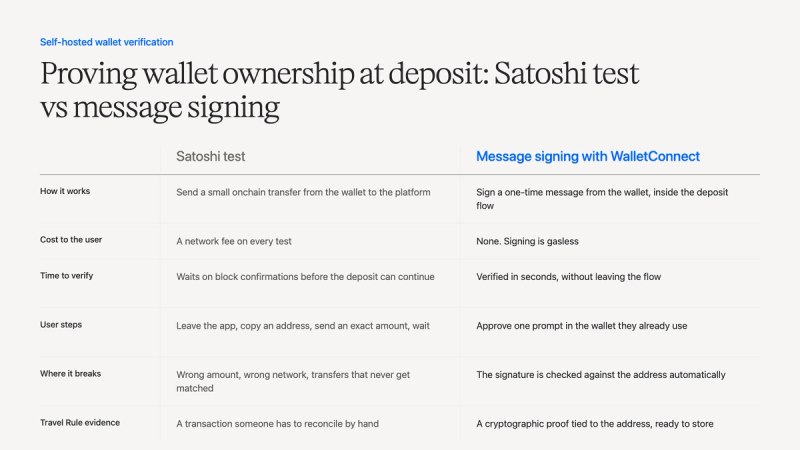
Speed to a credited balance. A Satoshi Test waits for a test transfer to confirm before the real deposit can be credited. Message signing verifies in seconds, so the deposit can follow straight away.
Cost to the customer. A Satoshi Test adds an extra network fee to every verified deposit. Message signing costs nothing.
Customer effort. A Satoshi Test asks for two transfers and an exact amount. Message signing asks the customer to tap approve.
Evidence. Both prove control. Message signing produces a cryptographic signature that can be stored and checked later, with the address, chain, and timestamp attached.
Operations. A Satoshi Test means matching test transfers, chasing failures, and releasing held deposits. Message signing is checked automatically.
For most stablecoin and crypto providers, message signing should be the default way to verify wallets at deposit, with other methods held in reserve for edge cases your compliance team defines.
How WalletConnect replaces the Satoshi Test at deposit
WalletConnect brings wallet verification and the deposit into one flow. Wallet Verification proves control with one-click message signing, and Account Top-ups & Deposits lets customers fund their account with stablecoins or crypto from the wallet they just verified, through the same integration.
- No test transfer, no extra fee, no address to paste. The customer opens a verification page, connects the wallet they already use, and signs once.
- Proof of control in seconds. The signature is verified against the address, so customers move straight from verification to funding.
- No ambiguity about the deposit. Chain, token, and amount are fixed before anyone signs, so funds arrive where and how you expect.
- Any asset in, the token you want out. Gas is sponsored by default and deposits are smart-routed, so customers fund with what they hold and you receive what you choose.
- Sanctions and IP screening run inside the funding flow before money moves, against OFAC, EU, UK, and UN lists, with the outcome enforced automatically
- Travel Rule capture in the same flow as an optional add-on, collected once and reused so returning customers go straight to confirmation.
- An audit-ready record returned to your systems in real time: proof of control, timestamp, chain, domain, URI, nonce, session ID, and connected-wallet metadata, with an export-ready copy in the WalletConnect dashboard. The record can be reused for later deposits from the same address, in line with your own risk policy.
Wallet Verification works across 700+ wallets compatible with the WalletConnect protocol, starting with EVM and Solana wallets. It runs on the WalletConnect Network, which has connected wallets, apps, and institutions since 2018, reaches 900M+ users, and is SOC 2 Type II certified. The same verified wallet carries through to withdrawals with Payouts.
See WalletConnect Wallet Verification in Action
Frequently asked questions
What does Satoshi Test mean?
A Satoshi Test is a method of proving control of a wallet by sending a small, predefined amount of stablecoins or crypto from that wallet to a provider. It is named after the satoshi, the smallest unit of bitcoin.
Why do exchanges ask for a Satoshi Test before a deposit?
In the EU, crypto-asset service providers must assess whether a self-hosted wallet belongs to their customer for transfers above EUR 1,000, including deposits. A Satoshi Test is one accepted way to do that. Message signing is another.
Is a Satoshi Test required by law?
No specific method is required in the EU. The TFR sets the obligation, and the EBA guidelines list several accepted methods, including both test transfers and message signing.
Is message signing as secure as a Satoshi Test?
Both prove the customer holds the wallet's private keys. A message signature is cryptographic proof that only the keyholder could produce, and it can be stored and verified later.
Can signing a message move my funds?
No. A message signature is not a transaction. No funds move, and no gas is paid.
Is wallet verification the same as KYC?
No. It proves control of a wallet. It is not KYC or customer due diligence, and it does not replace either.
Retire the Satoshi Test from your deposit flow.
Satoshi Tests solved a compliance problem by adding friction at the exact moment customers try to fund their accounts. One-click message signing solves the same problem in seconds, with stronger evidence and nothing extra to send, so the deposit is the only transfer your customer makes.
Talk to our team to see how WalletConnect can replace test transfers in your stablecoin and crypto deposit flow.
WalletConnect is a technical service provider, not a regulated financial services firm and not a law firm. Nothing here is a warranty that use of these features achieves compliance. You remain solely responsible for your own regulatory obligations and for determining what applies to you, including your licence scope and jurisdiction. These features do not replace your AML or CFT programme. Not legal advice.