
Institutional capital doesn't sit in browser wallets. It sits in custody and MPC platforms, behind policy engines, approval quorums, and address whitelists. Those controls are the point: no single person can move funds alone. They also make a copy-and-paste deposit flow a poor fit.
For institutions, WalletConnect is how custodied funds reach an external platform without breaking those controls. It's built into the custody and MPC platforms institutions already use. Exchanges without a clean WalletConnect flow make that capital work harder to arrive, and it tends to go where arriving is easy.
Institutional wallets already rely on WalletConnect to move money to the providers and platforms they work with. It's the connection their signers trust, because every request lands in their own console and runs through their own policies. In H1 2026 alone, the WalletConnect Network powered $155.9B in USDC volume, through institutional platforms and retail wallets alike. Your exchange just needs to be on the other end of that connection.
This guide covers where institutional capital sits, why it stalls at exchanges, which institutional wallets already connect through WalletConnect, and how to open your exchange to them.
It's the same problem retail-first platforms face from the other side: one way in for every kind of capital. See Stablecoin Deposits for CFD and Perpetuals Platforms: One Integration for Every Type of Capital.
Where does institutional crypto capital sit?
Funds, treasuries, market makers, brokers and corporates hold digital assets in a few places:
- Qualified custodians, which hold assets on a client's behalf under regulatory oversight
- MPC wallet platforms, which split signing keys across parties so no single person holds them
- Multi-signature setups, which need several approvers to sign every transaction
- Institutional self-custody, where the firm runs its own policy-governed wallets
What they share is control. Every outgoing transaction passes a policy engine: who can approve, how much, to where, and how many signers it takes. Thousands of institutions already connect through the WalletConnect Network to reach apps and platforms with those controls intact. The question for an exchange is whether its deposit flow meets them there.
Why do institutional deposits stall at exchanges?
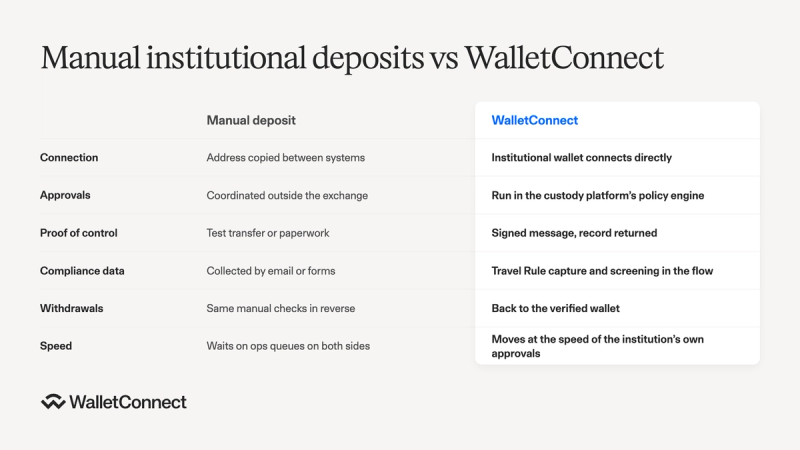
- Manual whitelisting. Ops teams on both sides exchange and approve addresses by email or ticket before the first transfer.
- Copy-and-paste on large tickets. Treasury teams move addresses between systems by hand, which is exactly the risk their controls exist to remove.
- No proof of control. Under MiCA's Transfer of Funds rules, transfers above EUR 1,000 from a self-hosted wallet need an ownership or control assessment, and institutional MPC self-custody can fall into that category.
- Compliance data by email. Travel Rule details get gathered after the fact, so transfers wait in review.
- No clean way back out. Withdrawals to institutional wallets face the same manual checks in reverse, which makes treasury teams wary of parking capital at all.
Each one adds days and doubt. Institutions notice, and they route capital to venues where funding is simpler.
More pain points treasury and ops teams raise
Talk to an institutional treasury team about funding a new venue and the same issues come up:
- Signers across time zones. Approval quorums span regions. Every manual back-and-forth with an exchange's ops team adds another round of waiting for signers to come online.
- Whitelist changes. Adding a new exchange address to a custody whitelist often needs its own approval cycle. With WalletConnect, the request comes from the exchange inside the connected session, and the institution's policy engine decides.
- Capital sitting idle. When funding takes days, desks pre-fund venues so they're ready to trade, tying up capital that could be working elsewhere.
- Proving where funds came from. The exchange's compliance team wants evidence of control and origin. Without it, large deposits sit in review.
- A different process at every venue. Each exchange has its own portal, paperwork and checks. Treasury teams favour venues that work the way their custody platform already does.
Why MiCA raises the stakes for institutional flows
Since the MiCA transitional period ended on 1 July 2026, every exchange serving EU clients operates as an authorised CASP. Institutional clients expect the same standard from their venues that their own compliance teams apply: documented checks, auditable records, and no shortcuts on large transfers.
That cuts both ways. An exchange that can prove control and capture Travel Rule data inside the deposit gives institutions one less reason to hesitate. An exchange that can't becomes an operational risk on their side.
WalletConnect's Compliance products are built for exactly that, and MiCA, the GENIUS Act, and the Travel Rule cover the wider regulatory picture.
Which institutional wallets support WalletConnect?
WalletConnect is built into the custody and wallet platforms institutions already use. If your institutional clients hold funds on any of these, they can already connect to your exchange through WalletConnect, with every transaction approved under their platform's own policies.
- Fireblocks: WalletConnect is built into the Fireblocks console, so vault holders connect without plugins or browser extensions.
- BitGo: WalletConnect is built into BitGo self-custody hot wallets across EVM networks and Solana, with every transaction governed by BitGo's policy engine.
- Hex Trust: Hex Safe custody wallets connect through WalletConnect, with whitelisting and permission controls applied to every interaction.
- Utila: institutions connect MPC wallets through WalletConnect from the Utila console or mobile app, under policy-governed controls.
- Dfns: enterprise wallet infrastructure connecting through WalletConnect, with its policy engine checking each request before a signature is authorised.
- Ledger Enterprise: Ledger's platform for institutions connects accounts through WalletConnect, with transactions approved inside the Ledger Enterprise interface.
- Zodia Custody: an institutional custodian whose clients connect through WalletConnect.
- GK8 by Galaxy: institutions transact through WalletConnect from GK8-managed MPC wallets, under their own governance policies and multi-step approvals.
- Fordefi: Fordefi's institutional MPC wallet lets customers connect to apps and platforms through WalletConnect.
- August: an institutional infrastructure provider whose clients connect through WalletConnect.
WalletConnect supports MPC wallets, multi-signature setups, and qualified custodians. The full set of institutional wallets grows as more platforms join the network.
Read how these platforms built WalletConnect: WalletConnect & Hex Trust, GK8 by Galaxy with WalletConnect, WalletConnect & Utila, and how WalletConnect enables institutional access to DeFi, staking and governance.
How WalletConnect brings institutional capital onto your exchange
- Your exchange adds WalletConnect's deposit flow, and institutional users see their custody platform among 700+ retail, hardware, and institutional wallets.
- The treasury user connects their institutional wallet. The request arrives inside their custody platform.
- It runs through the institution's policy engine and approval workflow as normal. Keys never leave custody.
- Wallet Verification proves control with a signed message, and Travel Rule Capture and sanctions and IP screening run in the same flow.
- Chain, token, and amount are fixed before signing; the deposit settles instantly and your exchange credits the account automatically, so the desk can start trading straight away.
The same verified connection carries withdrawals back to the institution's wallet. Deposits run on Account Top-ups & Deposits.
What compliance teams on both sides get
The exchange gets a MiCA-ready record for every institutional deposit: proof of control, timestamp, chain, session detail, and Travel Rule data, returned in formats its controls already read.
The institution keeps its custody, its policy engine and its approval quorum exactly as they are. Its signers see a request from your exchange inside the console they already use, and approve it the way they approve everything else.
Neither side builds anything new.
What institutions look for in an exchange's deposit flow
Treasury and operations teams tend to ask the same questions before they move capital:
- Can we fund from our existing custody platform? With WalletConnect, yes, for the institutional wallets listed above and more.
- Do our approval policies still apply? Yes. Every request runs through the institution's own policy engine.
- Is there any address to copy? No. The destination comes from the exchange inside the connected session.
- Can we get funds back the same way? Yes. Withdrawals return to the verified wallet.
- Is the infrastructure audited? WalletConnect is SOC 2 Type II, independently audited on a recurring basis.
Infrastructure institutions already trust
WalletConnect has connected wallets, apps, and institutions since 2018. The network powered $400B+ in transaction volume in 2025, connects 700+ wallets across all major blockchains, and is SOC 2 Type II, independently audited on a recurring basis. More on why in WalletConnect for secure, institutional-grade onchain access.
FAQ
Do institutions need to change their custody setup? No. They connect the institutional wallet they already use, and every request runs through their existing policy engine.
Can retail and institutional users use the same flow? Yes. One integration covers 700+ retail, hardware, and institutional wallets.
Does WalletConnect take custody of funds? No. Funds move directly between the institution's wallet and your exchange.
What if a client's custody platform isn't listed? Many more institutional wallets connect through WalletConnect. Talk to our team to check a specific platform.
Does this work for withdrawals too? Yes. The verified connection carries funds back to the institution's wallet.
Make your exchange easy for institutional capital to reach
Institutional capital moves through controls, not clipboards. WalletConnect lets it reach your exchange through the institution's own wallet and approvals, with proof of control and Travel Rule data captured on the way in.
The custody platforms are already connected. The only question is whether your exchange is too.
See how WalletConnect works for institutional wallets and financial institutions, or start with Account Top-ups & Deposits.
WalletConnect is a technical service provider, not a law firm. This article is not legal advice, and you remain responsible for your own regulatory obligations.