

Identity and fraud platforms have become very good at one question: is this person who they say they are? Document checks, liveness, device signals, and behaviour data all point at the person. Reusable identity takes it further, so a user verifies once and carries that result to the next platform.
Then the user asks to withdraw stablecoins to a wallet. The most important fact in that transaction- who controls the destination address- sits outside everything the identity stack has checked.
Wallet ownership verification closes that gap. With WalletConnect Wallet Verification, the verified person signs one message from their wallet, and the identity record gains a verified wallet with a proof your clients can keep. It's the approach Socure is taking: this week it announced it is bringing WalletConnect Wallet Verification into Socure Pass, its reusable verified identity.
What is wallet ownership verification?
Wallet ownership verification is a check that proves a person controls a specific stablecoin or crypto wallet address. The user connects the wallet and signs a message with it. Because only the wallet's controller can produce that signature, the platform gets cryptographic proof of control, without moving any funds.
It answers a different question from the checks most identity stacks already run:
- KYC and identity verification answer "who is this person?"
- Wallet screening answers "is this address risky?"
- Wallet ownership verification answers "does this address belong to this person?"
You need all three before an irreversible transfer. Most stacks only have the first two.
Why identity checks stop short of the wallet
A typed or pasted address could belong to the customer, to a money mule, or to an attacker who swapped it on the way. Teams that try to close this by hand use screenshots, test deposits or signed messages pasted into support tickets. Those workarounds are slow, inconsistent from one analyst to the next, and hard to put in front of an auditor. We covered what that costs a team in Wallet Verification: replacing the manual check.
The stakes keep rising. Stablecoins, tokenized funds, and other regulated assets now move between banks, brokers, exchanges, and wallets. Each of those transfers is final, and each one depends on the receiving address belonging to the right person. Identity providers are the natural place to answer that, because they already hold the verified person.
What proof of wallet control looks like
Proof of control is a cryptographic signature. The user connects the wallet they're claiming and signs a plain-text message that names the business and the purpose. Only someone who controls the wallet can produce that signature.
Nothing else happens on the wallet. No funds move, no transaction is sent, and the user pays no gas. What the platform gets is a record captured at signing: the signature, timestamp, chain, domain, URI, nonce, session ID, connection status, session reuse, and connected-wallet metadata. The Wallet Verification docs show the full record and how to re-check a signature yourself.
How WalletConnect Wallet Verification links a wallet to a verified identity
- The platform creates a verification for a user who has already passed identity checks, with its own reference and purpose.
- The user opens a branded verification page and connects their wallet from 700+ wallets on the WalletConnect Network.
- The user signs a message naming the business and the purpose. No funds move, and no gas is paid.
- WalletConnect checks the signature, runs sanctions and IP screening in the same step, and returns the record to the platform's systems.
- The platform attaches the verified wallet to the identity record. Next time, the user brings both: a verified identity and a verified wallet.
The sending or receiving address comes from the connected wallet itself, so the user never copies or pastes it. That's also what shuts out lookalike addresses: see how address poisoning slips past wallet screening.
Before and after: identity with and without a verified wallet
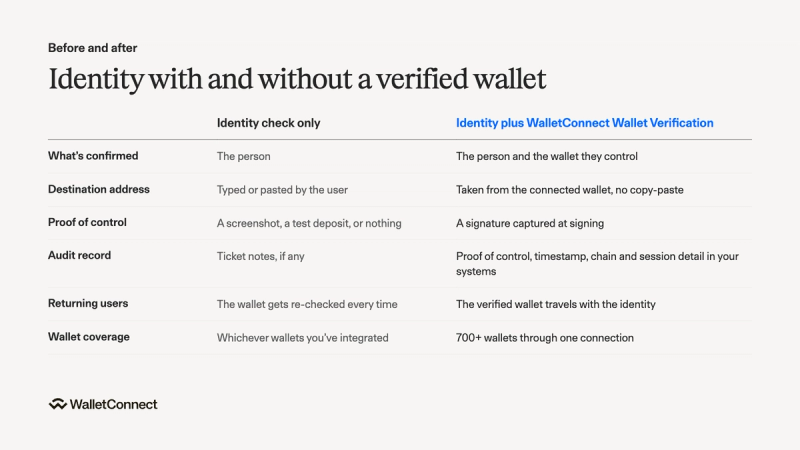
Build a verified wallet whitelist on top of identity
Most platforms that move stablecoin and crypto already keep a wallet whitelist, sometimes called an allowlist: the addresses a customer is astablecoinswithdraw to or deposit from. The idea is sound. The way addresses get onto the list usually isn't.
Where typical whitelists break:
- Addresses are added by copy-paste, so a poisoned or swapped address can be whitelisted as easily as a real one.
- An account takeover can add an attacker's address, and the list then protects the attacker.
- Cooling-off periods slow every genuine customer to guard against the few bad entries.
- Nothing proves who controls each entry, so the list is only as reliable as the person who typed it.
A verified whitelist fixes the entry point. With WalletConnect Wallet Verification, a wallet only joins the whitelist after the verified person signs from it. Every entry then carries its own proof of control, timestamp and chain. For an identity provider, that whitelist can sit on the reusable identity itself, so each verified wallet travels with the person to every platform they share their identity with.
What your clients can do with a verified whitelist:
- Allow withdrawals only to verified wallets, and send anything else to step-up or review
- Skip repeat checks for returning users withdrawing to a wallet already on the list
- Flag new wallets on risky sessions using the device and behaviour signals they already run
- Show auditors the list and the proof behind every entry, instead of a column of pasted addresses
Your clients own the whitelist and the policy that enforces it. WalletConnect supplies the verification and the record behind each entry.
Where wallet ownership verification fits in a reusable identity flow
- Device and behaviour check at sign-up
- Identity verification: verify once, or reuse an existing identity
- Prove wallet control with WalletConnect: the user links a wallet to their verified identity, and it joins the verified whitelist
- Destination wallet screening: allow, review, block or offboard
- Risk decision and case review for analysts
WalletConnect provides wallet ownership verification at signing, address verification before transfer, the record returned to your systems and connectivity to 700+ wallets. You and your clients keep identity verification, KYC, KYB and customer due diligence, the policy that sets the outcome, risk scoring, case management and record retention. WalletConnect is never in the custody or transaction flow, and never holds, routes or touches customer funds.
How Socure is adding verified wallets to reusable identity
Socure's announcement shows the model in practice. According to The Paypers' coverage, Socure verifies the person through identity verification, fraud prevention, and AML screening on its RiskOS platform. WalletConnect Wallet Verification asks the user to sign in to their own wallet, proving control without moving funds, and returns the record to the institution's systems. Socure then adds the verified wallet to the customer's identity record.
Socure's clients can let customers connect any of 700+ wallets through WalletConnect, without building separate wallet integrations. Socure summed it up in its own post: tokenized markets need more than a verified identity.
For other identity, fraud, and compliance providers, the takeaway is simple. A verified wallet is becoming part of what a verified identity means.
Use cases your clients will ask about
- Stablecoin transfers: confirm the receiving wallet belongs to the verified customer before an irreversible transfer. Relevant to FinTechs & Neobanks adding stablecoin flows.
- Deposits and top-ups: confirm the funding wallet belongs to the customer before crediting, with Account Top-ups & Deposits.
- Self-hosted wallets and the Travel Rule: give exchanges and brokers proof of control over self-hosted wallets, with the record on file, alongside Travel Rule capture. See Trading.
- Multi-accounting: tie each wallet to one verified identity on prediction markets and gaming platforms.
- Tokenized assets: let issuers' eligibility rules decide which verified wallets can buy, hold, and redeem, with RWA & Token Issuers.
Why identity providers build on WalletConnect
Wallet Verification runs on the WalletConnect Network, which has connected wallets and apps since 2018. It reaches 900M+ users across 700+ wallets and all major blockchains, and carried $400B+ in transaction volume in 2025. WalletConnect is SOC 2 Type II, independently audited regularly.
For an identity provider, that means one integration covers the wallets your clients' users already hold, rather than a build per wallet. And because WalletConnect is neutral, the same network works for every identity provider, institution, and client on it.
Wallet ownership verification FAQs
Does wallet ownership verification move funds?
No. The user signs a plain-text message. No transaction is sent, no funds move, and no gas is paid.
Is wallet ownership verification the same as wallet screening?
No. Screening scores an address for risk and sanctions exposure. Ownership verification proves the customer controls the address. They work best together.
Which wallets does WalletConnect Wallet Verification support?
700+ wallets on the WalletConnect Network, across all major blockchains.
Can the verification run on our own branded page?
Yes. The verification flow runs on your own branded page.
Can a verified wallet be reused?
Yes. Once verified, the wallet can sit on the user's identity record or verified whitelist, so returning users don't repeat the step for the same wallet.
Does WalletConnect hold or route customer funds?
No. WalletConnect is never in the custody or transaction flow.
Add a verified wallet to every verified identity.
Identity confirms the person. A signature confirms the wallet is theirs. With WalletConnect Wallet Verification, both sit in one record, and every wallet on your clients' whitelists comes with proof, captured before money moves.
Map your stack with our team in a 30-minute session. Walk us through how your verification flow works today, and we'll show you where Wallet Verification fits.
Talk to our team
Related reading
- Address poisoning: how platforms stop it at withdrawal
- Wallet Verification: replacing the manual check
- WalletConnect Compliance
WalletConnect is a technical service provider, not a regulated financial services firm and not a law firm. Nothing here is legal advice. You and your clients remain responsible for your own regulatory obligations.