
Address poisoning doesn't break anything. No keys are stolen, no malware has to touch a server, and no one hacks the platform. The attacker plants a lookalike address in a user's transaction history and waits for the user to copy it.
For a platform, the result looks like a normal withdrawal to a clean address. Screening passes. The transfer settles and can't be reversed. The support ticket arrives a day later.
The fix is to take the copy-paste out of the withdrawal. WalletConnect Wallet Verification confirms the destination address from the user's own connected wallet, with a signature that proves they control it, before the transfer goes out.
What is address poisoning?
Address poisoning is a scam where an attacker creates a wallet address that looks almost identical to one the victim uses, then plants it in the victim's transaction history. When the victim copies an address from that history, they send funds to the attacker instead. It's also called address spoofing or address substitution.
It works on people, not systems. That's why it gets past controls built to find risky addresses.
How address poisoning works
The attack relies on one habit: checking only the first and last few characters of a long address.
- The attacker watches the chain for a wallet that sends regularly to the same address.
- They generate a lookalike address that shares the same opening and closing characters.
- They send a tiny or zero-value transfer from the lookalike, so it appears in the user's recent history.
- The user copies the wrong address from history on their next withdrawal, and the funds go to the attacker.
The same gap shows up in other address substitution attacks: clipboard malware that swaps an address as it's pasted, and impersonators who send a "new deposit address" over chat or email.
Why wallet screening doesn't catch address poisoning
Wallet screening is built to judge an address's exposure: links to sanctioned addresses, illicit activity and known risky patterns. A freshly generated lookalike has no history at all, so it scores clean.
Screening answers "is this address risky?" Address poisoning exploits a different question: "does this address belong to my customer?" That's an ownership question, and no risk score can answer it. Identity and fraud platforms face the same gap: see wallet ownership verification for identity providers.
Withdrawal address verification: the control that answers the ownership question
Withdrawal address verification adds proof of control before an irreversible transfer. The customer shows they control the destination wallet, and the address used for the withdrawal comes from that proof instead of from a clipboard.
It sits alongside screening rather than replacing it. Screening scores the address. Verification proves it's the customer's. Sanctions and IP screening come built into the same step, as part of WalletConnect Compliance.
How WalletConnect stops address poisoning at withdrawal
- The user requests a withdrawal on the platform.
- The user connects the wallet they want to receive into, from 700+ wallets on the WalletConnect Network, on a branded verification page.
- The address is read from the connected wallet. Nothing is copied or pasted, so a lookalike from transaction history never enters the flow.
- The user signs one message proving control. No funds move and no gas is paid.
- Sanctions and IP screening run in the same step, and the platform's own screening and policy make the call.
- The record goes back to the platform: proof of control, timestamp, chain and session detail, ready for analysts.
- The verified wallet joins the customer's withdrawal whitelist, so later withdrawals to it skip the step.
One caveat matters for fraud teams. A signature proves who controls the wallet, not who controls the account. If an attacker takes over an account, they could try to verify their own wallet. Pair Wallet Verification with the device, behaviour and identity signals you already run, so a new wallet on a risky session gets stepped up or blocked. The Wallet Verification docs cover verification states and how to re-check a signature.
WalletConnect Wallet Verification In Action
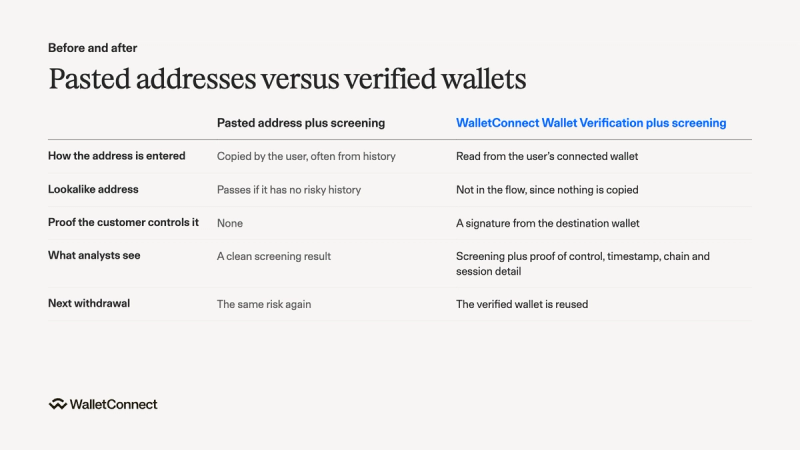
Before and after: pasted addresses versus verified wallets
Withdrawal address whitelists: make them poisoning-proof
A withdrawal address whitelist, or allowlist, is one of the most common defences platforms use. Customers can only withdraw to addresses already on their list, and new addresses usually face a cooling-off period. It's a good control with one weak spot: how addresses get onto the list.
How address poisoning beats a standard whitelist:
- The poisoned address gets whitelisted. If the customer pastes a lookalike when adding a new address, the whitelist now protects the attacker's wallet.
- Cooling-off periods only delay the loss. A poisoned address that waits 24 or 48 hours is still the wrong address.
- Account takeovers add their own entries. An attacker with account access can add their address and wait out the timer.
- There's no proof behind any entry, so analysts can't tell a real wallet from a planted one when something goes wrong.
A verified whitelist closes each of those gaps. With WalletConnect Wallet Verification, an address only joins the whitelist after the customer connects that wallet and signs from it:
- No copy-paste, so a lookalike from transaction history can't be added
- Proof of control on every entry, with timestamp, chain, and session details
- Shorter waits for genuine customers, because a signed entry carries more evidence than a pasted one. Your policy decides how much shorter
- Step-up on risky sessions, when a new wallet appears alongside unusual device or behaviour signals
- An auditable list, where every allowed address has a record behind it
The platform owns the whitelist and the rules that enforce it. WalletConnect supplies the verification and the record for each entry.
Identity providers are adding verified wallets too
Wallet ownership is moving into the identity layer. This week Socure announced it is bringing WalletConnect Wallet Verification into Socure Pass, so the verified person and the wallet they control sit in one record. Use cases named in the announcement include confirming that a receiving wallet belongs to a verified customer for stablecoin transfers, and Travel Rule obligations for self-hosted wallets. Socure's own summary: tokenized markets need more than a verified identity.
For fraud and risk teams, that means the wallet a customer withdraws to can carry the same level of proof as the customer.
Where withdrawal address verification matters most
- Exchanges and brokers: withdrawals to self-hosted wallets, with proof of control for Travel Rule checks. See Trading.
- Banks and institutions: stablecoin payouts where every transfer is final. See Financial Institutions.
- Marketplaces: seller and creator payouts to wallets they've proved they control. See Marketplaces.
- Deposits: confirming the funding wallet belongs to the customer, with Account Top-ups & Deposits.
Adding withdrawal address verification for your clients
For fraud, risk and identity platforms, Wallet Verification is a wallet check you can offer clients without building wallet integrations yourself. It also retires the screenshots and test transfers covered in Wallet Verification: replacing the manual check.
- It fits your flow. One step between identity and screening, on a hosted branded page.
- You keep the decision. Your risk scoring, policy, case management and record retention stay with you and your clients.
- It stays out of the money. WalletConnect is never in the custody or transaction flow, and never holds, routes or touches customer funds.
- It covers the wallets users hold. 700+ wallets and all major blockchains through one connection, on a network reaching 900M+ users.
- It's audited. WalletConnect is SOC 2 Type II, independently audited on a recurring basis.
Address poisoning FAQs
Can wallet screening detect address poisoning?
Not reliably. A freshly generated lookalike address has no risky history, so it usually scores clean. Screening judges risk, not ownership.
Does a withdrawal whitelist stop address poisoning?
Only if the address was right when it was added. If a customer pastes a poisoned address into the whitelist, the whitelist protects the attacker. A verified whitelist only accepts addresses the customer has signed from.
Does withdrawal address verification move funds?
No. The customer signs a plain-text message. No transaction is sent, no funds move and no gas is paid.
Does it stop account takeover?
Not on its own. A signature proves who controls the wallet, not the account. Pair it with device, behaviour and identity signals.
Which wallets are supported?
700+ wallets on the WalletConnect Network, across all major blockchains.
Stop address poisoning before funds move
Address poisoning works because the address is copied, and screening can't tell a clean lookalike from the real thing. WalletConnect Wallet Verification takes the address from the customer's own wallet, proves they control it, and gives every whitelist entry a record, before an irreversible transfer.
See where it fits in your stack. Book a 30-minute session and walk us through your withdrawal flow.
Talk to our team
Related reading
- Wallet ownership verification for identity providers
- Wallet Verification: replacing the manual check
- WalletConnect Compliance
WalletConnect is a technical service provider, not a regulated financial services firm and not a law firm. Nothing here is legal advice. You and your clients remain responsible for your own regulatory obligations.