

Most PSPs don't want to become crypto companies. They want to give merchants one more payment method that customers are asking for, without disrupting everything else.
The good news is that stablecoin acceptance can work exactly like that: as an alternative payment method (APM) that sits alongside cards, bank transfers and local wallets in your checkout. This guide walks through what that looks like in practice, what to evaluate, and how to roll it out.
When PSPs add a new APM, the pattern is familiar. The method appears at checkout, the customer completes payment in a flow they recognize, the PSP receives a confirmation, and the merchant is settled. Reporting, refunds and reconciliation follow the processes the PSP already runs.
An APM-style stablecoin integration follows the same pattern. The stablecoin complexity (wallets, chains, tokens, network fees, compliance data) is handled by the provider. The PSP sees a payment method with a clear status, clean payment data and predictable settlement.
1. Coverage
Customers hold stablecoins across hundreds of wallets, exchange accounts and chains. Ask how many wallets a provider supports, whether customers can pay directly from exchange accounts, and whether coverage spans all major blockchains. Limited coverage means failed or abandoned payments.
2. Routing and network fees
A customer might hold one stablecoin on one chain while the merchant wants a different token on another. The provider should route the payment so the merchant receives the token they chose, and sponsor network fees so the customer doesn't need a separate token just to pay.
3. Settlement
Confirm whether merchants can settle in stablecoin to a wallet, in fiat to a bank account, or both. For fiat, check that settlement runs through a regulated partner. Also check settlement timing: stablecoin settlement should be near-instant and available around the clock.
4. Reconciliation and reporting
Every payment should return structured data your systems can use: amount, token, chain, status and an order reference. Without it, your finance and support teams inherit manual work.
5. Compliance
Sanctions screening, geolocation and IP checks, and Travel Rule data capture where required should run inside the payment flow, not as a separate system. Results should come back to your systems so you can apply your own risk policy. Our Stablecoin Compliance for PSPs in APAC guide covers this in detail.
Step 1: Define the merchant segments
Start with the merchants most likely to see demand: cross-border ecommerce, travel, gaming, digital goods and merchants whose customers are already active in stablecoin and crypto. A focused first cohort makes the pilot easier to measure.
Step 2: Set your acceptance and settlement policy
Decide which stablecoins you'll accept, which you'll settle in, and whether merchants can choose fiat settlement. In APAC this may differ by market, so align it with your licensing in each jurisdiction.
Step 3: Configure compliance
Map your obligations by market: sanctions lists, restricted regions, Travel Rule thresholds and data fields. Configure the provider's screening and capture to match, and confirm results flow into your existing case management.
Step 4: Integrate into checkout and onboarding
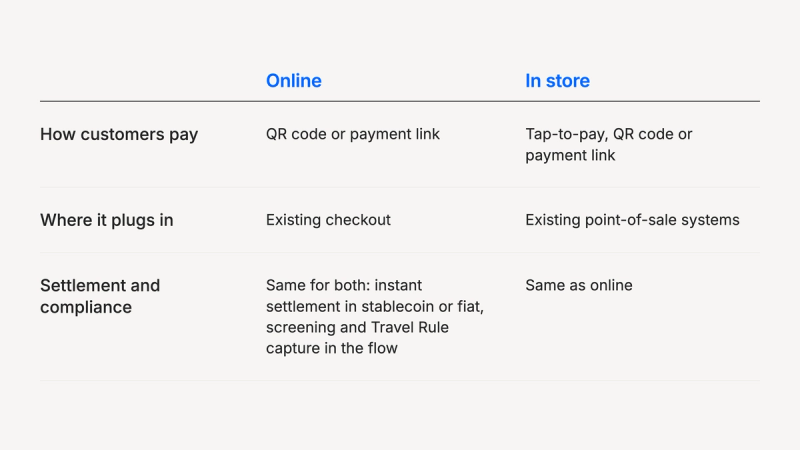
Add the payment method to your hosted checkout, API and plugins. Update merchant onboarding so merchants can switch it on and choose settlement preferences. For in-store merchants, confirm the payment options available at the terminal, such as tap-to-pay, QR code or payment link.
Step 5: Connect reporting and reconciliation
Map stablecoin transactions into your merchant dashboard, settlement reports and ledger. Test edge cases: underpayments, expired payment requests and status updates.
Step 6: Pilot, measure, expand
Launch with the first merchant cohort. Track conversion, payment success rate, settlement times and support tickets. Expand to more merchants and markets once the numbers hold.
In-store vs online
Questions to ask any stablecoin payments provider
- How many wallets and exchange accounts can customers pay from?
- Which chains and tokens are supported, and how are new ones added?
- Are network fees sponsored for the customer?
- Can merchants settle in fiat, and through whom?
- What payment data comes back with each transaction?
- How are sanctions screening, IP checks, and Travel Rule capture handled, and in what formats?
- What security certifications and audits does the provider hold?
- How long has the underlying network been in production, and at what scale?
How WalletConnect Pay approaches it
WalletConnect Pay was built for exactly this pattern. It lets PSPs offer stablecoin payments to merchants through a single APM-style integration that fits the existing stack.
- Accept from 700+ wallets and major exchange accounts across all major blockchains, reaching 900M+ users.
- Customers pay with any asset. Gas is sponsored and payments are smart-routed, so the merchant receives the token they choose.
- Settle in stablecoin in seconds, or in fiat via a regulated partner, at lower acceptance cost than card networks.
- Every transaction comes with clear payment data, so you reconcile automatically.
- Sanctions and IP screening and Travel Rule capture run on every payment, in formats your existing controls already read.
- WalletConnect is SOC 2 Type II, independently audited on a recurring basis, and has been building its network since 2018.
What is an APM?
An alternative payment method: any way to pay other than cards, such as bank transfers, local wallets or, increasingly, stablecoins.
Do PSPs need to hold or custody stablecoins?
Not with an APM-style integration. Settlement can go directly to the merchant, in stablecoin or fiat.
Can customers pay from an exchange account?
Yes, with providers that support exchange account payments alongside self-custody and other wallets.
Does stablecoin acceptance change refunds and disputes?
Stablecoin payments are final once settled, so there are no chargebacks. Refunds are handled as a separate transaction, following the merchant's refund policy.