

Ask a PSP why it hasn't launched stablecoin payments yet, and the answer is rarely technology. It's compliance. Stablecoins move across open networks, between wallets the PSP doesn't operate, often across borders. Compliance teams rightly want to know how sanctions exposure, restricted regions, and Travel Rule obligations will be handled before anything goes live.
This guide breaks down the core compliance components for stablecoin acceptance and payouts in APAC, how expectations differ across the region, and why building compliance into the payment flow beats bolting it on.
1. Sanctions screening
Every wallet address involved in a payment or payout should be screened against sanctions lists before funds move. Stablecoin payments are final, so screening has to happen before the transaction clears, not after. At a minimum, this means screening against OFAC lists. Many PSPs also apply local or regional lists through their own controls, so screening results need to come back to the PSP's systems.
2. Geolocation and IP screening
Regulators and sanctions regimes restrict activity from certain regions. IP and geolocation checks at the point of payment help PSPs block restricted-region activity and apply different policies by market.
3. Travel Rule data capture
The FATF Travel Rule requires originator and beneficiary information to accompany qualifying virtual asset transfers. Most major APAC financial centers apply it to digital asset service providers, but thresholds, data fields, and formats differ by jurisdiction. For payments, the challenge is capturing the right data without ruining the checkout experience. For PSPs serving several markets, capture also needs to be configurable by region, so each jurisdiction gets the fields it requires without a separate flow per market.
4. Wallet verification
Before an irreversible transfer, especially a payout, PSPs need confidence that the destination address is correct and controlled by the intended recipient. Wallet verification uses a cryptographic signature to prove control, replacing manual address checks and screenshots.
5. Audit-ready records
Every check needs a record: what was screened, what data was captured, when, and the outcome. Records need to be in formats compliance and audit teams can use without reformatting.
How expectations differ across APAC
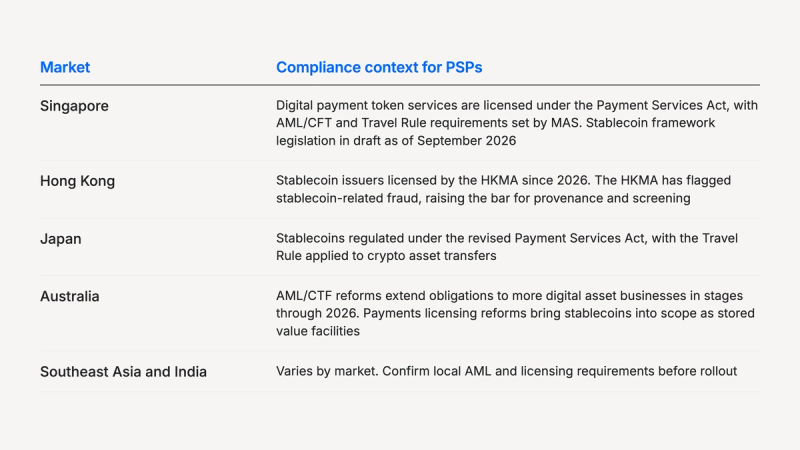
This is a summary, not legal advice. For the full regulatory picture, see Stablecoin Regulation in APAC 2026.
Bolt-on vs built-in compliance
There are two ways to handle all of this.
Bolt-on: the PSP accepts stablecoin through one provider, then runs screening, Travel Rule capture, and record-keeping through separate tools. This means more integrations, more vendors, data passing between systems, and gaps where a payment can clear before a check completes.
Built-in: screening, IP checks, and Travel Rule capture run inside the payment flow itself. The payment doesn't proceed until the checks are done, results come back to the PSP's systems, and the PSP's own policy decides the outcome. For PSPs serving a global audience, Travel Rule capture can be configured by region as you expand, without a rebuild.
For most PSPs, built-in is simpler to operate, easier to audit and safer, because there's no window where a payment moves ahead of a compliance check.
Keeping the checkout experience intact
Compliance that wrecks conversion won't survive long. A few principles help:
- Capture once, reuse. Returning customers shouldn't re-enter Travel Rule data on every payment.
- Configurable fields. Only ask for what's required in the customer's jurisdiction.
- Automatic address handling. Verifying addresses automatically removes copy-paste errors and wrong-address losses.
- Clear outcomes. Customers should know quickly whether a payment went through.
A compliance checklist for stablecoin acceptance
- Sanctions screening runs on every wallet before funds move
- Screening results return to your systems for your own risk checks
- IP and geolocation checks enforce restricted regions by policy
- Travel Rule data is captured where required, with fields configurable per market
- Customer data is captured once and reused
- Payout destinations can be verified before transfer
- Every check produces an audit-ready record in formats your controls read
- Policies can be set per market without a new build
How WalletConnect Pay handles compliance
WalletConnect Pay builds compliance into every payment and payout, so PSPs don't need new compliance tooling to offer stablecoin.
- Sanctions and IP screening checks wallets and users against OFAC sanctions lists and restricted-region IPs before a payment clears, with results returned to your systems and outcomes set by the policy you configure.
- Travel Rule Compliance captures full legal name, date of birth, and country or place of birth, with fields configurable to your requirements. Data is entered once and reused, so returning users go straight to confirmation, and it adapts to each region's Travel Rule requirements.
- Wallet Verification confirms in one click that a user controls the wallet, verifies the address automatically before an irreversible transfer, and captures an audit-ready record at signing: proof of control, timestamp, chain, and session details.
- Payout screening checks destination addresses against sanctions lists before a payout executes.
- Everything is delivered in the formats your existing controls already read. WalletConnect is SOC 2 Type II, independently audited on a recurring basis.
Does the Travel Rule apply to stablecoin payments?
It can, depending on the jurisdiction, the parties involved and the transaction value. Many APAC jurisdictions apply the FATF Travel Rule to virtual asset transfers, so PSPs should capture the required data where it applies.
What does wallet verification prove?
That the person signing controls the wallet, confirmed by a cryptographic signature, along with the verified address and a timestamped record.
Can we use our own sanctions lists?
Screening results are returned to your systems, so you can layer your own lists and risk checks on top before a payment or payout proceeds.
Do we need separate compliance tools to accept stablecoin?
Not when screening and Travel Rule capture run inside the payment flow and return data in the formats your controls already read.