
When a customer withdraws to another exchange, the Travel Rule has a playbook: two regulated providers swap originator and beneficiary data. When the other side is a self-hosted wallet, there's no provider to swap with. The exchange has a string of characters and an obligation to know more about it.
WalletConnect can help regulated providers close that gap. It captures Travel Rule data and proof of wallet control inside the transfer itself, then hands that info to the compliance stack the exchange already runs. And it does it under the exchange's own brand. Coinbase runs its Travel Rule flows on WalletConnect, and its customers never see our name.
What does the Travel Rule require for self-hosted wallets under MiCA?
The EU's Transfer of Funds Regulation has applied the Travel Rule to crypto transfers since 30 December 2024. Every MiCA-authorised CASP needs to fulfill these obligations.
For transfers to or from a self-hosted wallet, the exchange has to:
- Collect originator and beneficiary information from its own customer
- For transfers above EUR 1,000, verify that customer owns or controls the wallet
- Keep a record it can show a regulator
Comparable rules based on FATF Recommendation 16 apply in markets including the UK, Switzerland, Singapore and the UAE, with different thresholds and accepted methods. For the wider picture, see MiCA, the GENIUS Act, and the Travel Rule.
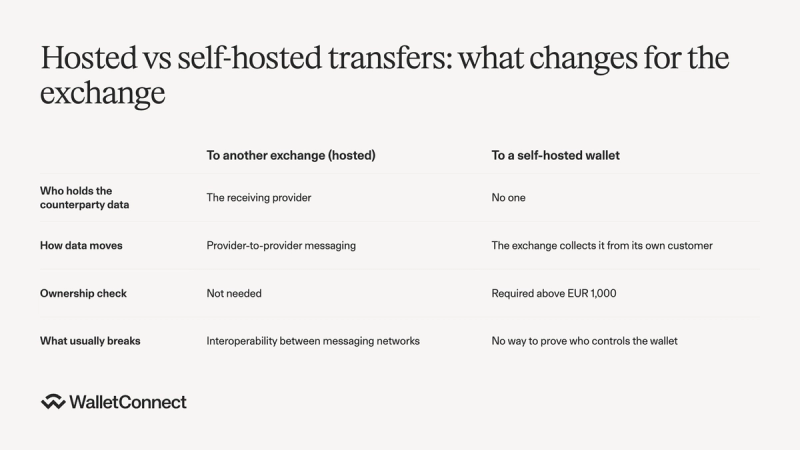
Most Travel Rule tooling was built for the left-hand column. The right-hand column is where exchanges are left building their own forms, checks, and workarounds.
For the deposit side of the same rules, see Self-Hosted Wallet Verification Requirements: What Stablecoin and Crypto Providers Need to Know About Deposits.
Why a wallet address isn't enough for Travel Rule checks
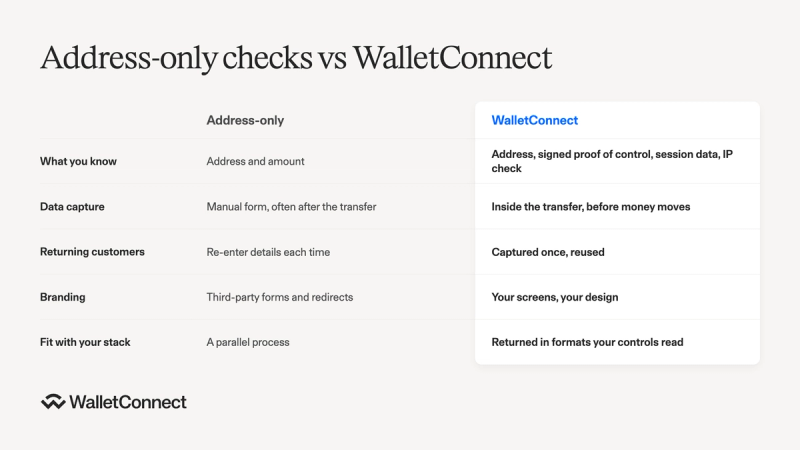
Today the exchange sees an address and an amount. It doesn't see who's in control of the wallet. The address was never designed to carry compliance data. But the connection to the wallet can.
Where Travel Rule compliance hurts exchanges today
Most exchanges already know the rule. The pain is in running it, transfer after transfer:
- Bad data in, bad data out. Customers type names and dates of birth into free-text forms. Typos and mismatches trigger reviews and slow transfers down.
- Asking returning customers again. Collecting the same details on every transfer frustrates frequent traders. WalletConnect collects once and reuses, so returning customers go straight to confirmation.
- Manual review queues. Transfers wait while ops teams chase missing fields or weigh up a self-declaration that regulators won't accept on its own.
- Different rules in every market. Thresholds, required fields and accepted verification methods change by jurisdiction. WalletConnect's capture fields are configurable to each region where the rules apply to you.
- Personal data handling. Collecting identity data adds data protection obligations. Data collected through WalletConnect with security and data protection protocols.
- Building it yourself. A self-hosted wallet flow means connections across hundreds of wallets, signature checks, screening, and record-keeping. That's a product to build and maintain, not a form.
- Drop-off at withdrawal. Clunky third-party compliance screens make customers abandon transfers or move to a venue that asks less of them.
For how Travel Rule capture scales to each wallet without changing the customer's flow, see Scan, confirm, done. For why a manual check doesn't hold up, see Wallet Verification: Replacing the Manual Check.
How WalletConnect captures Travel Rule data inside the transfer
- The customer starts a transfer to or from a self-hosted wallet and connects that wallet through WalletConnect.
- They sign one message to prove they're in control of it, with Wallet Verification.
- Travel Rule Capture collects what your jurisdiction requires: full legal name, date of birth, and country or place of birth, with fields configurable to your requirements. It's collected once and reused, so returning customers go straight to confirmation.
- The data and the verification record come back to your systems in the formats your controls already read.
The connection adds context an address can't: a signed proof of control, session data and an IP check, all captured before the transfer goes onchain.
How Coinbase runs Travel Rule flows on WalletConnect, under its own brand
Coinbase uses WalletConnect for its Travel Rule compliance flows. When a customer sends assets from Coinbase to an external wallet, WalletConnect powers the wallet interaction layer underneath: connecting the customer's wallet and handling the signature that proves they're in control of it.
Coinbase manages everything the customer sees. The confirmations and compliance prompts are Coinbase's own, built to Coinbase's design guidelines, in Coinbase's words. There's no WalletConnect screen, no redirect, and no logo. The customer experiences one consistent Coinbase flow from start to finish.
You'll never see WalletConnect in that flow. That's the point. It works at exchange scale, and stays out of the way.
What this shows for any exchange:
- Your brand stays front and centre. Customers trust the exchange they signed up to. Compliance steps that look like a third party break that trust and raise drop-off.
- You keep control of the compliance logic. Coinbase decides what it asks, when, and what happens next. WalletConnect supplies the wallet interaction and the proof.
- It holds up at scale. The same infrastructure that carries Coinbase's flows is available to every exchange, across 700+ wallets.
- It isn't a one-off build. Compliance providers also white-label WalletConnect inside their own Travel Rule products, so the same model works whether you build in-house or buy.
Read more about how Coinbase and other payment platforms build on WalletConnect.
White-label options for your exchange
You choose how visible WalletConnect is in your flow:
- Fully embedded: WalletConnect runs underneath your own screens and prompts, as it does for Coinbase. You design the experience; we power the wallet connection and the proof.
- Branded hosted page: the verification page carries your business name and logo, so customers see who's asking when they sign. It can open as a link, a redirect, or embedded in your app.
Either way, the message the customer signs names your business and the purpose, so they know exactly who they're approving.
How it fits alongside your existing compliance stack
WalletConnect doesn't replace your KYC, your transaction monitoring, or your Travel Rule messaging provider. It helps fill the self-hosted gap they can't reach. Data flows into the systems you already run, with no separate tooling, and it's stored with industry-standard security and data protection protocols. Your KYC, policy decisions, and record-keeping stay with you.
The same verified connection can carry deposits through Account Top-ups & Deposits, so compliance and funding happen in one step. See all Compliance products.
What your compliance team gets back
For every self-hosted transfer, your systems receive:
- The originator or beneficiary data your jurisdiction requires
- A signed proof that your customer controls the wallet, with timestamp, chain, and session details
That's the evidence a supervisor will ask for, captured before the transfer, not reconstructed after it.
Proof of control is the foundation of that evidence. Our CEO explains why in Verify the Wallet: Trust Both Ways in Stablecoin Money Movement.
FAQ
Does the Travel Rule apply to transfers between two self-hosted wallets? No. It applies when a regulated provider like an exchange is on one side of the transfer.
Is the EUR 1,000 threshold the only trigger? No. Information is collected on self-hosted transfers generally. Above EUR 1,000, the exchange must also verify ownership or control of the wallet.
Do we need to change our compliance provider? No. WalletConnect captures the data in the flow and passes it to the systems you already use.
Will customers see WalletConnect branding? Only if you want them to. Coinbase runs WalletConnect entirely under its own brand.
Does it work outside the EU? Yes. Required fields adapt to the Travel Rule requirements of each region where they apply to you.
The Travel Rule is handled where the transfer happens
Self-hosted wallets are where Travel Rule compliance breaks for exchanges, because there's no one on the other side to ask. WalletConnect gets the answer from the wallet itself: proof of control, the data your jurisdiction requires, and screening, captured before money moves, returned to your stack and delivered under your brand.
Coinbase already runs it that way. Your exchange can too.
See how Travel Rule Capture works for your exchange, or explore the Trading solution.
WalletConnect is a technical service provider, not a law firm. This article is not legal advice, and you remain responsible for your own regulatory obligations.