
Deposits bring money onto your platform. Withdrawals decide whether users comes back. A customer who waits hours for a withdrawal, or watches it land in the wrong wallet, remembers. The next ticket isn't "Where is my crypto?" It's "Where is my withdrawal?", and the one after that is a closed account.
Withdrawals are where an exchange proves it can be trusted with money. WalletConnect makes them fast, verified, and evidenced: the customer connects the wallet they want to be paid to, proves they're in control of it with one click, and the payout settles in seconds, with screening and a compliance record in the same flow.
Why withdrawals are where exchanges win or lose trust
A deposit is a customer trusting you. A withdrawal is you proving that trust was deserved. Traders compare venues on how quickly and reliably they can get money out, and they talk about it publicly when it goes wrong.
That makes withdrawals a growth lever, not just an ops cost. Fast, reliable payouts bring customers back to deposit again. Slow or failed ones push them to the venue next door.
What slows crypto withdrawals down?
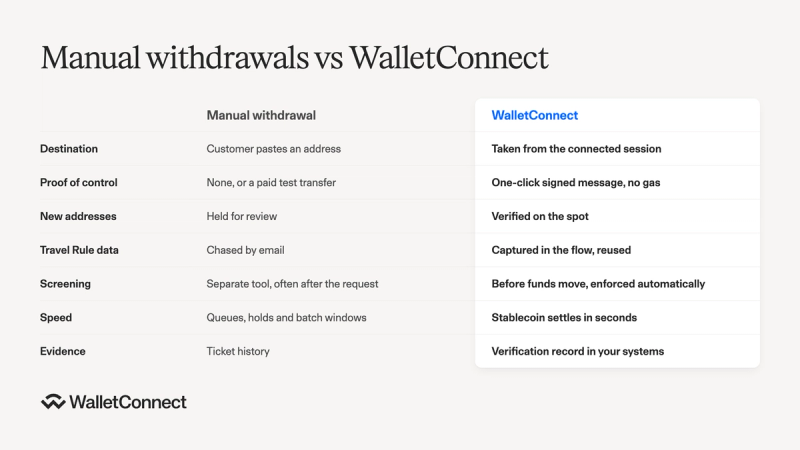
Most delays have nothing to do with the blockchain. They come from the checks an exchange runs because it can't trust the destination:
- Manual review queues. Withdrawals above a threshold, or to a new address, wait for an analyst to clear them. Queues grow at exactly the moments customers most want their money: volatile markets, weekends, launches.
- New-address holds. Many exchanges lock withdrawals to a newly added address for a period, because they can't tell whether the customer controls it. It protects the exchange and frustrates the customer.
- Whitelisting by hand. Customers add addresses to a whitelist, confirm by email, then wait again. Every step is another chance to drop off.
- Chasing Travel Rule data. For transfers to self-hosted wallets, ops teams email customers for missing details after the withdrawal request is already in.
- Batch windows. Withdrawals queue for the next processing batch rather than going out when requested.
- Wrong asset, wrong chain. The customer wants a token or network the exchange's hot wallet isn't set up to pay on, so the request stalls or fails.
Each of these exists because the exchange has no proof of who controls the destination wallet. Remove that doubt, and most of the waiting goes with it.
Why do withdrawals go to the wrong wallet?
The customer pastes an address into a form and confirms it by eye. One missed character, a clipboard-swapping attack, or a lookalike address copied from their history, and the funds go somewhere they'll never be recovered. Picking the wrong network has the same effect.
Once a withdrawal is broadcast, it's final. The exchange did nothing wrong, but it's the exchange that gets the ticket, the complaint and the review. We cover the deposit side of the same problem in Failed crypto deposits leave no record.
What does MiCA expect before funds leave?
Since the MiCA transitional period ended on 1 July 2026, every exchange serving EU customers is an authorised CASP. Under the Transfer of Funds Regulation, withdrawals to a self-hosted wallet need originator and beneficiary information, and for transfers above EUR 1,000, an assessment of whether the customer owns or controls the destination wallet.
A pasted address and a ticked checkbox won't provide evidence that. A signed message from the wallet will. For the full picture, see Self-Hosted Wallet Verification Requirements and MiCA, the GENIUS Act, and the Travel Rule.
How WalletConnect fixes crypto withdrawals for exchanges
- The customer chooses to withdraw and connects the wallet they want to be paid to from inside your exchange.
- They sign one message to prove they're in control of it, with Wallet Verification. No funds move and no gas is needed to sign.
- The destination address comes from the connected session. There's nothing to paste and no network to guess.
- For self-hosted transfers, Travel Rule Capture collects the required details in the same flow, once, and reuses them next time.
- Sanctions and IP screening run on the destination before funds move, and the outcome is enforced automatically.
- Payouts send the funds in the stablecoin or crypto you choose, smart-routed across chains, and stablecoin settles in seconds.
- Your systems get a verification record: signature, timestamp, chain and session detail, ready for audit.
Once a wallet is verified, the proof can be reused for later withdrawals to the same address, in line with your risk policy. Repeat withdrawals skip the hold and go straight out.
When should an exchange re-verify a withdrawal wallet?
You set the policy. Common triggers include:
- The first withdrawal to a new address
- Withdrawals above your MiCA threshold or internal risk limit
- A long gap since the wallet was last verified
- A change in the customer's risk profile or account details
Verification takes one signature, so tightening the policy doesn't slow good customers down. For why manual checks don't scale, see Wallet Verification: Replacing the Manual Check, and why a test transfer is the slower route in What Is a Satoshi Test?
What your customers will notice
- Speed. Money out in seconds, not a wait for the next batch or a review queue.
- Confidence. They pick their wallet from a list instead of pasting a string of characters.
- No repeat forms. Travel Rule details are asked once, not on every withdrawal.
- Your brand throughout. The flow runs inside your exchange, in your design.
And your support team will notice fewer "Where is my withdrawal?" tickets.
FAQ
Does verification add a step for customers? One signature, and only when your policy calls for it. Verified wallets can be reused.
Which wallets can customers withdraw to? Any of 700+ wallets on the WalletConnect Network, across every major chain.
Can we pay out in a different asset from the one we hold? You choose your payout currency, and payouts are smart-routed across chains.
Do we have to use WalletConnect for deposits too? No. Payouts and Wallet Verification work on their own, though running deposits and withdrawals on one integration keeps the flow consistent.
Does WalletConnect take custody of funds? No. Funds move from your wallet to the customer's wallet.
Faster withdrawals, fewer tickets, proof on file
Withdrawals are slow and risky for one reason: the exchange can't prove who controls the destination. WalletConnect fixes that at the source, so payouts go out in seconds, to a wallet the customer has proved they control, with the evidence MiCA expects already in your systems.
See how Payouts and Wallet Verification work together, or explore the Trading solution.
WalletConnect is a technical service provider, not a law firm. This article is not legal advice, and you remain responsible for your own regulatory obligations.