
Southeast Asia is one of the most dynamic payments regions in the world, and one of the most fragmented. Each market has its own currency, its own dominant local payment methods and its own regulator. Domestic payments have been transformed by real-time systems and QR codes. Cross-border payments, for many merchants, still feel like they did a decade ago.
For PSPs, that gap is an opportunity. This piece looks at where cross-border merchant payments still break down, what's already improving, and where stablecoins fit alongside the systems PSPs already run.
Why cross-border is still hard
Many currencies, many hops
A merchant in Jakarta selling to customers in Manila, Bangkok and Singapore deals with several currencies. Cross-border settlement often routes through correspondent banks and FX conversions, each adding time, cost and room for error.
Settlement windows
Bank-based settlement generally follows banking hours. Weekends and public holidays, which differ from market to market across the region, pause settlement. For merchants with thin margins or fast inventory turns, waiting days for funds is a real cash-flow cost.
Local methods don't always travel
Domestic QR schemes and e-wallets are hugely popular within their home markets, but a customer's local wallet may not work for a merchant in another country. Cards fill the gap, with the associated fees, declines and chargebacks.
Reconciliation across systems
PSPs serving merchants across several markets reconcile across multiple banking partners, currencies and settlement cycles. Every extra system adds operational load.
What's already improving
The region isn't standing still. Central banks and payment operators have been linking domestic fast payment systems and QR schemes across borders, including through initiatives like the BIS-originated Project Nexus and bilateral QR payment linkages between ASEAN markets. These make it easier for consumers to pay across borders using the apps they already have.
These initiatives are important, and they'll keep expanding. But they cover the markets and participants that have joined them, they typically settle in local currencies through the linked systems, and they don't reach customers outside the region who already hold stablecoin and crypto.
Where stablecoins fit
Stablecoins aren't a replacement for local payment methods or regional linkages. They're a complementary payment method that solves a specific set of problems well.
1. Reaching global stablecoin and crypto holders
Customers anywhere in the world who hold stablecoins can pay a Southeast Asian merchant directly, without a card, a local wallet or an FX step on their side. For merchants in cross-border ecommerce, travel, gaming and digital goods, that's new reach.
2. Settlement that doesn't stop
Stablecoin payments settle onchain in seconds, around the clock, including weekends and public holidays. Merchants who want to hold stablecoin can do so. Merchants who want local currency can be settled in fiat through a regulated partner.
3. Finality with no chargebacks
Once a stablecoin payment is settled, it's final. For merchants hit hard by card chargebacks and friendly fraud, that changes the risk profile of cross-border sales.
4. Lower acceptance cost
Stablecoin acceptance typically costs less than card networks, which matters most in cross-border ecommerce where card fees and FX markups stack up.
5. One integration across markets
For PSPs, a single stablecoin integration can serve merchants in every market they operate in, rather than adding one local method at a time.
What PSPs need to get right
Stablecoin acceptance only works cross-border if a few things are in place:
- Coverage. Customers must be able to pay from the wallet or exchange account they already use.
- Merchant choice on settlement. Some merchants want stablecoin, most want local currency. Offer both.
- Compliance per market. Sanctions screening, IP and geolocation checks, and Travel Rule capture where it applies, configured for each jurisdiction. See Stablecoin Compliance for PSPs in APAC.
- Local regulatory fit. Treatment of digital payment tokens varies across Southeast Asia. Confirm your licensing position in each market before rollout. Stablecoin Regulation in APAC 2026 covers the main frameworks.
- Clean data. Reconciliation must slot into your existing reporting, not create a parallel process.
A practical model for PSPs
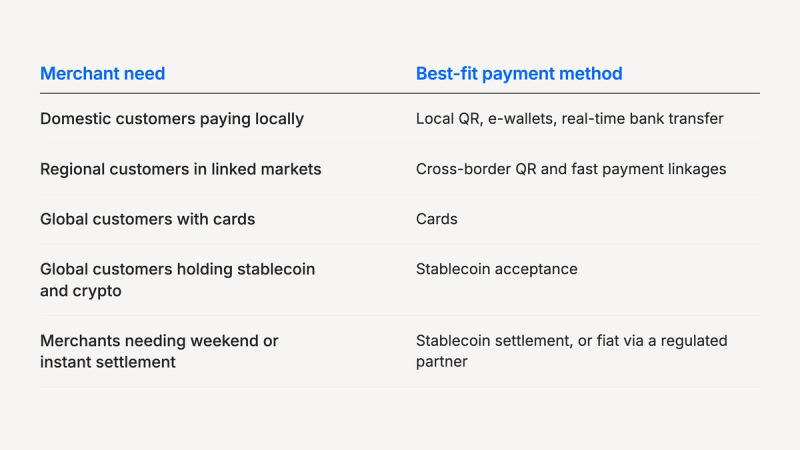
The goal isn't to push every payment onto stablecoin. It's to give merchants the right option for each customer, and stablecoin fills gaps the others leave.
How WalletConnect Pay supports cross-border merchants
WalletConnect Pay gives PSPs one APM-style integration to offer stablecoin payments to merchants in every market they serve.
- Customers pay from 700+ wallets and major exchange accounts, reaching 900M+ users worldwide.
- Customers pay with any asset. Gas is sponsored and payments are smart-routed so merchants receive the token they choose.
- Merchants settle in stablecoin in seconds or in fiat via a regulated partner.
- Sanctions and IP screening and Travel Rule capture run on every payment, adapted to each region's requirements.
- The WalletConnect network supports all major blockchains and powered $400B+ in transaction volume in 2025.
Are stablecoins replacing local payment methods in Southeast Asia?
No. Local QR schemes and e-wallets remain the default for domestic payments. Stablecoins complement them for cross-border customers and faster settlement.
Can merchants receive local currency?
Yes. Merchants can choose fiat settlement to their bank account through a regulated partner.
Do stablecoin payments settle on weekends?
Yes. Stablecoin payments settle onchain around the clock, independent of banking hours.
Are there chargebacks with stablecoin payments?
No. Settled stablecoin payments are final.