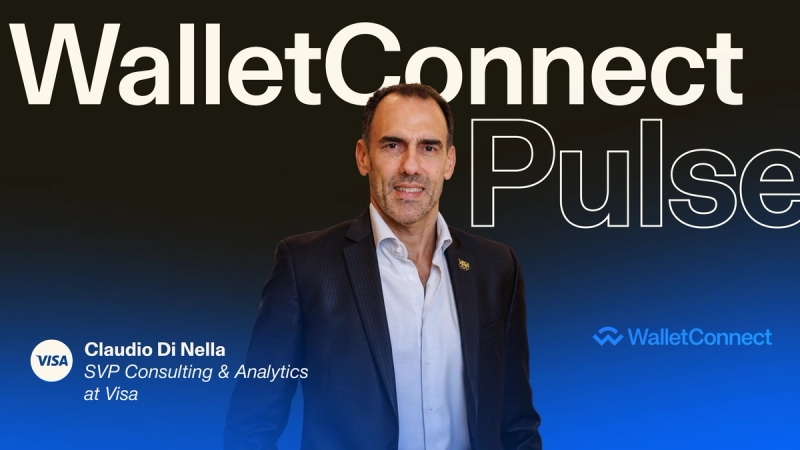

Claudio Di Nella describes himself as a software engineer by trade who spent a big chunk of his career on the technology consulting side of the fence, "digital before it was called digital." Today he's on the other side of that fence as Head of Visa Consulting & Analytics, working directly with the banks, fintechs, and merchants that are figuring out where stablecoins fit into the future of money.
Dayana Aleksandrova sat down with Claudio for an episode of the WalletConnect Pulse, WalletConnect's talk show on the digital asset ecosystem, modern money movements, and the future of finance. His view from inside one of the world's largest payments networks is refreshingly pragmatic: stablecoins aren't here to rip and replace what already works, they're here to plug the gaps it can't fill.
In this episode, Claudio explains why the best stablecoin use cases are commercial rather than consumer, why blockchain as we know it still isn't built for high-throughput, confidential payments, which agentic payments will scale first, and how OpenUSD aims to turn a vertical stablecoin ecosystem into a horizontal one.
Full Transcript
Dayana: Welcome to the WalletConnect Pulse, our talk show where we discuss the digital asset ecosystem, modern money movements, and the future of finance with global leaders from the space. Today with us we have a very special guest. He is the Head of Visa Consulting and Analytics for Europe, Claudio Di Nella. Claudio, welcome to the show.
Claudio: Thank you, Dayana. Pleasure to be here. Thank you for having me.
Dayana: It's great to have you. We kick off with the same question for all of our guests: how did you get to where you are today, and what were you doing before your role at Visa?
Claudio: I'll confess I'm a software engineer originally, by trade, and I spent quite a chunk of my career in the technology consulting space. So I would say digital before it was called digital. I spent quite a bit of my time on the other side of the consulting fence. I'm still doing a consulting role, but let's say full-fat consulting, so to speak.
Dayana: Wow, that's such a cool story, and the truth is you never know where you're going to end up. So here you are today in crypto. Let's dive into the harder questions. From your role working with fintechs, banks, and merchants, what do you think is the single biggest barrier when it comes to stablecoin adoption?
Claudio: Firstly, of course, there's been the regulatory uncertainty, or lack of clarity, that has been dogging the space for the last few years. But I think we've made great progress, with the GENIUS Act in the US and MiCA in Europe, and that will only accelerate in the years to come. The trajectory is clear, and the more those regulations get localized and cater to specific use cases, the more confidence there will be in the overall ecosystem.
Separately from that, there was the view of crypto in general, let's broaden the question a little, as mostly a speculative asset rather than an actual functional means of payment. That view is rapidly changing. Stablecoins, ultimately, were invented to address precisely that, to go beyond currency or digital asset speculation. That's shifting the mindset and the perception, and perception can be reality. And on the regulated side of things, banks by definition have to tread very carefully because of the potential entanglement with AML, KYC, and so on. All of that has been part of the reason it's been relatively slow going, but as I said, I expect it to accelerate as these things become clearer.
The second element, when we think about use cases, is that for consumers, certainly on the retail side, money is already digital today. In the vast majority of economies around the world, we don't walk around with notes and coins. Yes, of course I work for Visa, but just generally, when you think about the level of digitization across most major economies, any mainstream consumer already takes part in digital money flows in one way or another. So the end-user case for consumers is less clear. It's like, what would this give me that I don't have today?
Because mainstream crypto, if there is such a thing, Bitcoin and so on, came mostly from the retail consumer world, when we shifted the paradigm to stablecoins, we continued to look at it through that lens. But in reality, the best use cases for stablecoins are much closer to B2B payments, cross-border, commercial flows, and the whole advent and power of programmable, configurable finance. That's not a retail consumer play, it's a commercial play. Once those use cases find their natural home in the value chain, I think we're going to see the next big wave of adoption. So it's shifting, and it's shifting as a result of much better understanding and much better regulatory clarity.
Dayana: That's a good point, and it segues really well into our next one. From an infrastructure perspective, what do you think is the biggest gap we still face, and how can we make stablecoin payments more seamless and easier?
Claudio: We have to address, at some point, the fact that blockchain as we know it today, distributed ledger technology as we know it today, was never really designed for high-throughput, highly confidential payments. We process something like 80,000 transactions per second, and the levels of throughput and resilience, whilst also protecting confidentiality, that traditional payments networks have today just aren't attainable with blockchain as we know it.
There's been a lot of innovation on L1, L2, L3, layering blockchain, hence our investment in things like Tempo. But it's still very much an evolving space. It's not as if anyone has cracked it at scale in a universal way just yet. I have no doubt that we will, that's the way technology goes. But for the time being, we need to acknowledge the limitations of existing incarnations of blockchain when it comes to addressing the use cases we were talking about.
Then, of course, there's plugging that into the more traditional banking systems, and the bridge between fiat and crypto, which used to be a barrier back in the day and no longer is. We have over 160 card-linked stablecoin programs around the world that do exactly that, bridging the fiat world and the stablecoin world. So that's no longer a barrier, but the underlying architectural fitness for purpose of blockchain as we know it today is where I think we need to continue to invest to get it to the next level.
Dayana: Let's move on to use cases. Everyone will tell you the number one use case for stablecoins is cross-border payments, but surely there's more than that. What other top use cases do we not talk about enough?
Claudio: I think commercial flows in particular, B2B flows, where there's been, and continues to be, tons of opacity, fragmentation, and lack of reliability, and obviously plenty of opportunity for cash flow optimization. I think those have an almost inherent appeal, because there's tons of money that gets lost simply through the suboptimal settlement times. So that's a very obvious one.
Dayana: Tell us a little more about Visa. Visa has invested in cards, stablecoin settlement, advisory services, Visa Direct. Why did you think stablecoins were so important? Why did Visa bet on stablecoins, if you will?
Claudio: I think it's been a gradual realization. The advent of digital assets and the tokenization of money, if you will, we're part and parcel of the broader understanding of what that means, given what a digital payments network does today. But there's a very clear view that some of the other things that come with DLT-enabled payments, such as programmability and configurability, bring huge untapped potential. As our CPO, Jack Forestell, says, if we were to build a payments network from the ground up today, we would probably build it on some form of scalable distributed ledger technology.
That is the acknowledgment and the realization of where the future of money is heading. But when we talk about the future of money, it's important to take a perspective on it, which is that it has always been about the integration and augmentation of what already exists. It's never about replacement. It's horses for courses, specific flows for specific use cases, and stablecoins are a very clear example of that.
So the value for the entire ecosystem, for the industry, is not about ripping and replacing what exists and jamming DLT infrastructure into business-to-consumer or consumer-to-business payments all around the world. That would be hugely expensive and for no clear benefit. It's about adding the power and potential of programmable money rails on top of everything else, for example for these B2B commercial flows, which are a lot more complicated and have cash flow and balance sheet implications. That's a clear value-add the current network doesn't solve for. That is the ultimate answer: finding additional value that helps us plug the gaps in what we don't have today.
Dayana: Let's slightly shift gears to the topic of payments. We're seeing agentic commerce everywhere. It's the hottest new thing at the moment. What part of agentic payments do you think will scale first, and how do you envision that happening?
Claudio: I think machine-to-machine payments, CLI payments for developers out there who are using agents to build their applications and their code. And then the promise of machine-to-machine payments, which we've been living with since the days of the Internet of Things. And here we are, no fridge has been ordering groceries just yet. But stablecoins and agentic commerce are definitely one of the cases that could enable that most easily, because the rules are super clear.
Nobody wants to spend time on these micropayments, again machine to machine, whether that's a toll gate or what have you, and all of those things could easily be enabled by an agentic interface and by programmable payments powered by stablecoins in the background. Same for content creators. We've already enabled settlement on stablecoin rails across a number of different blockchains, and the program we rolled out for content creators was one of the very first ones. If you think of content creators as a very present-day, modern form of small or micro business, that's also a perfect case in point, in terms of ads and how they collect their money.
Dayana: Okay, Claudio, the next question is a bit controversial. Do you think stablecoins will replace finance as we know it, speaking about fiat, or do you think they'll simply become part of the cycle, and why?
Claudio: When you look at the history of our industry, it's never been about wholesale replacement. It's been about augmenting and amplifying what already works and plugging the gaps in what isn't working, hence the focus on B2B payments that I was talking about earlier. I think it will continue to be horses for courses.
If we step outside the stablecoin discussion for a second, many of us don't use peer-to-peer or account-to-account payments for booking a rental apartment, a place you haven't been to before, or an airline ticket, for example. The reason is trust, because of what happens if something goes wrong, because there's no chargeback. It's about understanding which rails are best suited for a specific use case and what you're trying to do.
Dayana: Let's talk about the future. I know you don't have a crystal ball and it's very hard to predict in this space, but give us your best guess. What do you think will happen in the next two to three years in finance, looking at the way digital finance is converging with traditional finance?
Claudio: I think the convergence of AI and stablecoins, and that side of the agentic commerce evolution, will clearly have a role to play. The next one tied to that is improvements in level two and level three blockchains, and almost customization, to make sure we tailor blockchain for specific use cases. That will continue to evolve rapidly and is key to achieving scale, as I was saying before.
The final one is the continued evolution of regulation. MiCA is great, but it's a bit like open banking: we had PSD2, now PSD3. As we get a better understanding and more adoption, and identify blind spots or things that weren't anticipated by wave one regulation, wave two and wave three make sure it ceases to be innovation and goes from innovative to mainstream across the landscape over time. That's definitely something we still have ahead of us.
Dayana: And this is our final question, a personal one. In your role at Visa as head of Consulting and Analytics, what are the biggest misconceptions you hear, and what are the biggest questions people have for you?
Claudio: Even today, some of our clients are a bit confused about the use cases. They're a bit confused as to why they should even contemplate stablecoins as part of designing for the future of finance, and where the value resides. That's part of the reason that led to the launch of OpenUSD, which you might have heard about, very hot off the press. OpenUSD is ultimately about launching industry-wide infrastructure, with 140 companies behind it. It's also about ensuring that distributors can help grow the pie and become more than distributors, so the benefits are shared equally across issuers and distributors.
If you're not issuing, the value becomes less attractive unless you go for vertical integration. It's been a vertical ecosystem up until now. OpenUSD is aiming to make it an infrastructure-wide play, and therefore much more of a horizontal thing. As those things continue to evolve, it's no longer going to be a question of "help me understand why I should do this" or "where's the value for my customers?"
Think about the way open banking evolved. In Europe, it was pushed by regulation. However, a concept similar to open banking has existed in Australia and North America, and there it arrived simply through market demand. I think that's where we're going to get to: our clients' customers, their partners, and the businesses they serve will come to their bank with an ask to get that offering. That's what will change the conversation. It will be an outside-in pull as opposed to an inside-out push.
Dayana: Claudio, it's been an absolute pleasure. Thank you so much for being a guest on the WalletConnect Pulse.
Claudio: Thank you for having me, Dayana. Thank you so much.