
Global Dollar (USDG) processed $206 million in onchain value across 5,273 transactions during the first half of 2026, according to WalletConnect’s data for H1 2026. The figures point to a stablecoin with strong usage with both retail users and institutions alike across a host of apps.
The wallets behind USDG's volume, like Fireblocks, connect through WalletConnect to reach DeFi apps like Jupiter and Kamino. That connection is what actually accounts for money movement. For instance, an institutional wallet initiates a session with an app through WalletConnect, and the transaction settles directly between them.
That's the mechanism behind the numbers above. Institutional custody platforms on the network use WalletConnect to plug into DeFi apps, and that access is what drives USDG's onchain activity. The same pattern holds across the network more broadly: WalletConnect connects 700+ wallets to 80,000+ apps across all major blockchains, giving thousands of institutions and retail users alike a single point of access to onchain money movement.
What is USDG?
USDG is a USD-pegged stablecoin issued by Paxos through regulated entities in Singapore and Europe. Launched in November 2024 as the flagship token of Global Dollar Network (GDN). It has since grown to ~$3.5 billion in circulation as of August 2026. USDG is supported by a network of over 150 global exchanges, wallets, and fintech companies including Kraken, OKX, Robinhood, Mastercard, Bullish and Paxos.
USDG is backed 1:1 by cash, short-term U.S. Treasuries, and other high-quality liquid assets, with each token redeemable for one U.S. dollar.
What distinguishes USDG from major players such as USDC and USDT is its revenue-sharing model. Rather than the issuer retaining all reserve income, the exchanges, wallets, fintech platforms, and payment processors that integrate USDG can earn a share of the rewards generated by its reserve assets, creating an incentive structure where network partners benefit from adoption.
What is Paxos?
Paxos is a blockchain infrastructure firm and stablecoin issuer. It builds and operates branded stablecoins on behalf of partners, and builds enterprise-grade infrastructure for digital asset custody, trading, money movement and more
Paxos is federally regulated in the U.S. by the OCC, and has over a decade of history operating a regulated stablecoin issuance and custody platform that partners use to launch branded dollar tokens with segregated reserves, monthly attestations, and 1:1 redemption guarantees.
Its issuer portfolio includes several major tokens under one roof: PayPal's PYUSD and Global Dollar Network's USDG. Paxos operates internationally through separate regulated entities: Paxos Digital Singapore Pte. issues USDG in Singapore while Paxos Issuance Europe Oy issues USDG in Europe in compliance with MiCA and under FIN-FSA supervision. This allows Paxos to serve partners across different jurisdictions from a single technical and compliance stack.
The headline numbers
Over the six-month period, USDG activity totaled:
- $206.0M in transaction value
- 5,273 transactions
Institutional custody and settlement wallets moved more than $150M in value, leaving more than $36.7M flowing through every other address combined. That concentration is the defining feature of USDG's H1 profile, as a small set of large institutional flows sit on top of a much smaller, but more diverse, layer of retail and self-custody activity.
Volume varying from month to month
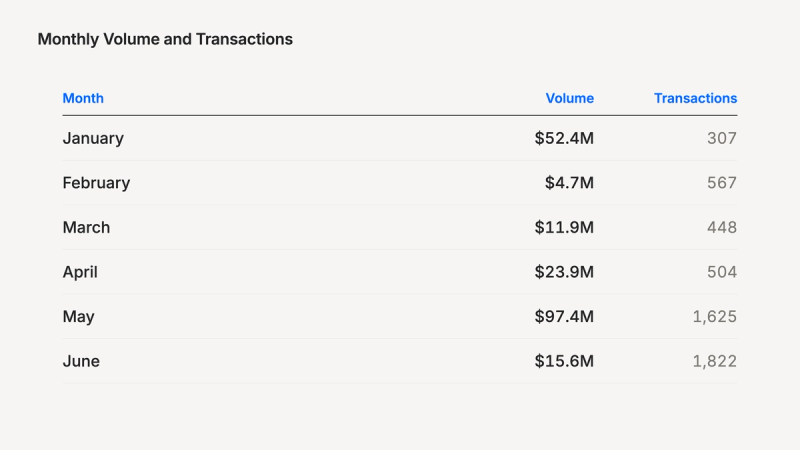
Monthly volume differed greatly in H1, and was driven both by institutional and retail transactions.
In January, only 307 transactions drove more than $50M in volume, signaling institutional transfers.
In February and March, the amount of transactions increased from January while volumes cooled, implying that there was more retail activity than before.
May was the standout month by a wide margin, as it brought $97.4M in volume across 1,625 transactions. That’s nearly half the half-year's total value packed into a single month.
June then told a different story, as the transaction count kept climbing to a mid-year high of 1,822, while volume fell back to $15.6M. Transactions grew sixfold in H1 2026, increasing from 307 in January to 1,877 in June.
The combination of rising transaction counts and falling average transaction size across May and June suggests a shift from a small number of large transfers toward a larger number of smaller, more retail-like transactions.
Solana drives USDG usage
In H1 2026, USDG's onchain footprint was driven by activity on Solana. Solana carried $205.6M (99.8%) of all volume, 5,117 of 5,273 transactions, and 289 of 328 active addresses.
DeFi dominates as a use case, with Jupiter and Kamino leading
Broken out by category, DeFi accounted for $198.8M, which is 96.5% of total volume, across 20 applications and 299 addresses. Interoperability protocols contributed $6.8M (3.3%), largely from cross-chain bridging, while payments-specific applications remained a rounding error at $50.0K.
Two applications drove the overwhelming majority of DeFi activity:
- Jupiter Aggregator. $128.4M, 2,389 transactions
- Kamino. $68.2M, 1,704 transactions
Together, Jupiter and Kamino represent roughly 95% of all DeFi volume and nearly two-thirds of total half-year volume. Jupiter is Solana's dominant DEX aggregator that routes trades across every major Solana DEX, calculating the optimal path for each swap. It has grown into a multi-product DeFi platform spanning trading, derivatives, staking, and token launches. Kamino, meanwhile, is Solana's largest lending protocol by assets, the largest single Solana DeFi protocol by TVL at $1.48 billion, where users deposit and borrow against crypto collateral.
Stargate ($6.8M) was the clear leader in cross-chain interoperability. Built by LayerZero Labs, Stargate is a composable cross-chain liquidity protocol that provides unified liquidity pools for native assets like USDC, USDT, and ETH across multiple blockchains, enabling transfers without fragmenting liquidity, letting a token move between chains as a single seamless transaction rather than through a wrapped substitute.
Orca ($1.2M) stood out for high transaction frequency relative to its volume, consistent with smaller, more frequent swaps rather than large one-off trades. Orca runs a concentrated-liquidity automated market maker known for tight spreads on USDC/USDT and SOL/stable pairs, and is widely used as a building block inside other Solana products, including Kamino's automated vault strategies.
Top wallets confirm institutional and retail usage
In H1 2026, $206M USDC moved through wallets like Fireblocks, Ledger Live, Tangem, OKX, and Trezor. These wallets span the full spectrum of how money actually moves on-chain, from Fireblocks' institutional custody rails handling large treasury-scale settlements, to hardware wallets like Ledger and Trezor and software wallets like Tangem and OKX carrying the higher-frequency, smaller-value transactions typical of retail and self-custody users.
If you're a stablecoin issuer, can you use WalletConnect?
Yes. Think of it as one connection instead of many. Today, getting your stablecoin into DeFi apps means integrating with each one separately, or hoping wallets already support it. WalletConnect removes that: connect once, and your stablecoin is reachable across 700+ wallets and 80,000+ apps on all major blockchains, the same network already carrying USDG's volume through wallets like Fireblocks into apps like Jupiter and Kamino.
That single connection does two things. First, it puts your stablecoin in front of both audiences at once: institutions moving large treasury-scale transfers, and retail users making everyday swaps, without building separate paths for each. Second, it opens the door to WalletConnect's payment products, so your stablecoin isn't limited to DeFi. It becomes something people can actually spend.
WalletConnect is a neutral, open network connecting millions of users, thousands of institutions, hundreds of wallets, and hundreds of chains. It is exactly the infrastructure a multi-chain asset like USDG needs to move seamlessly across Solana, Ethereum, and beyond.
In 2025 alone, the WalletConnect Network processed over $400 billion in volume with 119% year-over-year growth, and is already embedded in fintech stacks like Stripe, Coinbase Commerce, and MoonPay, giving USDG reach across retail and institutional users.
Note: All figures are self-reported activity metrics for the January 1 – June 30, 2026 period and reflect on-chain, USDG-denominated transaction legs only.