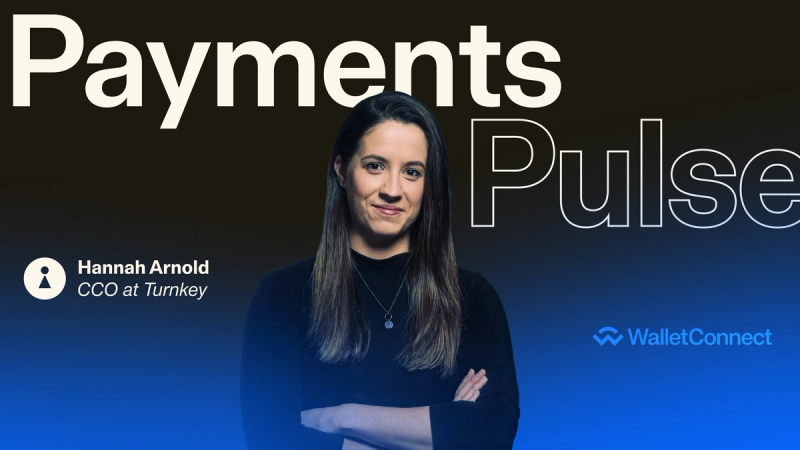

Hannah Arnold has spent her career on every side of financial plumbing: early fintech venture investing in companies like Toast, Flywire, and Quovo, then the operator side at Argyle building employment and income data infrastructure, and now as COO of Turnkey, building the wallet infrastructure layer that programmable money runs on. That range gives her an unusually grounded read on where stablecoins and agentic payments are actually headed, versus where the hype cycle wants them to go.
Dayana Aleksandrova sat down with Hannah for an episode of the Payments Pulse, WalletConnect's talk show covering the convergence of traditional and digital finance, not long after Money20/20 Amsterdam, where stablecoins and agentic payments dominated the conversation.
In this episode, Hannah explains why most consumers may never know they're using stablecoins at all, why she thinks legacy payment rails like ACH and SWIFT are more broken than fintech veterans like to admit, and why agentic payments could be the trend that quietly becomes the dominant way software transacts with software. She also talks about the underrated use cases of treasury management and programmable payments, how Turnkey's policy engine puts hard limits on what an AI agent can spend, and what it feels like to watch traditional finance companies start showing up in Turnkey's pipeline without being asked.
Full Transcript
Dayana Aleksandrova: Welcome to the Payments Pulse, WalletConnect’s talk show where we discuss the future of finance, from decentralized finance to TradFi and anything in between. Today with us we have a very special guest — please welcome the COO of Turnkey, Hannah Arnold. Hannah, welcome to the show, great to have you. We ask this question to all of our guests to get some of the lore and find out where you're coming from: what did you do before Turnkey, and how did you get to where you are today?
Hannah Arnold: Thanks for having me. My background is actually mostly in fintech, not crypto. I started my career at Bain many years ago, which is actually where I first met one of the founders at Turnkey — that's how I got reconnected a decade on. Then I spent several years on the venture side, investing in fintech specifically — early success stories like Toast, Flywire, and Quovo, which got purchased by Plaid. From there I joined the operator side at a company called Argyle, which builds employment and income data API infrastructure.
I led BD and mortgage there and got really deep into how lending, origination, and data infrastructure work on the traditional finance side. And then at Turnkey, we're building the infrastructure layer that everyone else runs on top of for programmable money and crypto. So across my career I've seen all the different sides of financial plumbing. When it was time to find my next role, I felt that fintech was solving a lot of problems, but many of them were a bit more on the surface. I was ready to jump into something where we were rebuilding a ledger that everyone could share across borders and across all the different segments of finance. That's how I made my way to Turnkey.
Dayana: That's so relatable, and it's so important that you've seen both sides — fintech and crypto — as the two are converging. I bet you have a much broader perspective than the average person we talk to. First question is about stablecoins. We recently went to Money20/20 in Amsterdam and everyone was talking about them. A lot of people do use stablecoins — according to internal WalletConnect data we share on our socials, we see billions of transactions happening every week in stablecoins.
But if you ask people about the most popular means of spending money, they'll still say the dollar, the euro, their local currency. What needs to happen, and is it possible for stablecoins to become the dominant means of payment?
Hannah: Yeah, I do think it's possible, and I think it will happen over time. Even if stablecoins become the massive success story I believe they will, a consumer may know it, or they may not. Think about how someone uses Venmo or Zelle — sometimes they know how the payment is actually being made on the back end, sometimes they don't. Zelle actually just announced, I think yesterday, that they're adopting stablecoin for remittances. Bridge, one of Turnkey's customers, is working with consumer companies like Klarna and Shopify. So the transition is happening — sometimes transparently to consumers, sometimes very behind the scenes. For Turnkey specifically, we've built our product to make the crypto of it all invisible to end users. If our customers are building an end-user wallet, they shouldn't need to know it's a crypto wallet — they can just use the product. If they're using us for back-end wallets and automations, it should feel completely seamless. So I think this transition is happening, and happening quickly, whether or not it's clear to consumers. The one thing that I think could really accelerate this — and I won't be the first person to say it — is agentic payments. We're probably all thinking that will happen faster than it will, but the acceleration could come quickly. When payments start happening in very small increments, when software starts transacting with other software, stablecoin will be the natural rail for that. I think we could see that rail become a dominant form of payment very quickly.
Dayana: I agree, and that tracks with what I heard at Money20/20 — the second most talked-about topic after stablecoins was exactly that, agentic payments. Looking at payment rails and how everything has functioned so far, where do you think the biggest point of fracture or tension is? And how can we fix it?
Hannah: Honestly, there are a bunch of issues. There's this funny thing among people who come from fintech where sometimes there's a view that the payment rails work just fine, and I never really understood that, because they don't. ACH was designed in the 1970s for overnight batch processing — that's why it takes one to three days to settle. SWIFT is faster, but it still relies on a correspondent banking chain, and every hop adds a bit of latency, a bit of cost, a bit of failure surface. Even cards feel instant to consumers, but they're not — settlement between issuer and acquirer happens over two days, not over weekends. There are a lot of slow, batch-processed areas in the payment system today.
People will often bring up RTP, FedNow, and SEPA as counterpoints to the batch processing and slowness, but those are domestic layers — they don't solve the cross-border problem. As we move to a world where software is transacting with software, at machine speed, globally, all those areas where we hit borders and have to do FX, where we hit batch processing speeds — that's friction we're going to need to wipe out piece by piece. Those are exactly the areas where stablecoins perform very well.
Dayana: So the job's not done yet, and you've already covered a couple of the elements I was going to point out. One major use case we hear about over and over for stablecoins is cross-border payments. Can you think of other use cases we don't talk about enough?
Hannah: One I really like, which is very boring, is treasury and working capital. I've heard from treasurers and CFOs about how having certainty that they can move money from one jurisdiction to another instantly really reduces the amount of cash they need on hand, which brings down their overall cost of carrying capital. Another one is programmable payments — we talk a lot right now about how quickly and cheaply we can move value, but as we get more comfortable with these forms of value movement, I think we'll start to realize what's so exciting about smart contracts: things like escrow, milestone disbursements, revenue share agreements — bringing elements of the legal system almost directly into our payment modalities. Those are two things I'm genuinely excited about that are a bit less talked about today, just because we're still in early stages.
Dayana: I can already tell treasury management is going to be big — I've been hearing side talks about it, there's social media content on it. I think that'll be one of the big metas, alongside agentic payments. Give us your best guess: where do you see stablecoins going in the next one to three years?
Hannah: It's maybe not the most exciting or unusual take, but I really do believe in agentic payments, for all the reasons I said a moment ago — it's just such a clear use case for stablecoins. I think there are some hype cycles that don't deserve to be hype cycles, and others that do. Right now we're in a hype cycle, and I think we'll actually feel the bottom fall out where there's not that much volume happening yet and not that many real use cases.
But the fit is so strong. Because AI is allowing companies to launch with such low opex, I think we'll see competitors in SaaS launch with a purely variable payment model, and those competitors will become extremely competitive in the market very quickly. So right now it looks like there's not much happening in agentic payments, and it's just a meta — but I think the market will shift quickly when it does, and suddenly we'll see it become the dominant payment model for how online services are consumed.
Dayana: I think that's the key word — "yet." Not yet, but soon. How does Turnkey fit in? Where do you think Turnkey will play a pivotal role in infrastructure, in the future of payments, and in this new world of finance?
Hannah: What we've built is crypto wallet infrastructure designed for flexibility, speed, performance, and — chiefly — security. Security has been a huge piece of everything we've done from the very beginning, and it's what we designed the entire company around. What we enable is a wallet that can be held by a company, an end user, or an AI agent, in either a non-custodial or custodial way.
The policy engine, which is a critical piece of our product, is fully configurable — so if you want to limit an agent's spending to a certain amount over a certain period of time, you can, or you can get much more granular by writing your own logic in our hosted infrastructure, Turnkey Verifiable Cloud, even calling out to external services to define exactly how you want the agent to make its spend choices.
That's where we play in this space: you can spin up a wallet very easily and then have extremely tight controls over how that wallet actually executes spend. Performance, speed, and latency have also always been very high on our list — compared to something like an MPC wallet or other cold wallet options out there, Turnkey is doing 50-millisecond signing. Very fast, which matters a lot for these agentic use cases.
Dayana: I think that's going to be absolutely necessary. One question I have to ask for our last question, because you've seen fintech, you've seen crypto, and there's a lot of talk about the convergence of the two — it started as crypto being its own fringe thing, and then the technology got so good that traditional finance and fintech companies started paying attention. Like you mentioned, Zelle is now using stablecoins for remittances and cross-border. How do you see the two converge? What will that look like — will it still feel like crypto, will it be purely finance, or something else?
Hannah: For me, this has been the most fun. I've been at Turnkey for three and a half years now, and this has been one of the most fun years, because the convergence is really here. There was a long time where my old fintech friends weren't that interested in what I was doing over at Turnkey.
Now they've really come back around. I think the threshold we've crossed is that the ledger has actually delivered on its promise — because we have stablecoins, and because legislation is getting clearer. I often feel like it's even clearer here than it was in my fintech days, which is interesting. We're now seeing all kinds of traditional financial companies come into our pipeline without much push at all — that's everything from fintech and fast-moving companies across every layer of fintech, to traditional banking players who are now very interested in finding their path: what's their play in stablecoins, what's their play in tokenized traditional assets, and what the future is going to look like.
A year ago, most of our inbound came from crypto-native companies. Today, a lot more of it is coming from folks already inside the existing financial system looking to bring crypto, stablecoin, and real-world assets into their stack. So I do think the convergence is here, and it's been a really meaningful shift we've felt very aggressively this year. I think Stripe has certainly helped move the market in that direction with their big announcements and pushes, but it's been a genuine shift across the board.
Dayana: So we can finally go back to having normal conversations with our friends where we can proudly say "I work in crypto" and they won't think we're some kind of scammer or meme coin person. That's very optimistic. Hannah, thank you so much for being a guest on Payments Pulse.
Hannah: Exactly. Yeah, great — thanks for having me.