

A prediction market can price a general election to the decimal, settle a contract on an agreed source, and hold an order book together through a volume spike. Then it loses the user at the deposit screen.
Funding is the least written-about part of this vertical and the part that most determines whether a new user ever places a first trade. Policy coverage is thorough. Market sizing is thorough. The mechanics of getting money onto the platform are covered almost nowhere.
Which of the three funding models is your platform running?
Three models, not variations on a theme. Each implies a different user, a different failure rate, and a different regulatory perimeter.
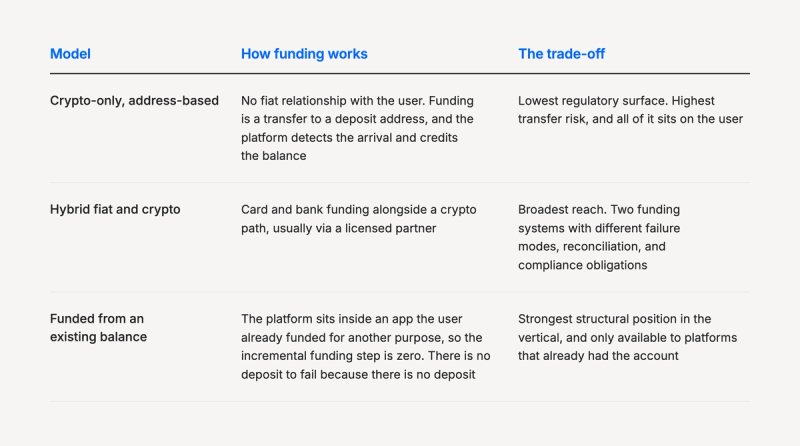
The third model is why distribution matters more than pricing here. A platform reached through an app where the user's money already sits does not compete on deposit conversion. It skips the problem.
What this means if you run model one or two
Your deposit screen is a competitive surface, not plumbing. You are up against platforms where the deposit step does not exist at all, so the gap has to close inside the flow. It will not close on price.
What does a crypto-only funding flow ask of the user?
Polymarket is crypto-only and documents its flow in more detail than its peers, which makes it the usable worked example of model one. As of its 8 June 2026 help centre update: choose a token, choose a network, and send to a fixed deposit address assigned per blockchain, which "cannot be changed or regenerated manually". Addresses differ by network, so a user's Solana address is not their Polygon address.
That is four decisions before any money moves, and each one carries a cost.
- Wrong token or wrong network and the transfer is gone. "Transactions sent to the wrong chain or address cannot be reversed."
- Below the per-chain minimum, $20 on Ethereum or $3 on Solana, and the deposit "will remain pending until the cumulative amount meets the required minimum". On a high-fee chain a small transfer costs more to process than it delivers, so a first-time user testing with a small amount gets no balance.
- Wrong anyway, and there is a documented recovery route, which on Ethereum requires sending gas to a specified address first. The user pays to undo the mistake.
Why this costs more in this vertical than in most
A user funding a prediction market is funding to act on something happening now. Four decisions, a pending state that only clears if the user sends more, and a recovery route that costs gas to use are not a friction problem here. They are a missed event, and the market they wanted has already moved. Polymarket documents this more openly than its peers, and most platforms publish neither a minimum nor a recovery route.
Who is locked out before funding starts?
Geography closes the funnel before any payment method applies. Regulated event-contract venues and offshore prediction markets both operate country restrictions, and the restricted lists are long enough that a meaningful share of global interest cannot fund an account at all, on any method.
This is also where the two halves of the vertical diverge.
- Inside a regulated perimeter: a defined jurisdiction, and a compliance obligation attached to each user.
- Outside one: broader reach, and a thinner claim to it.
Both models are live and both are funding real volume. Either way, a funding conversation that starts at the payment method starts one step late.
What does WalletConnect change about the model you chose?
Latency is the whole game here, and every second between intent and a usable balance is a trade that gets smaller. Three things matter in this case.
It closes most of the gap to model three. The user connects the wallet they already use and approves. No address, no network picker, and no new account to link, because WalletConnect is the connection standard 700+ wallets already ship, reaching 900M+ users. A platform on model one or two cannot make the deposit step disappear. It can make it a single approval inside a flow the user has already completed elsewhere, which is the closest thing available.
It compresses intent to balance into one session. The payment intent locks asset, chain and amount before the user signs, so there is no field left in which to supply a wrong value. Smart routing takes whatever the user holds and delivers the asset you credit balances in, and gas is sponsored, so the four decisions above collapse into one approval. Confirmation is instant and final with no chargeback window behind it, so crediting is automatic and the user can fund and trade on the same event.
It puts screening where the eligibility question is. Geography decides who can fund at all in this vertical, so both controls sit inside the funding flow rather than beside it.
- Sanctions & IP screening: screen wallets and users against OFAC and global sanctions lists, and block restricted-region IPs before a payment clears.
- Configurable Travel Rule capture: collects required Travel Rule data, customisable to your compliance requirements.
Where you need proof that the funding wallet belongs to the user, Wallet Verification runs on the same flow and produces a reusable, audit-ready record. Funds reach you in stablecoin in seconds, or in fiat via regulated settlement and offramp providers.
And the incentive is funded by us. Cashback in $WCT on deposits is paid by WalletConnect rather than out of your margin, which in a vertical competing hard on fees and promotions is a promotional lever nobody has to underwrite.
Why does this deserve more attention than it gets?
Because the funnel above the deposit screen is already well optimised and the deposit screen is not. Markets are liquid and the interfaces are good. The step where a user converts intent into a balance is still a copied address, a network picker, and a warning that mistakes are irreversible.
No platform publishes the number that would prove what that costs. The ones that built recovery tools have already told us it is not small.
How do prediction markets accept deposits today?
Three models are in use. Crypto-only platforms assign a deposit address per blockchain and credit the balance when a transfer arrives. Hybrid platforms run card or bank funding alongside a crypto path, usually through a licensed partner. And platforms reached through an app the user has already funded draw on that existing balance, so there is no separate deposit step at all. The three carry different failure rates and different regulatory obligations, so they are not interchangeable.
Why do prediction market deposits fail?
Usually in the user's wallet rather than on the platform: the wrong token, the wrong network, or an amount below an enforced per-chain minimum, in which case the transfer succeeds on-chain and still does not become a usable balance. Because deposit addresses are network-specific and transfers are irreversible, a wrong choice is a loss rather than a decline. In this vertical the timing compounds it, because a user funding to trade a live market has lost the trade by the time the problem is resolved.
Are there minimum deposit amounts, and why?
Some platforms enforce them per chain. Polymarket documents $20 on Ethereum and $3 on Solana, with sub-minimum deposits held pending until the cumulative total clears. The reason is transaction cost: on a high-fee chain, a small transfer can cost more to process than it is worth. Sponsored gas removes that cost from the user, and a locked payment intent removes the possibility of sending below the floor.
What compliance obligations attach to a crypto deposit on a prediction market?
That depends on the platform's licence and jurisdiction rather than on the funding method, and it is the operator's determination to make. Practically, a funding path should carry two controls: sanctions and IP screening that checks wallets and users against OFAC and global sanctions lists and blocks restricted-region IPs before a payment clears, and configurable Travel Rule capture that collects the required data to your compliance requirements. Screening at the point of deposit is materially easier than reconstructing it afterwards.
How fast does a deposit need to confirm?
Faster than the event the user is trying to trade. Someone funding during a live market is not funding for tomorrow, so a confirmation delay is not a queue, it is an abandoned trade. Instant, final confirmation is what allows a balance to be credited automatically instead of held behind a manual check.
Is there public data on prediction market deposit conversion?
None, from any platform or any independent source. No conversion rate, no abandonment rate, no deposit-to-first-trade lag, no stablecoin share of deposits. That absence is itself the reason this part of the vertical is under-examined.