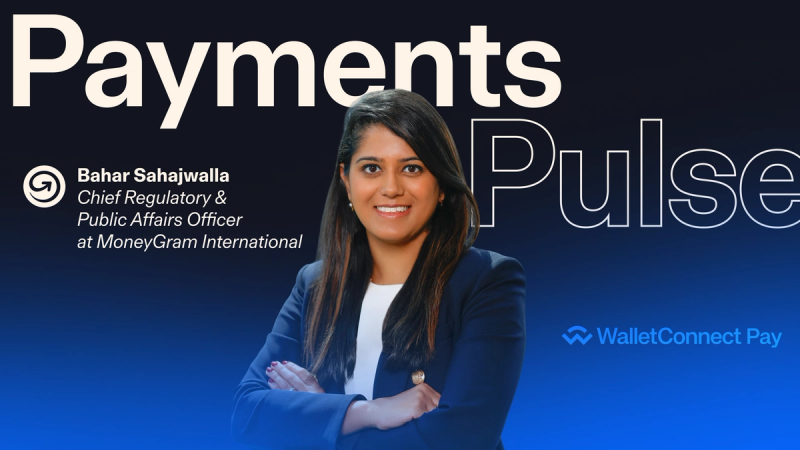

Bahar Sahajwala has spent eight years at MoneyGram, most recently as Chief Regulatory and Public Affairs Officer. Before that she was at the US Chamber of Commerce, helping American companies navigate regulatory and government affairs challenges across the Middle East, Europe, and Asia. That background, straddling both the compliance and commercial sides of financial services, gives her a perspective on stablecoins that cuts through a lot of the noise.
Dayana sat down with Bahar at Money20/20 Europe in Amsterdam for an episode of Payments Pulse, WalletConnect Pay's talk show covering the convergence of traditional and digital finance. MoneyGram operates in 200+ countries and has been in the remittance business for 80 years. When a company like that leans into stablecoins, it's worth paying attention to why.
In this episode, Bahar explains why the last mile is still the hardest problem in stablecoin adoption, how MoneyGram is using stablecoins to cut cost of capital and improve settlement speed, and why the GENIUS Act was more clarifying than disruptive for an institution already operating under Bank Secrecy Act obligations. She also shares what MoneyGram is building next, including a $2 billion stablecoin trading run rate and an omnichannel payments platform built around the actual needs of remittance receivers.
Full Transcript
Dayana: Welcome to Payments Pulse, WalletConnect's talk show where we discuss anything money and payments, from traditional finance to digital and the convergence of the two. Today we have a very special guest, Bahar Sahajwala, Chief Regulatory and Public Affairs Officer at MoneyGram International. Bahar, welcome to the show.
Bahar Sahajwala: Thank you. Thanks for having me.
Dayana: Now we ask all our guests this to extract the lore of their previous life. What did you do before MoneyGram and how did you get there?
Bahar Sahajwala: I've been at MoneyGram for about eight years. I started in the government affairs space, handling that portfolio, and before MoneyGram I was at the US Chamber of Commerce in the international division, helping US companies with regulatory and government affairs issues, particularly across the Middle East, Europe, and Asia.
Dayana: Let's talk stablecoins. We attended Money20/20 and it dominated the conversation. At the WalletConnect Network we see billions of dollars moving in stablecoins, but everyday people are still largely using fiat and many aren't even aware stablecoins exist. What needs to happen for stablecoins to become the dominant means of payment?
Bahar Sahajwala: It's a fair question. You see the headlines, you hear about billions in stablecoin circulation, and then you ask a regular person if they're using stablecoins day to day and the reality looks very different. I think it comes down to the last mile. There's a good example I saw recently: social media platforms are paying influencers and content creators in stablecoin. The creator receives their payout into a non-custodial wallet, and from that point the platform is done with the transaction. The creator, whether they're in Colombia or the Philippines, is left thinking: okay, great, now what? I have money in a wallet I manage myself. How do I actually use it? Converting stablecoin into local currency to participate in the real consumer economy, that's what matters. And that's exactly what MoneyGram was built to do. We've had a physical network around the world for 80 years that was designed to solve that last mile problem. The question for us is whether we can bridge that gap for the stablecoin world.
Dayana: How are stablecoins and blockchain actually improving that last mile experience? And do you think users need more education, or does the product just need to get easier?
Bahar Sahajwala: You have to start with the consumer need. What is the consumer actually struggling with, and are you building something that genuinely addresses it? MoneyGram operates in 200+ countries, and every single day we have to pre-position or pre-fund our partners with cash to make transactions happen. With stablecoins, we can position that capital instantly in something that's dollar-backed, liquid, and cuts the cost of capital for the business. That means less capital tied up, and because you're not dependent on traditional banking hours or waiting for a wire, the speed of the whole operation improves. If you're reducing cost and increasing speed on your side, you can pass that along to consumers. The other piece is integration. Consumers want something that brings all their financial needs into one place rather than spreading across multiple platforms. That's another dimension they're actively looking for.
Dayana: Cross-border payments always comes up as the headline stablecoin use case. What are we not talking about enough?
Bahar Sahajwala: Right now most of the stablecoin volume people reference is B2B, larger players moving stablecoin between each other. And a lot of the use cases feel disconnected from each other, almost like companies were told by consultants that stablecoins are hot right now so they should do something with them. It's a bit like how companies competed to mention AI as many times as possible in earnings calls. The real value comes from product market fit. When MoneyGram launched MGUSD, it was built into the MoneyGram balance, meaning the user experience for both the stablecoin and the wallet comes from MoneyGram directly. The use case we designed around is real: a daughter in the United States sending money to her mother in a country where currency volatility is an everyday reality. The value of that remittance can change week to week. How far the money goes for groceries, rent, electricity, that changes based on circumstances entirely outside the mother's control. What we built allows the mother to hold her funds in stablecoin and choose when to cash out. She can track the balance, see when funds arrive, and pick the moment that works best for her. For the first time, she has actual control over her money. From there, can we let the daughter seamlessly repeat the transaction? Can the mother eventually spend that balance at her local grocery store? The real future use case is a genuinely omnichannel experience that fits into the consumer's existing life rather than asking them to build their financial life around something new.
Dayana: That directly answers one of the biggest criticisms of stablecoins, that they're a solution looking for a problem. Here legislation is increasingly relevant. MiCA in Europe, the GENIUS Act in the US. If you had to pick one piece of legislation as the most impactful, what would it be?
Bahar Sahajwala: For a company operating in 200 countries, it's genuinely hard to pick just one, because so many markets interconnect. Where remittances originate and where they land, and which diaspora you're serving, all of it affects the regulatory picture on both sides. But if I have to choose, the GENIUS Act is meaningful. For MoneyGram, it didn't impose entirely new requirements. We've been under Bank Secrecy Act obligations for a long time, reporting SARs, conducting sanctions screening, all of that was already our reality. What the GENIUS Act did was formally classify issuers under BSA obligations, which raised the bar so that only well-capitalised, compliance-ready players could compete. And it gave banks, regulators, and the broader industry confidence that this wasn't going to be the Wild West. That gave a company like MoneyGram the ability to lean in, because we're no longer operating in a pure grey space. I also think both the GENIUS Act and MiCA will continue to influence regulation globally, but in a more bespoke way. You'll see countries focus on different aspects: some will prioritise safeguarding expectations, others will focus heavily on disclosure requirements. We'd like to see as much harmonisation as possible, but we have a lot of experience operating across jurisdictions that manage risk differently, and our job is to meet each regulator where they stand.
Dayana: Regulation isn't the sexiest topic, but it's foundational for everything that's about to unfold. Final question: what's next for MoneyGram in the next one to two years?
Bahar Sahajwala: We started with the MoneyGram Balance and MGUSD as our core consumer use case, with a current focus on Latin America and receive countries where we can offer people real access and visibility into their funds. The next step is expanding what consumers can do with those funds, providing genuine financial control rather than just a transfer mechanism. What you'll see is MoneyGram continuing to build out a true omnichannel payments platform that integrates into the consumer's financial life in multiple ways. On the infrastructure side, separately from MGUSD, we're running almost a $2 billion run rate in active stablecoin currency trading, which gives us more agility and flexibility to expand our services. MoneyGram can move in ways that simply weren't possible 20 years ago, and we're very excited about where that takes us.
Dayana: It's always encouraging to see a legacy company fully embrace technology and drive it forward in meaningful ways. Bahar, thank you so much for being a guest on Payments Pulse.
Bahar Sahajwala: Thank you, Dayana.