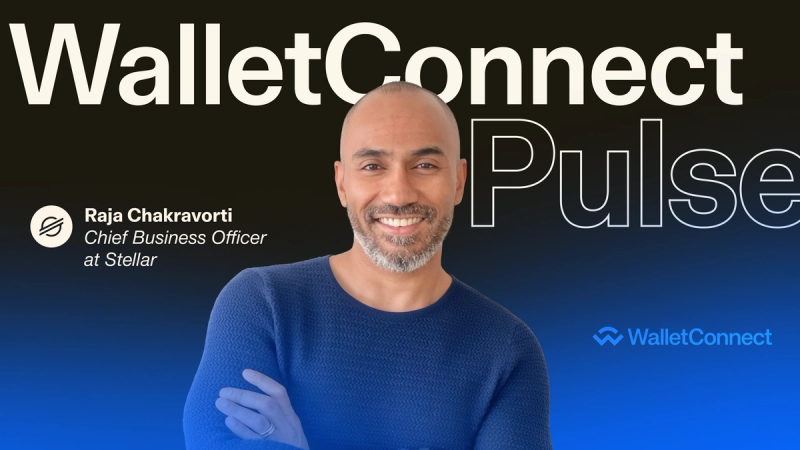
Raja Chakravorti has seen finance from nearly every angle. He started his career in traditional finance, working in structured finance and capital markets at JPMorgan and Goldman Sachs through the 2000s, before moving into payments with an eight-and-a-half-year run at PayPal, followed by time at Plaid. The through line, he says, has always been using technology to make financial services more efficient for consumers and businesses alike. Today he is Chief Business Officer at the Stellar Development Foundation.
Dayana Aleksandrova sat down with Raja at Meridian, Stellar's signature event, in Lisbon for an episode of the WalletConnect Pulse, WalletConnect's talk show on the digital asset economy and modern money movements. It was a big day for both teams: WalletConnect announced three updates, including expanded support for the Stellar ecosystem and the launch of WalletConnect Pay with Stellar in Bermuda.
In this episode, Raja explains why Bermuda's push toward a digital-first economy matters for small businesses paying 3 to 10 percent in card fees, why the best blockchain experience is one users never notice, how DTCC opening up to Stellar could unlock traditional finance at scale, why "TradFi versus DeFi" is really just "Fi," and his spicy take that most of the top ten financial institutions will launch a blockchain project.
Full Transcript
Dayana: Welcome to the WalletConnect Pulse, our talk show where we discuss the digital asset economy and modern money movements. Today we're here on the ground in Lisbon at Stellar's signature event, Meridian, with a very special guest. This is Raja Chakravorti, the Chief Business Officer of the Stellar Development Foundation. Raja, welcome.
Raja: Thanks so much for having me. It's so great to be here with you.
Dayana: Great to have you. The first question we ask every guest is: what did you do before your current role? And what is your current role? Give us some lore.
Raja: Some lore. Well, the first job I ever had was stocking women's shoes at Talbots, back when I was in high school. I wasn't very good at it. I only lasted a couple of weeks. Once I actually got into the workforce, I started my career in traditional finance. I worked at JPMorgan and Goldman Sachs through the 2000s in structured finance and capital markets, mortgage-backed securities, CDOs. That was quite a ride, and around 2008 that expired for me. I decided to go get a graduate degree and transition into payments, really focusing on building applications oriented around consumer financial empowerment.
I found a lot of value in my time at PayPal. I was there about eight and a half years and worked across most of merchant services, while also focusing on the connectivity of people with their payments and with merchant acceptance, and everything that happens at that intersection.
Beyond that, I transitioned into a couple of additional fintechs and spent some formative time at Plaid, which is an open finance connectivity platform for fintechs. For me, the through line has always been financial services, but at every step it was about: how do we leverage technology to make things more efficient for consumers of all types? How do we connect businesses, merchants, and the global financial base altogether? So Stellar became a fairly natural progression once I got into it and thought about what we do here.
Dayana: I think it's fair to say we're very happy you were bad at stocking shoes, because that could have taken you in a very different direction. You've played a major role with Stellar in the digital asset economy, so we're very happy you're here. Now, today is a very special day. We dropped not one, not two, but three announcements at WalletConnect. One of them is expanded support for the Stellar ecosystem, and one is that we're bringing WalletConnect Pay with Stellar live in Bermuda. Have you been to Bermuda? Why should we get excited about this?
Raja: Bermuda is vibrant, and if you haven't been there, you should definitely go. I'm from the United States, and when I think about Caribbean islands, I tend to think hot and south of the US, but Bermuda is actually much more level with the North Carolina area. So it has a really temperate climate, absolutely beautiful all year round, with some seasonality. It's fantastic. I was really excited to see this announcement.
In fact, earlier this year I went to Bermuda to visit with the Premier, David Burt, to talk about Stellar supporting digital assets in the Bermuda economy. I think what they've done there is really empowering. The core focus has been on how to bring digital assets into the economy and almost make it a digital-first economy. The rationale has always been that there are high costs and high fees associated with a lot of the traditional transactions happening there. Can we leverage digital assets to reduce that cost and create stronger merchant empowerment?
I think the integration you just launched is exactly what we're looking to do within an economy like that, because it allows a very seamless integration and the ability for a consumer to pay at a merchant in a one-click experience. There's so much value behind creating that streamlined blockchain experience and leveraging stablecoins. But ultimately, and this is something I learned through my time at PayPal and elsewhere, if you don't have a strong user experience, it's very difficult for both consumers and businesses to leverage the technology. I think this is going to be a shining example of success, and I'm really optimistic about what happens.
Dayana: Absolutely, and we're so excited, and we've seen the concept proven. We have a location here in Lisbon, 94 Degrees coffee shop, where you can go and pay directly out of your wallet with WalletConnect Pay, and the money arrives near-instantly to the coffee shop owner. It's a big game changer, and for an economy like Bermuda, where there are so many family-owned businesses, mom-and-pop shops, it's really a major next step. And can we have the next Meridian in Bermuda?
Raja: That's definitely an idea. And I'm glad it's in a coffee shop, because with the jet lag I need coffee delivered to me near-instantly as well, so that's kind of perfect. And I'll get cash back as well.
Dayana: We'll probably get cash back too.
Raja: I'll say one additional thing: the cost burden of card transactions borne by small businesses is always much higher than for a large business. It's always oriented around the number and volume of transactions, and small businesses don't have the same leverage with card networks as larger businesses do. Card costs can go anywhere from 3 to 10 percent, and if you're a small business, absorbing that is really difficult, especially if you're a coffee shop. You have to pay your suppliers, you need to make sure you have inventory every day, and that's a huge amount of cost savings that can be redeployed to grow your business.
That's what's so fascinating about what Bermuda is trying to do, because they recognize that their economy is mostly small businesses, and they're the ones typically getting hit by these high fees. The stablecoin aspect, with Stellar as a fast, low-cost settlement rail, leveraging a WalletConnect experience that creates the seamless one-touch experience, is exactly the combination we want to see to scale these solutions well beyond a pure remittance use case.
Dayana: The perfect pair. And you said remittance there. There are a lot of use cases we talk about when we talk about digital assets and stablecoins, and one of the major ones is cross-border payments. But apart from that, we've heard guests on the show say treasury management. What do you think is a use case for stablecoins that we don't talk about enough?
Raja: I think treasury management is great. Being able to pair stablecoins as a cash leg with an on-chain security is where you can actually get the value of that kind of atomic settlement structure. If you only solve one side and haven't solved the cash leg, you're still going to create delays. But there's a lot of talk about that already, so I want to throw this right onto the specific scenario we're talking about here.
There's been this concept that stablecoins in merchant payment structures can be something of value, but you haven't really seen it happen. We haven't seen a full-scale merchant economy accepting stablecoins, with consumers wanting to pay with stablecoins as well. It's one of those use cases that seems to have a lot of value, but the user experience has always been really difficult. At Stellar, we spend a lot of time talking about this idea: the power of the blockchain technology is critically important. It's what regulators and asset issuers want to understand to a T. But from a user experience perspective, you want that absorbed into the background, and you just want to be able to do the thing you want to do.
If we're able to execute that well between a consumer and a merchant, you can create tremendous efficiency. That's been circling for a long time but hasn't really landed, which is why I'm particularly excited about what you're announcing here. Now we're seeing a government, an economy, and a desire, all paired with the technology, and we can actually make it happen. I'm excited to see what happens over the course of next year.
Dayana: As are we, and as our CEO Jess Houlgrave says, it just works. Use WalletConnect, it just works. Now, you worked in TradFi previously, and now you're in digital assets. The two worlds of economics are colliding, converging, whatever you want to call it. How do you see the economy in general changing when DeFi meets TradFi?
Raja: I tend to simplify, probably because I'm not that smart, I just have to simplify everything in my head. There can be a lot of complexity when folks talk about DeFi versus TradFi and how to implement different component pieces, but ultimately the question is: you've got money, you want it to do the thing you want it to do, and you want to figure out ways to make it active. And how do I do that? I don't think these are two different things. I think it's really a convergence.
Within the traditional financial system is where all of the value currently is, which is one of the reasons we spend so much time with financial institutions. There are many here in Lisbon, and we've partnered with many of them: US Bank, State Street, Société Générale, the list goes on and on. DTCC is coming on board. We also have traditional partnerships with Franklin Templeton, WisdomTree, and MoneyGram, not to continuously rattle them off.
What I'm suggesting is that we're seeing a confluence of traditional financial institutions understanding that they can have efficiency leveraging blockchain, and find opportunities for growth. This is where the distribution piece comes in: with a more efficient technology, whether it's a tokenized asset like a money market fund or a stablecoin, I can put that into something like a DeFi protocol, which at its basic level is borrowing and lending, but on a levered basis, so you can create really unique yield profiles that become very attractive to different investor sets.
And because of what's enabled here, you can create composable opportunities that don't exist in existing traditional finance, because there's a lot of paperwork and a lot of management of what happens. Here, leveraging smart contracts and pairing different asset types, you can do these things efficiently and quickly. You can create unique structures and personalize financial services in a way that never existed before. To me, that's the convergence between TradFi and DeFi, because ultimately it's just Fi. It's financial services that work for you.
Dayana: So much cleaner: just Fi. Drop the Trad, drop the De. I think programmable money, as you said, is the future, composable money, and we're headed in the right direction. What are some exciting initiatives Stellar is working on that we'll see in the next one to two years? Something you want to brag about.
Raja: I'm really excited about the narrative we've been spending a lot of time on with traditional financial institutions, which is where a lot of the capital is: how do they get comfortable bringing not just a pilot asset onto a blockchain, but all of their assets? We announced earlier this year that DTCC is going to open up and work on Stellar with its settlement services, which is really exciting because DTCC is the financial backbone of US financial services.
What it specifically indicates to financial institutions is: this counterparty we trust for settling all of our securities transactions is now going to leverage blockchain, with it opened up for efficiency's sake. That means we, as a traditional financial institution, feel much more comfortable going ahead and doing that, and it's the type of thing that has to happen to create scale. That's one side, which is really oriented around tokenization, securities coming on-chain, and more value on that side.
On the other side of the house, when I think about the impact at the human level, localized payments and actual impact there, the opportunity is really scaling this out globally. We're using Bermuda as an example of a place that's really forward-thinking about leveraging digital assets in its economy, because it creates efficiency. There are other places we've been working with. The Marshall Islands, for example, has leveraged digital assets to build a universal basic income deployment across all of its islands. When you see Bermuda, you see the Marshall Islands, you see other economies looking and saying, "How do we go fuller scale into it?" I think within the next couple of years, that should turn into a snowball effect.
Ultimately, I think we're right at the beginning of seeing what that future wave can look like, for every economy to say: "I don't need to think about this digital asset thing as some little corner project that I can only invest in through an exchange and grab some coins. It's actually the underlying infrastructure for all of what I'm trying to do." That's where I hope we go.
Dayana: We're seeing the light at the end of the tunnel, if you will. Final question: give us your boldest prediction for the next year in finance, crypto, and digital assets. Give us a spicy take if you have one.
Raja: The spicy take, for me, is that the boring stuff just works.
Dayana: That's a bland take. That's a bland take.
Raja: Well, I think the reality here is that you're going to see the majority of the top ten financial institutions all launch a blockchain project. They will all do it. And the reason a bank launches a product isn't just FOMO, it's because they think there's actual value there. If they think there's value there, there's going to be value there, and that value is going to distribute through the economy, and that's what I'm hoping to see.