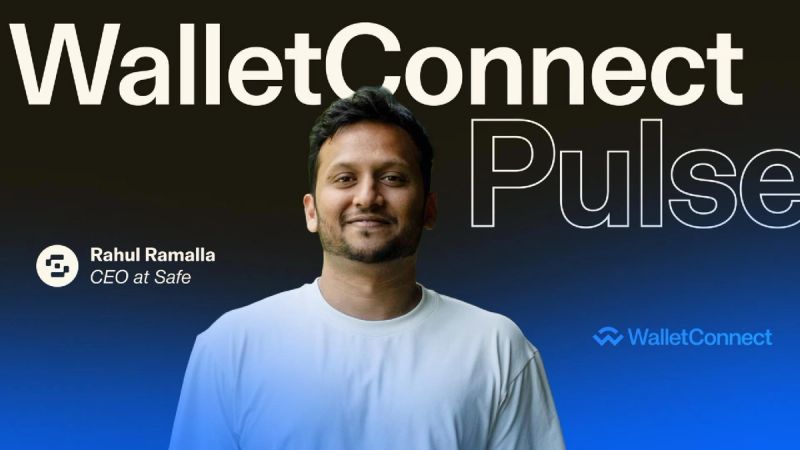
Rahul Rumalla's path to crypto started with music. A self-described "proper metalhead" turned engineer and product builder, he spent a decade working in either the music industry or crypto, drawn in by how well blockchain technology matched the problems he saw in the music value supply chain.
He has been building in the space since 2017, has founded a handful of startups along the way, and today is CEO of Safe, the self-custody platform that secures roughly $60 billion in assets and moves around a quarter trillion dollars a year.
Dayana Aleksandrova sat down with Rahul for an episode of the WalletConnect Pulse, WalletConnect's talk show on modern money movements and the digital asset ecosystem. The conversation landed on a big day for Safe: the launch of Safe Pro, the company's first enterprise-focused product.
In this episode, Rahul explains why self-custody is the mission that drives him, how he coined the term "Cypherprise" to bridge cypherpunk values and enterprise-grade infrastructure, why this moment is a critical juncture for institutions entering crypto, and his two predictions for the next two years: more scrutiny on what you can actually do with the assets you custody, and a shift in where decisions get made, from wallets to LLMs.
Full Transcript
Dayana: Welcome to the WalletConnect Pulse, our talk show where we discuss modern money movements and the digital assets ecosystem. Today with us, we have Rahul Rumalla, CEO of Safe. Rahul, welcome to the show, thanks for being here. Now, the first question we ask all of our guests: what did you do before your current occupation? Give us a little bit of background.
Rahul: Yeah, thanks for having me. My career path to Safe has been rather nonlinear. I've lived and worked in many different countries, and now I'm in Berlin. I started playing a lot of music. I had a music career, and I always wanted to work in music, even as a professional software programmer. My background is engineering and product, and for the last ten years I've actually worked in either the music industry or crypto.
A lot of the problems I found in the music value supply chain, I found the solutions to be more coherent with what blockchain technology offered, and that's how I entered. I've founded a couple of startups in crypto, which also tended to gravitate towards music. I've been building since 2017, I'd say. Ultimately, what gravitated me towards where I am is working more in self-custody.
Dayana: When you say music, what kind of music?
Rahul: I was a proper metalhead growing up. I had a ponytail, black T-shirts only.
Dayana: Do you still play?
Rahul: I still play, more like a corporate events guy now, and just playing in a rehearsal space with my friends in Berlin. As a matter of fact, we have a crypto band going called Hard Fork. We actually played in Buenos Aires, at Devconnect. Hopefully we reconvene the band. We have a few different players from different companies.
Dayana: That is the most random and fun thing I've heard during this entire conference, so I love that. You mentioned that you ended up working in self-custody. Why did you choose that path, and why is it important to you?
Rahul: I think there are a few layers to it. When I moved to the United States, at twenty-one or twenty-two, I remember having to establish something called a credit history, so you can buy things on credit, or even rent an apartment, which is impossible in America without one. That was a telling tale: even though I own my assets, I can't deploy them in some way.
But ultimately, like I mentioned earlier, music is what really drove me. I've been a big proponent of independent artists owning their rights and not selling them to record labels in order to have a career, and that hit straight to my heart. I consider myself a failed, or maybe recovering, musician, so I've always wanted to work in the music business.
When I started looking at all the problems there, I found a lot of solutions in crypto. So I took that mission forward. I see a world where people should own the things they build and create value from, which includes music rights, assets, or properties. If it's not for self-custody, what are we even doing in crypto?
Dayana: I think that's a really cool mission. One other question I'm wondering about: how do you feel about crypto's values? We started off years ago talking about cypherpunk, and now it's all about institutions and adoption and mainstream and regulation, shirts and suits and that whole thing. How do you feel about that as an OG builder?
Rahul: I see it as waves of growth in the ecosystem, and we've seen many of them over the years. With each wave comes a new wave of entrants into the space, and with them new requirements, new needs, new problems to solve. When we established the industry a decade ago, the cypherpunk values took strong root, and they are still valued.
I think they've also evolved to a point where we probably need them now more than ever, especially as we rapidly bring mainstream audiences into the core.
It requires us to develop a shared language and connect the two worlds, building more enterprise-grade infrastructure on top of cypherpunk values. At Safe, I coined a term, "Cypherprise," which is about finding a middle ground. I think it's super important to build this vision on the foundations we set up, especially right now, as our influence grows beyond the ecosystem itself.
Dayana: I agree. And since cypherpunk culture has existed for so long, it's kind of up to us to educate institutions that are joining, even if they don't necessarily care. We should still try to do some of that. And you've been building on Ethereum for a very long time. What are you hopeful to see happen specifically in Ethereum in the near future?
Rahul: There are several things I could say, but the thing that's been on my mind a lot lately is the narrative that institutions are coming in, enterprises are coming in. If you look at the timeline of events, seven years ago these were ideas, they turned into hackathon projects, then seed funding, then professional companies, and now enterprises and institutions.
To a large degree, we are the enterprises and institutions too, working with the incumbents in the space.
I think the critical juncture we're at is this: as we grow into inviting incumbent enterprises and institutions, are we recreating the systems and dependencies we originally thought about improving in the first place? And we're seeing projects fail, but I don't mean that's a failure of the industry. It just means letting go of something that didn't work and moving on to something that did.
We're seeing more consolidation, there are going to be more acquisitions, and we're seeing a lot more compression, with projects focusing on just the things that matter. We're maturing as an industry, and even the business models are maturing, quite ripely at the moment.
So it's a very interesting point to be in, actively building in this transition phase. My hope is that we're not recreating the dependencies we set out to improve and replace in the first place. But I think there is a version of this where we can merge the two worlds, and it's necessary.
Dayana: I agree with you, and like we said earlier, it's always a cycle. Hopefully it's a cycle of solving problems and not creating more. Give us your boldest prediction: if you had a crystal ball for the next two years in crypto, what's going to happen?
Rahul: I have two bets, and I don't know how bold they are. The first is that I think we've largely solved the problem of who controls the keys, who owns the assets. As new entrants come in, I predict there's going to be a lot more scrutiny toward what you can do with them.
Can you move them across platforms? Can you actually deploy the things you have custody over and give them value the way you perceive it? I think that's going to get tested, and that's where the value is, in my opinion: preserving our core principles in those layers.
The second is probably a less bold bet, but a lot of our attention is shifting towards LLMs. Nobody goes to a wallet and says, "What should I do now?" You already know what you want to do, and then you come to a wallet and transact. That decision power of what you want to do is increasingly shifting towards LLMs, where the trigger happens, and I feel it's super important for us to play there.
But when I think about this, I also ask: what does self-custody look like in the LLM space? I think these two things will dramatically change the landscape in the next couple of years.
Dayana: And what can we expect to see from Safe in the next year or so? What are you most excited about?
Rahul: As I mentioned earlier, we're seeing the space grow and evolve. Safe has been around for seven years. It was the third dapp on Ethereum, coming out of Berlin, from Devcon Zero.
So there's a lot of history there. Safe was created when a bunch of people needed a savings account, a secure way to store their assets for all the ICOs that were happening, and it grew, and we're growing with it.
Seven years later, we're building a more opinionated product for self-custody at scale. When you're operating about $60 billion in assets and moving a quarter trillion a year, self-custody becomes more than a responsibility, and at scale it's a challenge in itself.
So today, actually, we're launching Safe Pro, at 3 p.m. Central European Time. It's our first enterprise-focused product, built on the Cypherprise principles, as I call them. I'm excited to see how it gains traction. We have some very promising early partners, like Lido, Compound, and the Ethereum Foundation.
And there's going to be a lot more of that into 2027. We're definitely seeing a lot more movement in the agentic and smart account space, so there's a lot to play around with and a lot to grow into.
Dayana: Congrats on the launch. Safe Pro, go check it out. Rahul, thank you so much for being a guest on the show.
Rahul: Thank you.