
A trader buys a challenge, fails it, then disputes the charge with their bank. You lose the fee, pay a dispute fee on top, and take a hit to your chargeback ratio. That cost never shows up in the rate on your card invoice, and it’s only one part of what prop firm payment processing really costs.
Add high-risk pricing and rolling reserves, and the cost of every challenge sale ends up spread across your P&L, your support queue, and your relationship with your processor. This guide shows where that cost hides, and what changes when traders pay in stablecoin and crypto through WalletConnect Pay: final payments, instant settlement, and lower cost than cards.
Why prop firms pay more to accept cards
Card processors tend to classify prop trading as high risk. In practice, that usually means:
- Higher processing rates than standard e-commerce
- Rolling reserves that hold back part of your revenue for months
- Close scrutiny of your chargeback ratio, with your account at risk if it climbs
Switching processors rarely changes this, because the risk category follows the business.
The chargeback problem on challenge fees
A trader buys a challenge, fails it, and disputes the charge with their bank. You lose the fee, pay a dispute fee on top, and the case counts against your ratio. Your team spends time gathering evidence for a sale you already delivered.
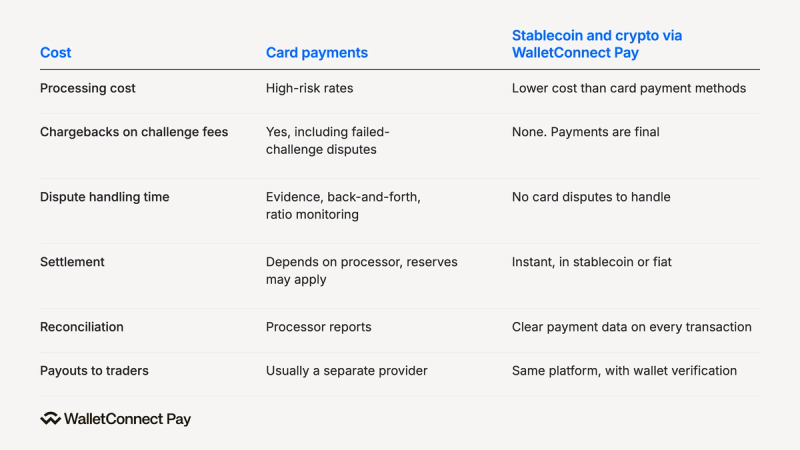
Where the cost of a challenge sale hides
How stablecoin checkout works
With WalletConnect Pay, traders pay for challenges from their own wallet or exchange account, through a single APM-style integration in your existing checkout.
- Final payments: no chargeback mechanism on a challenge fee paid in stablecoin or crypto.
- Instant settlement: in stablecoin to your wallet or fiat to your bank.
- Any token in, the token you want out: smart routing converts what the trader pays with. Gas is sponsored.
- 700+ wallets and major exchange accounts to pay from.
- Compliance in the flow: sanctions and IP screening, plus configurable Travel Rule capture.
The other half: stablecoin payouts
Challenge payments are only half the money movement. The same platform sends stablecoin payouts back to traders in minutes, not the days card and bank payouts take, with wallet verification available so funds only go to wallets traders are in control of.
You don't have to drop cards
Keep cards for traders who want them, and add stablecoin and crypto alongside as the cheaper, chargeback-free option. See how prop firms can offer both.
Why is prop firm payment processing classed as high risk?
Processors tend to see prop trading as a higher chargeback category, which usually brings higher rates, reserves and closer monitoring.
Can traders charge back a challenge fee paid in crypto?
No. Stablecoin and crypto payments are final. Refunds become your policy decision rather than a dispute a cardholder opens with their bank.
How quickly do we receive funds?
Settlement is instant, in stablecoin or fiat.
Do we need to stop taking cards?
No. Keep cards and add stablecoin and crypto alongside them.
Can the same platform handle trader payouts?
Yes. Payouts and wallet verification run on the same platform as pay-ins.