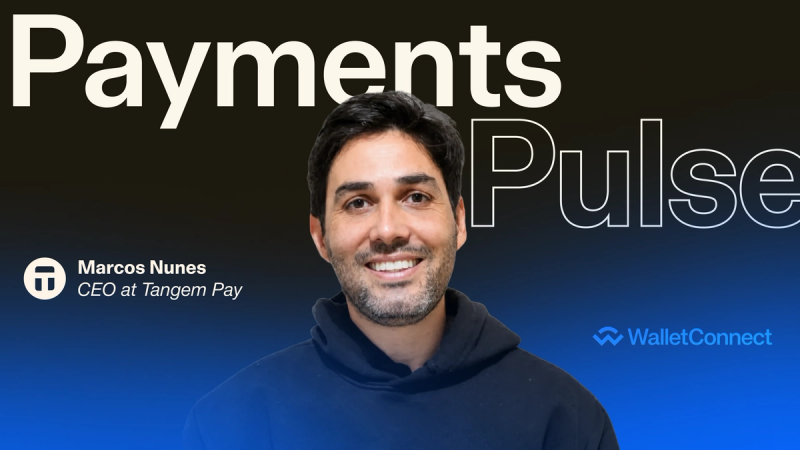

Marcos Nunes has been building payment infrastructure since long before stablecoins were a buzzword. He helped traditional payment players become interoperable within the Visa and Mastercard networks, ran a payments company as CEO, and partnered on Gnosis Pay, one of the first decentralized payment solutions. In 2022, he joined forces with Tangem, the Swiss self-custody hardware wallet company, where he now serves as CEO of Tangem Pay.
Dayana Aleksandrova sat down with Marcos at Money20/20 in Amsterdam for an episode of the Payments Pulse, WalletConnect's talk show on the convergence of traditional and digital finance.
In this episode, Marcos explains why stablecoins are a back-end infrastructure problem, not a front-end conversation, why real-world asset tokenization might be the most consequential legislation of the next five years, why stablecoins could enable true global banking without anyone needing a banking license, and how Tangem sees itself as the next generation of banking for eight billion people, not just crypto natives.
Full Transcript
Dayana Aleksandrova: Welcome to the Payments Pulse, WalletConnect's talk show, where we discuss traditional and digital finance, and the convergence of the two. Today we're live in Amsterdam at Money20/20 with Marcos Nunes, who is the CEO of Tangem Pay. Marcos, welcome to the show.
Marcos Nunes: Well, thank you very much, thank you for having me.
Dayana Aleksandrova: We're so happy to have you. Now, this is a question we ask all of our guests: what did you do before your current role?
Marcos Nunes: I'm an old guy, I've seen this event before, it was actually in Amsterdam too, so that probably says a lot about me. I've been in payments for quite some time. I was part of a company that helped traditional payment players become interoperable in the Visa or Mastercard world — essentially, if you wanted to launch any payment scheme product, you had to go through us. As a consequence, I learned everything about payments, about regulations all over the world.
Before that, I was CEO of a payments company, and I partnered on Gnosis Pay, which was the first decentralized payment solution.
Dayana Aleksandrova: Yes, our viewers are familiar with Gnosis. And now let's dive into stablecoins — this is the hot topic here, everyone in Amsterdam at Money20/20 is talking about stablecoins. Where do you see the biggest challenge for stablecoins that prevents them from becoming the money that people use daily? Why aren't people using stablecoins as much as fiat, and what can we do to accelerate that adoption?
Marcos Nunes: So in 2022, I met the founders of Tangem and the founders of Gnosis, and we decided to create a collaboration. The reason for that was, at that time, we saw that stablecoins weren't really the front-end story people should be talking about, but more of a back-end infrastructure that could solve a bunch of interoperability, money movement, and real-time settlement problems.
What we learned at that time was that it basically comes down to a decision internally: are you ready to expose your kitchen? I believe, when I hear four years later about the adoption and things like that, I'm an early adopter, an early believer of this story, and even an early pusher to the FCAs and FSAs of this world, with multiple meetings trying to convince them this is actually a better solution for the market. But essentially it's just a matter of institutions being transparent, and that's a difficult, big ask.
Dayana Aleksandrova: That is a big ask indeed. And since you've been in payments for so long, when you look at the current payment rails we have, where do you think is the biggest rupture, and how can we fix that and make the tech better?
Marcos Nunes: Real-time settlement, which means you need reconciliation. Payments is an orchestration of multiple systems that needs to function in perfection across multiple jurisdictions, cultures, development skills. With AI you can create optimization, but you still need interoperability.
If you look at getting this entire reconciliation to happen in real time, within seconds, it requires a lot of tech scalability and changes to how the back end functions today. Think of it as: I am a bank, I consolidate all transactions, and then within that consolidation I settle, within a cutting-off hour defined by the local clearing houses, payment schemes, whatever that is.
The moment you want to switch from that to real time, it requires everybody to talk to everybody in a flawless way. And you're talking about systems from 1959, COBOL language, which still handles about 94% of transactions globally, all the way to blockchain infrastructure.
When I built Gnosis Pay, my vision at that time was essentially: we still use checks. In the US and the UK, if you're getting a tax rebate, the government is probably going to send you a check and hope you never cash it. Unfortunately for them, most people still do.
What you learn from that is you don't get rid of things — you make sure you can talk to them as simply and easily as possible. So when we created this bridge, later named the "stable sandwich," for those using stablecoins in the middle and fiat on either end, it was actually to prove that money can travel from the moment of authorization to the subsequent balance sheet. Hopefully I'm not complicating this too much.
Dayana Aleksandrova: You had me at "stablecoin sandwich." Now I'm hungry.
Marcos Nunes: Because the entire point is that clearing and settlement happens in a black box, like a plane — you only learn what's going on when it crashes, and then you go see what happened, what were the final words from whoever made the mistake. With blockchain, you actually have access in real time, every time, all the time, and it's still very safe, very protected from unauthorized access.
So, in a nutshell, we need to fix reconciliation, but we also need to be more transparent and say we're okay with leaving kitchens open, because this isn't a competitive advantage at the business level — it's a security mechanism, something that helps societies develop open, clear systems. Hopefully I can build the bridge on the thinking from a regulatory perspective. It's essentially saying: can we please have open banking as defined by Europe in 2015? Because that's what we can actually do with blockchain.
Dayana Aleksandrova: And speaking of regulatory, we've seen a couple of key pieces of legislation come out in the last two years, one still upcoming. In your opinion, if you had to pick only one piece of legislation, what would be the most impactful, and why?
Marcos Nunes: RWA — real-world assets. Stablecoins, honestly, aren't really a regulation problem. If you go back to videos I did in 2023, when we officially launched the Gnosis Pay product, every single element needed to launch a stablecoin card was already regulated in 99.99% of jurisdictions globally. Because if you treat stablecoins as a back-end problem, not a front-end conversation, you already have everything figured out — how money should move, how it comes in, how it goes out, taxes. It's basically just a question of who is allowed to be accountable for my money, and who's holding that responsibility.
RWA is essentially converting assets into a new tradable format. That, for me, is a game-changer — you're going to boost economies, flood them with liquidity. Economists are going to be freaking out, because you'll have a bunch of assets that were previously non-tangible becoming fully tangible, tradable, cross-border, 24/7. That's going to be quite the challenge. I think it's probably the most interesting, exciting thing for the next five years.
Dayana Aleksandrova: "Economists are going to be freaking out" — for once, they will be. And when we talk about use cases, people always talk about cross-border payments as the major one for stablecoins, but there's far more than that. What can you think of that isn't talked about enough?
Marcos Nunes: To me, that's not really it. When you want to watch a movie, you connect to Netflix, whether you're in Brazil, India, wherever. When you want to rent a room, Airbnb. Buy something, Amazon. You have so many global solutions, and now with AI, individual entrepreneurs can build global businesses by connecting to MCPs like Stripe and operating across multiple jurisdictions. So if that's the premise, the only thing we don't have is global banking.
I can give you my own terrible experience with Barclays — I have a special account in the UK, and then I needed an account in the US, and it took six months to open. They should know who I am, that's the entire purpose of KYC, know your customer. JP Morgan and companies like it often position themselves as global banks, but in fact they operate as local subsidiaries, fully autonomous and independent. So what the heck is a stablecoin then, and why does it matter? It's the first time you can actually create true global banking, with no banking license.
Why? Because what's the concept of a bank? Deposits. What's a stablecoin? Deposits. If I have a partner in Europe who can issue a stablecoin associated with my brand — let's say I'm Brazilian, and we have Itaú, a very strong brand, top twenty bank in the world, full of assets under management, makes billions in profit every year, but 99% of Europeans have probably never heard of it — these guys can't accept deposits in Europe. But if they have a partner, or even an e-money license, or a MiCA license in Europe, they can launch a deposit in Europe.
Dayana Aleksandrova: We have two Tangem-specific questions. The first: Tangem takes self-custody and puts it into a physical card that feels like something from a traditional wallet. Who is actually buying and using Tangem cards for payments today? And does the profile of that user match who you expected when you started building?
Marcos Nunes: Let me elaborate quickly on Tangem, because when I decided to partner with Tangem, what did I see? Tangem is a Swiss company, and if you go back to the 1800s, people didn't trust their local economies and moved funds into Switzerland, which created an easy way for people to store value. Effectively, it was cash or assets — you'd go to a vault, a nice fancy manager would come with a key, give it to you, the two of you would open the vault together, put your stuff inside, and then you'd go home and tell your family: don't lose this key. Fast forward 150 years, and Tangem is doing exactly the same concept.
Where Tangem started from, obviously, was the "degen" crowd — early adopters in crypto who saw digital assets as a means of storing value to protect against global volatility, the Strait of Hormuz, wars, political events driving societies to reorganize. So if I come from that angle, Tangem has the DNA of creating that storage element, but for the Homer Simpsons of the world, for my dad. My dad truly believes I work for Bitcoin, and he'll probably always think that.
If you come at it from simplicity in a complex topic — storage with hardware — it is the best and most secure way to save money. Then you have two elements: I need to save money in a new era that respects the best security practices when using hardware, and I know I can do this without seed phrases, just by memorizing something like the name of my dog.
That's the simplicity we created. Today, a lot of Tangem's customer base still comes from the crypto-native world, but I want the next wave of customers, because in my view, Tangem is the next-generation banker. We'll never call it that, we'll never position ourselves as a bank, because we'd never hold licenses like that unless regulators change them.
I wrote a paper in 2023 with a vision of splitting banks into two streams: asset management and access. Asset management should be ten times more complex than today — you must be extremely liable for whatever you do with people's money, with a lot more capital requirements to protect institutions from failing when they hold custody of other people's cash. Access, on the other hand, needs to ensure two things: point of entry and point of exit, regardless of where, when, or how, should be legitimate and respect local rules in a given economy, whether that's Europe, Dubai, China, wherever.
We can use technology today to allow people from sanctioned countries to function in countries where they're accepted. Maybe one out of two hundred, but it's not up to us to decide — it's up to the country. I'm not here to judge, I'm here to comply, and to comply with intelligence, not stupidity.
One example I use a lot: you have Russians in Russia being sanctioned for backing the local government, so they're not allowed to have international brands trading there. Then you have Russians leaving Russia because they don't believe in the system, but because they're Russian, they're not allowed to open bank accounts in Europe either, because they send their passports and get rejected. So we're punishing them twice, with no alternative. This isn't meant to be a political conversation, but it illustrates the concept: we need to change the system. Tangem is there for eight billion people.
The technology is becoming simple, and the vision is to make it even simpler, to the degree that you shouldn't have to care. Today you don't care if your card uses this or that chip customization or EMV standard — you care that once you type in your password, the money leaves your account, pays the merchant, and you get to take the goods. Simple as that.
Dayana Aleksandrova: And our final question: where do you see the world of stablecoin finance in the next one to three years? Give us your best shot, I know no one can truly know.
Marcos Nunes: Optimizing back ends, optimizing money movement and transfer, basically putting a lot of old institutions in a better position from an operational cost and efficiency standpoint, but at the same time challenging entire risk and compliance departments. Old bureaucrats, I'm sorry, you're going to have to change how you deal with your internal processes, because AI will help these institutions think about policy better.
I think it's essentially about creating ease for individuals — because if you don't adapt, you're not going to be here in the next three years to be part of this great party.
Dayana Aleksandrova: Marcos, thank you so much for being a guest on Payments Pulse.
Marcos Nunes: Thank you.