

Every PSP evaluating stablecoin payments eventually asks the same question internally: should we build this ourselves? The instinct is understandable. Stablecoin settlement seems conceptually simple: move a token from one wallet to another, so building it in-house feels like it should be a matter of weeks, not months.
The reality looks different once the full scope of what's required becomes clear, and it's worth walking through honestly rather than assuming either path is obviously right.
What "building it yourself" actually requires
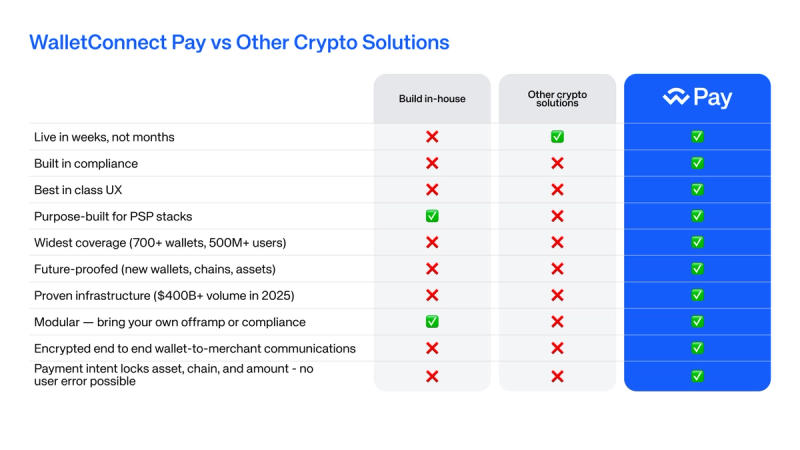
A stablecoin payment product needs to do more than move tokens between wallets. It needs wallet connectivity across every chain and wallet provider a customer might use, which today means 700+ wallet providers if you want the coverage a mainstream product needs. It needs Travel Rule compliance, collecting and transmitting IVMS-101 formatted data to receiving VASPs before any transaction broadcasts. It needs sanctions screening against OFAC, EU, and UK lists on both sending and receiving addresses, ideally before authorisation rather than after. It needs blockchain analytics to risk-score transactions against sanctioned addresses, mixers, and ransomware clusters. It needs wallet ownership verification, proving a user controls the wallet they claim to without exposing their private key. And it needs a settlement and off-ramp relationship with a regulated conversion provider if merchants want the option to receive fiat rather than holding stablecoin balances.
That's six distinct systems, each governed by different regulatory standards, each requiring its own vendor relationships or in-house expertise, before a single payment can move through the product in production.
The in-house option: full control, full maintenance burden
Building in-house gives a PSP complete control over the checkout experience and no per-transaction dependency on an external infrastructure provider. For a PSP with a large enough engineering team and a long enough timeline, that control can be worth the investment, particularly if stablecoin payments are expected to become a core, differentiated part of the product long-term.
The honest cost of that control is significant, though. Wallet connectivity has to be built and maintained separately for every provider added, and wallet providers update their APIs regularly, meaning ongoing maintenance rather than a one-time build. Compliance requirements shift as regulation evolves, MiCA, the Travel Rule, the US GENIUS Act, and FATF guidance are all still maturing, which means an in-house compliance stack needs a team actively tracking regulatory change rather than a static implementation. And every new chain or asset a PSP wants to support in the future means additional engineering work, not a configuration change.
Other crypto-native point solutions: partial coverage, partial risk
Between full in-house builds and full infrastructure integration sits a category of crypto-native payment solutions that solve part of the problem well but often leave gaps elsewhere. Some offer strong wallet connectivity but limited compliance tooling. Others handle compliance well but only support a narrow set of chains or wallet providers. Some require months to get live rather than weeks, despite being positioned as faster than building in-house.
The risk with this middle path isn't that these solutions don't work, many do, for the specific scope they cover. The risk is discovering the gaps after committing engineering time to the integration, then needing a second vendor relationship or in-house build to cover what the first solution didn't.
What integrating existing infrastructure actually looks like
The third path is integrating infrastructure that already solves wallet connectivity and compliance together, rather than building or partially assembling either. WalletConnect Pay is built on WalletConnect's existing connectivity layer, which already reaches over 500 million users across 700+ wallet providers and 125+ chains, live in 195 countries, with more than $400 billion in volume moved through it in 2025. Compliance, Travel Rule, sanctions screening, wallet ownership verification, blockchain analytics, and ISO 20022 messaging, is embedded in the product itself rather than requiring separate integration work.
That doesn't mean giving up control. PSPs choose how deep to integrate: offering it as an alternative payment method only, bringing their own off-ramp or compliance layer where they already have one they trust, using WalletConnect's compliance infrastructure end to end, white-labelling the checkout experience, or configuring additional fees on top of the base rate. It's modular by design specifically because most PSPs already have some infrastructure in place and don't want to discard it to move forward.
Comparing the real cost across all three paths
Measured against the same criteria, the differences are stark. Time to live: building in-house typically takes months to over a year given the compliance and connectivity scope involved; other crypto solutions vary widely; integrating existing infrastructure can go live in weeks. Compliance: building in-house means owning every regulatory mechanism and its ongoing maintenance; many point solutions leave gaps; integrated infrastructure comes compliance-built. Wallet and chain coverage: in-house builds start narrow and expand slowly; point solutions vary; integrated infrastructure starts at 700+ wallets and 125+ chains from day one. Ongoing maintenance: in-house requires a dedicated team tracking wallet API changes and regulatory shifts indefinitely; integrated infrastructure shifts that maintenance burden to the infrastructure provider.
None of this means building in-house is always the wrong call, for a PSP with a genuinely differentiated stablecoin product vision and the engineering capacity to match, it can make sense. But for most PSPs evaluating stablecoin payments as a way to meet growing customer demand quickly, the honest comparison usually favours integrating infrastructure that's already solved the hardest, least differentiated parts of the problem.
The question worth asking before committing engineering time
The real question isn't "can we build this," almost any capable engineering team can build a basic version of stablecoin settlement. It's "is building wallet connectivity and compliance infrastructure the best use of our engineering time, given that it's not the part of the product that differentiates us to customers." For most PSPs, the answer points toward integrating existing infrastructure and spending engineering time instead on the checkout experience, merchant tools, and product features that actually set them apart.
Frequently asked questions
How long does it take to build stablecoin payment infrastructure in-house?
Given the scope of wallet connectivity, Travel Rule compliance, sanctions screening, and blockchain analytics required, in-house builds typically take several months to over a year, depending on team size and existing expertise.
What's the highest hidden cost of building stablecoin payments in-house?
Ongoing maintenance is usually underestimated. Wallet provider APIs change regularly, and compliance requirements continue evolving as MiCA, the Travel Rule, and other regulations mature, requiring continuous engineering investment rather than a one-time build.
Can a PSP use existing compliance vendors while still integrating a stablecoin payment rail?
Yes. Infrastructure like WalletConnect Pay is designed to be modular, letting PSPs bring their own compliance or off-ramp provider where they already have a trusted relationship, while relying on built-in infrastructure for the parts they don't have.