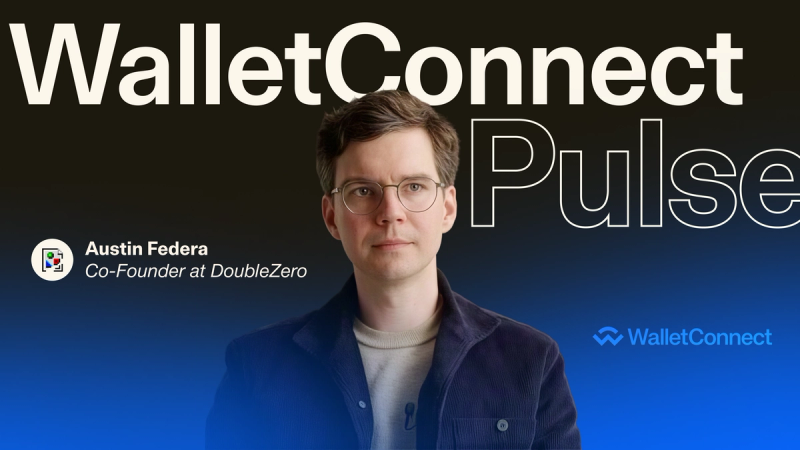

Austin Federa spent four years at the Solana Foundation before deciding to build something of his own. The spark, he says, goes back to 2022, when the Solana community was weighing whether to push the Firedancer client. If you could build a client capable of a million transactions per second, could any network actually run it? On the public internet, the answer was no. That question became DoubleZero, where Austin is now co-founder.
Dayana Aleksandrova sat down with Austin at Solana Breakpoint in London for an episode of the WalletConnect Pulse, WalletConnect's talk show on the digital asset economy and modern money movements. The conversation is a candid look at how fast blockchains really are, how fast they need to be, and why the biggest problems in crypto are better solved as many small ones.
In this episode, Austin explains how DoubleZero borrows the networking technology traditional finance has used for decades, what IBRL (increase bandwidth, reduce latency) really means, what he means when he says Solana must scale or die, why he'd rather face a lot of small problems than one big one, why on-chain direct listings will matter more than on-chain IPOs, and what's next with Edge for Builders.
Full Transcript
Dayana: Welcome to the WalletConnect Pulse, our talk show where we discuss the digital asset economy and modern money movements. Today we're live at Solana Breakpoint in London with a very special guest. There's probably not a single person who doesn't know this gentleman right here. His name is Austin Federa, and he's the co-founder of DoubleZero. Austin, welcome to the show, it's great to have you. Let's start with the first question we ask all of our guests: we would like to unpack your lore. You have been building for a long time, and you worked at the Solana Foundation for four years. What was the aha moment that had you go, "I'm going to go and build my own thing"? What led you to where you are today?
Austin: Hey, thanks for having me. It probably goes back to 2022, to be honest. We were in the process of deciding: should we do the Firedancer client? Is that a major initiative Solana pushes for? What that really came down to was, can we go even faster than what the public internet allows? If we could build a client that does a million transactions per second, what would that actually look like in practice? Could we have a network that was capable of running it? And on the public internet, the answer was no.
So this idea started brewing: how are we going to solve that problem? There were ideas like, should we buy all the validators super-fast networking cards or something like that. But it really came down to this: we need to use the same type of technology traditional finance has been using for decades, but build it from first principles with crypto principles in it, and really make it something a blockchain network can trust.
Dayana: That is incredible, and you are thinking way ahead of your time. You have a very iconic acronym, IBRL: increase bandwidth —
Austin: Reduce latency.
Dayana: Why is that important, and how are you working on this?
Austin: This isn't a DoubleZero-exclusive thing. It's something Anza and the Solana folks have talked about for a while. But the main idea is that, to really compete with traditional finance, if Solana wants to be the best blockchain, sure, there are a lot of ways to go about that. But if it really wants to compete with traditional finance, we need to think about all the things that matter in traditional finance. One of those is massively reducing latency and increasing capacity.
Increasing bandwidth is a very easy way of saying we can do more with more, as opposed to doing more with less. And reducing latency makes every system move faster and much more predictable, and it brings a trading experience on-chain that more closely resembles the determinism and speed you get trading in traditional finance.
Dayana: So recently you posted on X something along the lines of: if Solana doesn't get ten times faster, this can't go on. It's a question of survival. That sounded very dramatic, Austin. What do you mean by that? And is Solana getting faster?
Austin: My definition of survival is maybe different from other people's. Blockchains really don't die, for the most part. There are so many zombie chains that still exist from the heyday of 2019. Solana is never going to actually die, but it might fail at its mission, right? And failing at its mission means it's not continuing to get faster every year. To be clear, Solana is getting faster every year. What I see is that it's not necessarily fast enough yet.
The pace of innovation has slowed as the project has matured, and that's natural. More people depend on Solana now than ever before. But you can't take your foot off the gas. You can't rest on your laurels, you've got to keep pushing forward, faster and faster. So when we look at what we're doing to help support the Solana ecosystem, it's really about maximally using everything that's available today. Firedancer can do 3.5 million transactions per second. The Agave client can do a huge number as well. Today, what do we see on mainnet? Maybe 5,000. There are a lot of protocol limits that, for a lot of good reasons, people are hesitant to push up faster and faster.
But I think it's true. Solana runs a technical conference called Scale or Die, and I think we have to take that seriously. We have to scale more, or we may risk actually dying.
Dayana: Scale or Die. It's right there in the name. It sounds like a lot of these innovations are coming faster than the technology, and it's a race for the technology to catch up. But I see a lot of determined people like yourself, a lot of builders in the Solana space, who are making it happen. In your opinion, what is the single biggest obstacle, if you can think of just one, that's preventing blockchain from being massively adopted worldwide?
Austin: I don't know if there's just one. I would say there are actually a lot of small things, and I'd much rather have a lot of small things than one big thing. One big thing is hard. It may be easy to get people moving towards it, but you basically have to get one big issue solved, and only one team can do that. Having a lot of small problems is actually great, because you can have a lot of different teams working on solving them.
What we see is that the core infrastructure in crypto is not mature enough. It's not fast enough, it's not performant enough. Other people see the problem as being that there are no on-chain transfer agents. We have to do a bunch of legal work and practical work to get equities on-chain. Backpack has done an incredible job of that, and there are lots of teams working on it. But having everybody work on their component of the problem is much better than having one big monster to kill.
Dayana: You make it sound a lot better and a lot easier than slaying one big monster. It's kind of like whack-a-mole, but people can do it together if they work together.
Austin: Every successful technology problem is whack-a-mole. Why is AI getting faster? It's not any one thing. It's a lot of different companies pushing in a lot of different areas. It's not just NVIDIA, it's not just the data centers. There's optimization throughout the entire stack, and I think crypto is very much the same way right now.
Dayana: Exactly. Now give us a bold prediction. What is your biggest, boldest prediction for the next two years in the space? It could be about the vision, it could be a technical prediction.
Austin: Everybody's talking about on-chain IPOs. I think on-chain IPOs are quite boring. I think on-chain direct listings are going to be the actual thing. An IPO still requires thirty to fifty million dollars in fees to a bank, and even if it's on-chain, that's not necessarily a huge unlock. The direct listing disrupted the IPO model. I think the on-chain direct listing is going to disrupt the direct listing and decentralized exchange models too.
Dayana: That is a bold prediction, and I'm very excited about it. Final question, Austin: what can we expect to see from DoubleZero? What can we get excited about? What are you cooking?
Austin: We just recently announced Edge for Builders, a new framework where anybody can come in and deploy their own market data feed on top of DoubleZero. So if you're building a DeFi application, an L2, a centralized sequencer, any type of system, and you want to distribute that market data faster, the way traditional finance and market makers expect it, you can now use the DoubleZero technology stack and our fiber network to do that yourself.
Dayana: Incredible. Austin, thank you so much for being a guest on the show.
Austin: Thanks for having me.