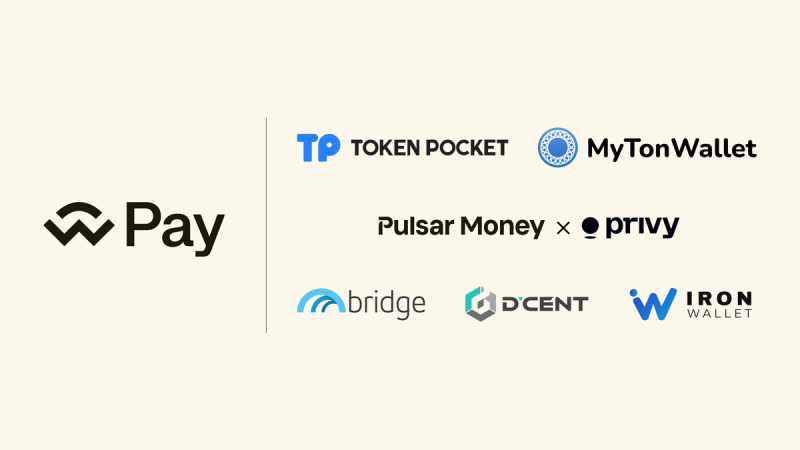

The stablecoin payments moment is here. Not coming, it is here. At Money2020 Amsterdam 2026, WalletConnect Pay announced six new wallet partners going live simultaneously: TokenPocket, MyTonWallet, Pulsar Money with Privy, Bridge Wallet, D'Cent Wallet, and Iron Wallet. Thirty-five million users across those wallets can now pay with stablecoins directly from self-custody, across chains, wherever WalletConnect Pay is accepted.
If your wallet or neobank isn't in that list, here's what you need to know.
The stablecoin payments opportunity is no longer theoretical
For years, stablecoin payments were framed as a near-future capability. In 2026, they are a present-tense product decision. PSPs and acquirers are building stablecoin acceptance into checkout infrastructure. Regulators are clarifying the compliance framework for self-custodial wallet transactions. And users, millions of them, are holding USDC, USDT, and EURC in self-custodial wallets with no way to spend themdoesn’t.
That last point is the product gap. Wallet users who hold stablecoins and cannot spend them are not loyal users. They are users looking for a wallet that ships the feature their current one doesn’t have.
WalletConnect Pay closes that gap. It connects wallets to a global PSP acceptance network through a single SDK integration, so users can pay with stablecoins directly from self-custody: no bridging, no off-ramping, no friction.
What six wallet integrations at Money2020 signal
The partners announced today span every major wallet category.
TokenPocket serves 35 million multi-chain users. MyTonWallet extends WalletConnect Pay to Ethereum, Solana, Base, and beyond. Pulsar Money, built on Privy's embedded wallet infrastructure, shows how DeFi-native apps can surface real-world payments without changing the core product experience. Bridge Wallet adds EUR/CHF IBANs linked directly to wallet addresses. D'Cent brings biometric-grade self-custody into the network. Iron Wallet delivers self-custody and seamless payments in a single app.
These are not experiments. These are production integrations, live today, built by wallet teams that identified the payments gap in their product and closed it without rebuilding from scratch.
The signal is clear: payments is becoming a standard feature of the wallet stack. The question for every wallet team is when, not whether.
Three reasons wallets are integrating now
Users expect to spend their stablecoins. Stablecoin holdings in self-custodial wallets have shifted from speculative positions to working balances. Users expect to spend them. Wallets that don't offer that capability are increasingly explaining an absence rather than a roadmap.
PSP acceptance is reaching critical mass. WalletConnect Pay's commercial pipeline includes major acquirers and payment service providers actively building stablecoin acceptance at checkout. Wallets that integrate now inherit that acceptance network from day one, with no individual PSP negotiations.
The regulatory path is clear. TFR Article 14 establishes a workable compliance framework for self-custodial wallet-to-merchant transactions. WalletConnect Pay is engineered to satisfy Travel Rule requirements natively, removing the compliance build cost that previously slowed enterprise-grade wallet integrations.
How WalletConnect Pay integration works
WalletConnect Pay is API-first. There is no payment flow rebuild, no PSP negotiation, no compliance architecture to design from scratch.
You embed the API. You surface the payment option to your users. WalletConnect handles routing, settlement, and the compliance layer beneath it.
The SDK supports all major EVM chains plus Solana and Base. USDC, USDT, EURC, and other leading stablecoins are available at launch. Travel Rule compliance is built in. Your users connect to the WalletConnect Pay PSP acceptance network on day one.
For neobanks on embedded wallet infrastructure, Privy, Dynamic, or similar providers, the same API applies. Pulsar Money's Money2020 integration demonstrates exactly how a DeFi-native product surfaces WalletConnect Pay as a spending layer on top of an existing onchain portfolio, with no friction added to the user experience.
Most wallet teams complete technical integration within a few weeks.
What happens when you integrate
Beyond the technical integration, WalletConnect actively supports wallet partners through launch. That includes co-marketing, social amplification, and presence at tier-one events, as today's coordinated Money2020 announcement demonstrates. Partners are announced alongside WalletConnect on the world's largest payments stage, to an audience of PSPs, acquirers, and financial institutions actively evaluating stablecoin infrastructure.
That distribution matters. It accelerates merchant and PSP awareness of your wallet's payment capability, which in turn drives user value from the integration faster.
Get started integrating
WalletConnect Pay is open to wallet teams and neobanks ready to ship stablecoin payments to their users. To apply for integration access, review the documentation, or speak with the partnerships team directly, contact [email protected]. Alternatively, fill out the form below.
The ecosystem is growing. The acceptance network is expanding. The wallets moving now are the ones their users will be paying with.