
Solana processes two trillion dollars worth of stablecoin transfers every quarter. That number alone says something significant about where the serious infrastructure for blockchain payments has landed. But the more interesting question isn't the volume. It's what comes next, and what still needs to be built before stablecoins become something an ordinary merchant accepts or an ordinary consumer reaches for without thinking about it.
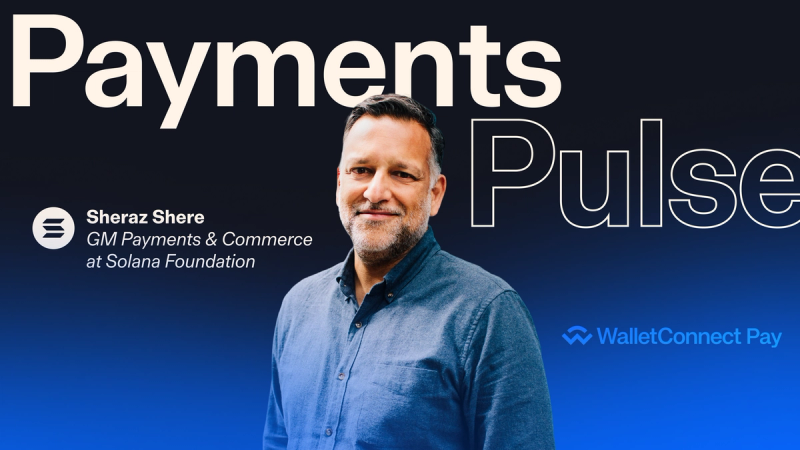
That's the thread running through this episode of the Payments Pulse. Our guest is Sheraz Shere, Head of Payments at Solana Foundation, and one of the more unusual profiles in the blockchain space: someone who came to crypto not from trading or DeFi but from a decade and a half inside the traditional payments industry. He spent eight years at American Express and then a similar stretch at Google, where he worked on the first iteration of Google Wallet and Google Pay, focused squarely on merchant payments. He joined Solana in 2021 after the founders made a simple pitch: fast, cheap, scalable blockchain plus payments is an obvious combination, and you know payments, so why not come build it?
Five years later, that bet looks well placed. Solana has attracted PayPal for PYUSD, Paxos for USDG, Worldpay, Western Union, Fiserv, SoFi, and, most recently, Meta, which announced it will pay creators on Solana. Enterprise adoption has compounded into network effects, and those network effects have made Solana the default answer when a large institution asks which chain to build payments on.
What Sheraz brings to this conversation is a practitioner's view of where stablecoins actually have product market fit today, where the gaps are, and why the boring infrastructure work, things like wallet connectivity standards and cross-border settlement rails, matter more than the shinier narratives. He's bullish on agentic payments but thinks on-chain credit and direct merchant acceptance of stablecoins are the use cases that will define the next phase. And he's clear-eyed about what WalletConnect Pay unlocks: not just reach, but a ubiquitous standard that bridges crypto-native wallets and real-world commerce in a way that card-linked workarounds simply cannot.
The conversation also gets into what it actually takes to win enterprise deals at scale, why battle-tested infrastructure beats cutting-edge novelty for institutions, and why the future of on-chain finance will be largely invisible to the people using it.
Transcript
Dayana Aleksandrova: Welcome to the Payments Pulse, WalletConnect's talk show where we talk anything payments, from decentralised finance to traditional finance and how the two are converging at a pivotal point right now. Today with us, we have a very special guest, Sheraz Shere, who is the Head of Payments at Solana. Sheraz, welcome to the show.
Sheraz Shere: Thanks for having me.
Dayana Aleksandrova: It's great to have you. We ask this question to all of our guests. First things first: what did you do before your current role and how did you find your way to Solana?
Sheraz Shere: My background prior to Solana was a bit more traditional. I worked in traditional finance and traditional payments. I wasn't particularly deep into crypto or blockchain back then, though I was aware of it. I spent about eight years at American Express and then a similar stretch at Google, working on the first iteration of Google Wallet and Google Pay, which was all about merchant payments. That's part of why WalletConnect was always near and dear to my heart in terms of what you were building. After Google I worked at some startups, and then around 2021 I started getting curious about what was happening in the blockchain and crypto world. I got connected to the founders of Solana. They were building a fast, cheap, and scalable blockchain and said that payments is an obvious use case when you have those properties, and that I came from payments, so why not join? So I said sure, why not.
Dayana Aleksandrova: I love that. And Solana has been referred to as a black hole for talent, which we'll come back to. But let's get into the substance. Solana currently processes two trillion dollars worth of stablecoin transfers quarterly, which is a significant number. How do you see the role of stablecoins, and what needs to happen for them to finally become money for your average merchant, user, and consumer?
Sheraz Shere: There's an evolution happening in how stablecoins are innovating in payments. Like any new technology, it always starts where there is the most friction, the biggest pain points. Right now, cross-border money movement is the use case where stablecoins have most clearly demonstrated product market fit. Sending money across borders has historically had the most friction, and that's where most of the innovation in payments today is concentrated: cross-border remittances, B2B flows, marketplace payouts, contractor payouts, moving money between different payment networks that traditionally have to go through correspondent banking rails. That's where the fit is today. In terms of what needs to happen for stablecoins to become a daily payment method, that's going to take more time and more innovation. WalletConnect provides some of the infrastructure to make it more seamless. You already have users in certain markets who hold stablecoins in their wallets and want to spend them without off-ramping. Today that's largely happening through cards linked to stablecoin balances. But I think the more interesting innovation will be direct wallet-to-wallet stablecoin transfers at the point of sale. We're not there yet, and there's a lot of work still to be done to build up the value proposition for both consumers and merchants.
Dayana Aleksandrova: I'm with you on that. We're seeing a lot of crypto-linked cards, but that's a stepping stone, not the destination. Now, Solana announced its payments vertical not too long ago and there have been serious milestones since then. What are your favourite highlights?
Sheraz Shere: It's been quite an evolution. I've been here five years and the nature of the job feels like it changes every quarter. In the beginning, stablecoins were brand new, so a lot of it was just educating people on what they were. Back then, having a fast, cheap, and scalable blockchain was enough to start getting stablecoin volume on Solana and getting integrated into the early cross-border money movement use cases. But then other blockchains started to innovate. New chains were created that were also fast and cheap. That became table stakes. Nobody with Ethereum L1 properties, ten transactions per second and fifty-dollar gas fees, can run payments at scale. But we're no longer the only ones who've addressed that. So the question became: what can you build on top of the fast and cheap blockchain? That led to innovations like token extensions, a new token programme that lets stablecoins have confidential transfers, more programmability, whitelisted and blacklisted wallet ecosystems. But for me personally, the biggest milestones have been the network effects that come from large enterprises joining. PayPal with PYUSD, Paxos with USDG, Worldpay, SoFi, Fiserv, Western Union. Every large enterprise that comes on builds the network effect further, so new entrants aren't coming into a cold-start problem. They're coming into a chain with liquidity, global on and off-ramps, efficient markets, and active commerce already happening.
Dayana Aleksandrova: You mentioned Western Union, Worldpay, and Meta just announced they'll pay creators on Solana. Why are all these heavy hitters choosing Solana? What are you giving them that makes them say yes?
Sheraz Shere: The baseline is infrastructure. The core developers maintaining the client code, a group called Anza, are laser focused on speed, low cost, and scalability. That work never stops. Even where we are today, they're not satisfied. But above and beyond the infrastructure, I think enterprise players want to come into a battle-tested network. If you look at the last couple of years, Solana has had to navigate some serious stress tests, including being associated with some difficult moments in the broader industry. Coming through those stronger has actually been a feature, not a bug. Institutions looking to build on blockchain want to know that the network has survived adversity. Beyond that, I think the other thing is the growing community of developers and builders and the growing set of use cases and liquidity and activity that is just magnetic. When enterprises look at where to build, they want to see that other serious players are already there.
Dayana Aleksandrova: And when we talk about the wallet connectivity layer, what was missing and how is WalletConnect Pay able to help Solana when it comes to payments?
Sheraz Shere: When I first got into crypto, I noticed that the wallet connection layer was a different paradigm from what I was used to in traditional finance. The connectivity that existed was very crypto-native. You could connect your wallet to an NFT marketplace or an AMM, but there was no ubiquity. You couldn't take your Phantom wallet and connect it to more traditional commerce venues. What's important about WalletConnect, and we saw something similar with the Solana Pay standard, is that it's a multi-chain framework. It's going to be a multi-chain world and I don't expect Solana to be the only chain. Having a framework that creates a ubiquitous standard for wallets connecting to applications, not just crypto-native applications but merchants and point-of-sale systems, is critically important. You have a growing user base, starting with crypto-native people but expanding to non-crypto-native people who are holding stablecoins because they have a remittance app or similar. Giving those users the ability to spend those balances in the real world is essential. Card issuance is one surface area, but it's not the whole answer. You need as many different surface areas for connectivity as possible. That's why WalletConnect Pay is critically important. It's infrastructure, and it's the right kind of infrastructure.
Dayana Aleksandrova: It's a cumulative effort. We can build the rails, we can build the infrastructure, but it's up to the builders of value-driven apps to carry things further. Now if we look at the last year or so, there's payments.org, X402, pay.sh, which was recently announced. Solana has established itself as the ultimate payment stack at the layer level. What do you see happening in the future of on-chain finance and how does Solana plan to be part of it?
Sheraz Shere: The agentic payments conversation is exciting but it's also a bit of a shiny object right now with a lot of people jumping on it. I'm genuinely curious to see where it goes, but I think there are other use cases that will define the future more meaningfully in the near term. On-chain credit is one that I find really compelling. In TradFi, credit is a massive category. Using blockchain and stablecoins to facilitate credit, bringing in liquidity and demand for credit on-chain, is an area where we're already seeing real growth. And then merchant payments is the other one I'm most interested in, maybe because of my background at Amex and Google. What does a world look like where merchants are directly accepting stablecoins? A raw wallet-to-wallet stablecoin transfer needs infrastructure built around it: frameworks for refunds, chargebacks, and all the surrounding mechanics. The beauty of blockchain is that all of that is programmable and it's being built. And you can combine credit and merchant payments too. Buy now pay later on-chain is greenfield and genuinely interesting. For Solana specifically, our success will continue to come from having deep liquidity, a chain that can support fast and cheap micro-transactions, and continuing to be the place where serious enterprises want to build. The agentic payments wave will land well on Solana for exactly those reasons. But thinking about what defines the next five years, it's credit and merchant payments.
Dayana Aleksandrova: That's a future I'm excited about too. If we can build buy now pay later better on-chain than it exists in TradFi, that's a genuine game changer not just for crypto users but for the world. Sheraz, thank you so much for being a guest on the Payments Pulse.
Sheraz Shere: Thanks for having me.