
Money has always changed form. Not because someone decided to replace it, but because the world it needed to serve changed first.
Commodity gave way to paper because carrying gold across borders did not scale. Paper gave way to cards because cash did not work for a world moving to digital commerce. Each time, the underlying thing, a trusted unit of account, a reliable store of value, a practical medium of exchange, stayed the same. Only the form changed.
We are in another one of those moments. And the form money is taking next is digital, programmable, and settling on public and private blockchain rails. Stablecoins are not a challenge to national currencies. They are what national currencies are becoming.
What money has always needed to do
Before we talk about where money is going, it helps to be clear about what it has always done.
Money is a unit of account: a shared language for pricing things. It is a store of value: something you can hold today and spend tomorrow without it becoming worthless overnight. It is a medium of exchange: accepted widely enough to be useful. And in the modern era, it is an instrument of policy: something central banks can expand, contract, and direct to manage economic conditions.
Every transition in the history of money has preserved those functions while making them easier to use in practice. The question now is what form makes those functions work best for a world where commerce is global, instant, and increasingly happening outside the traditional banking system.
Stablecoins are a compelling answer. Not because they invent something new, but because they take something that already exists and make it work better.
The dollar showed it was possible
The clearest proof of concept is already running at scale.
The US dollar is the world's reserve currency. And the majority of stablecoin supply is denominated in dollars. USDT and USDC together represent hundreds of billions in circulation. They cross borders in seconds. They settle without a correspondent bank in the middle. They are accessible to anyone with a smartphone and an internet connection, including people in countries where the local banking system is unreliable or the local currency is unstable.
Stablecoins did not challenge the dollar. They extended it. They took the world's most trusted currency and gave it the properties that a digital-first world actually needs: programmable, fast, borderless, and available around the clock.
In parts of Latin America, sub-Saharan Africa, and Southeast Asia, dollar stablecoins are already functioning as everyday money for millions of people. Not as a crypto investment. As a practical tool for holding value and making payments in a currency that does not lose a third of its purchasing power in a year.
The dollar proved the model works. Now other currencies are following.
The demand is already there
The policy debate about stablecoins as a monetary form tends to run ahead of something more important: people are already using them this way, and the data makes that clear.
Research we conducted across 1,422 verified users in early 2026 found that 78% of crypto users now prefer stablecoins over any other form of crypto for spending. Their primary stated use is payments. USDT and USDC are the dominant holdings, with 82% and 73% of respondents holding each, respectively.
This is not speculative appetite. The sweet spot for comfortable transaction size is $100 to $999, the everyday spending range, not large investment moves. 76% of respondents said that is where they are comfortable transacting. These are real users making real payments, not whales moving capital.
The gap is not in the demand. It is in the infrastructure available to meet it. 69% of those users want to pay with crypto today. Very few actually can, because the acceptance layer is not there yet. And of those who have tried, 69% abandoned at least one payment in the last six months, most commonly because of gas fees, slow confirmation, or unclear costs at checkout.
That friction is not a reason to conclude stablecoins are not ready for mainstream use. It is a precise description of the infrastructure problem that needs solving. The demand side has already moved. The supply side is catching up.
What is happening now: currencies are going digital one by one
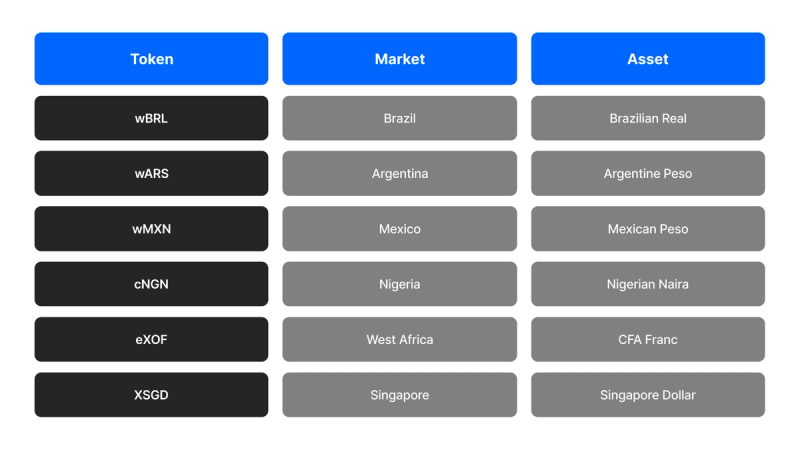
The emergence of country and currency-specific stablecoins is not a handful of pilot projects. It is a global pattern accelerating across multiple jurisdictions simultaneously, and it is the clearest signal that we are watching a genuine monetary transition rather than a technology trend.
The EU's Markets in Crypto-Assets regulation created a clear legal pathway for euro-backed stablecoins, and issuers have moved quickly into that space. Singapore has run regulated digital SGD pilots with major financial institutions. Brazil's central bank has been among the most progressive globally on a digital real framework. The UAE built a regulatory environment specifically designed to attract stablecoin issuers working with dirham-denominated products. Hong Kong has licensed regulated issuers for HKD-backed instruments.
Each of these is a national currency taking on a new form. Not disappearing. Not being replaced. Evolving into something that works better for the infrastructure the world actually runs on now.
What if there were a fully recognised digital pound?
A digital pound already exists in early form. Regulated issuers have begun offering GBP-backed stablecoins, and the Bank of England has been consulting on a retail digital pound for several years. But it does not yet carry the full government recognition and legal clarity that would make it function as a true national digital currency. The government's position remains cautious: interested, studying, not committed.
That gap matters because the technology is ready before the policy is.
Imagine a digital pound with full recognition behind it, backed one-for-one by sterling reserves, running on the same public rails that other stablecoins already use. A British freelancer invoicing a client in Singapore gets paid in seconds, not three to five business days. A small retailer selling through a global marketplace collects revenue without a payment processor taking 2 to 3 percent per transaction. A family sending money abroad pays a fraction of what it costs today.
None of that requires reinventing the pound. It requires giving the pound the same digital properties that USDC gave the dollar.
The most recent Bank of England consultation acknowledged that any digital pound would need to sit alongside private issuers rather than replace them. That is the right instinct. The practical outcome is likely a regulated ecosystem where multiple institutions issue pound-denominated digital money on shared rails, closer to how the existing banking system works than a government monopoly, and more useful for it.
What a digital Canadian dollar could look like
Canada's payment system works, but it is slow and expensive the moment you cross a border.
A Canadian business paying a supplier in the Philippines today goes through SWIFT, waits several days, and pays fees at both ends. A digital Canadian dollar settles in minutes. The currency conversion happens at the point of payment, not through a bank's FX desk at a margin the customer rarely sees clearly.
For individuals, the case is just as strong. Canada has a large diaspora. Families send money back to India, the Philippines, and the Caribbean every month. That is expensive and slow today. A regulated digital Canadian dollar that the recipient can hold or spend without needing a bank account changes the economics of those flows entirely. It is exactly the use case that drove dollar stablecoin adoption in similar corridors.
The Bank of Canada paused its retail digital currency work in 2024, citing a lack of public demand. But the businesses and fintechs trying to move money efficiently tell a different story. Public demand tends to follow availability, not precede it. People did not ask for contactless payments before they existed.
The more likely outcome is that a regulated private issuer builds a digital Canadian dollar before a government one arrives. When it does, it will run on the same global infrastructure already carrying stablecoins across dozens of markets.
Are they safe?
This is the right question, and it deserves a direct answer.
The honest answer is: it depends on which stablecoin, and the risks are different from the ones people usually worry about.
The most widely used stablecoins, USDC and USDT, are backed by cash and short-term government securities held in regulated institutions. USDC publishes monthly independent attestations of its reserves. Both held their pegs through the significant market stress of 2022, when algorithmic stablecoins like TerraUSD collapsed entirely. That distinction is important. An asset-backed stablecoin and an algorithmic one are not the same instrument, in the same way a money market fund and a hedge fund are not the same instrument.
The risks worth understanding are these.
Reserve risk: A stablecoin is only as good as the institution holding its reserves. If the issuer fails or misrepresents its backing, the peg breaks. Regulatory frameworks in the EU and the US address this directly, requiring full backing, regular audits, and clear redemption rights.
Smart contract risk: stablecoins run on code, and code can have vulnerabilities. The mitigation is using stablecoins on audited, well-tested infrastructure, and not holding large balances in protocols that have not been independently reviewed.
Platform risk: holding stablecoins on a centralised exchange exposes you to that exchange, not just the stablecoin. FTX customers holding USDC on FTX lost access when FTX collapsed. The stablecoin was fine. The exchange was not. Self-custody or regulated custody removes this exposure.
Regulatory risk: the legal status of stablecoins is still being defined in most jurisdictions. The direction in the US, UK, and EU is toward regulated frameworks rather than restrictions, but the work is not finished.
For someone holding a stablecoin issued by a regulated institution, with independently attested reserves, on infrastructure they control, the risk profile sits closer to a money market fund than a cryptocurrency speculation. The problem is not that stablecoins are inherently unsafe. The problem is that not all stablecoins are the same, and the frameworks that make that distinction clear are still being built.
The trajectory
The evolution of money does not happen all at once. It happens when the combination of technology, regulation, and commercial demand reaches a point where the old form starts to feel unnecessarily limited.
We are at that point now.
Card networks took decades to achieve global scale. Stablecoins are already at hundreds of billions in circulation, with infrastructure serving payments companies, neobanks, and wallets across dozens of markets. The data we see from users confirms the direction: stablecoins are already functioning as a payment layer, not a speculative asset, for the majority of people holding them. The friction points that remain are infrastructure problems, not appetite problems.
The currency-specific stablecoin ecosystems taking shape in Europe, Asia, Latin America, and the Middle East are not isolated experiments. They are the early architecture of a new global payments layer, one built on local currencies that interoperate across borders rather than everything routing through dollar intermediaries.
Money will not be replaced. It will evolve, as it always has. The currencies we use today, the pound, the dollar, the euro, and the dirham, will still be the currencies we use in ten years. They will just work differently. Faster, more programmable, more accessible, and running on rails that do not require a correspondent bank in every country to function.
That is the evolution already underway. The infrastructure to carry it is being built right now.