

Short answer
Yes. PSPs without stablecoin and crypto payment infrastructure are already losing merchants to providers that offer it, and the economics increasingly justify moving. Stablecoin settlement is faster, cheaper, and more accessible than traditional rails. The merchant demand is real. The regulatory frameworks are in place. Stripe, Visa, PayPal, and JPMorgan all went live with stablecoin payments in 2025. The question is no longer whether to add stablecoin and crypto payment capability, but how to do it without rebuilding your existing stack.
Why is this happening now?
Three things converged in 2025 that shifted stablecoin and crypto payments from speculative to structural.
The technology proved itself. Annualized stablecoin transaction volume reached $46 trillion in 2025, comparable in scale to the world's largest traditional payment networks. Stablecoin supply exceeded $305 billion, up from $5 billion in 2020. The liquidity to support large-scale payments is already there.
The regulatory environment is clear. The EU's MiCA framework gave European PSPs a definitive compliance structure for the first time. The US OCC cleared financial institutions to build out crypto projects. Singapore, Thailand, and Hong Kong all enacted frameworks. For PSPs that were waiting for regulatory cover, it's arrived.
The incumbents moved. In 2025, Stripe, Visa, PayPal, JPMorgan, and Cross River all went live with stablecoin payments in production. This is the signal that changes the competitive calculus for every PSP below them. When enterprise payment infrastructure runs stablecoin rails, merchant expectations shift, and PSPs without an answer to "can you support stablecoins and crypto?" face an increasingly uncomfortable conversation.
What the data actually shows about merchant and user demand
The adoption gap between crypto holders and merchant acceptance is the defining market dynamic right now, and it represents a direct opportunity for PSPs.
According to WalletConnect's State of Stablecoin & Crypto Payments 2026 report, which draws on 12 months of network data across 22 PSPs, 177 wallets, 125 chains, and 10 regions, plus a survey of 1,127 active crypto users:
- 96% of stablecoin and crypto holders want to pay with crypto, but fewer than 4% of merchants currently accept it
- 76% of users have abandoned a crypto or stablecoin payment in the past six months, with gas fees, slow confirmation times, and confusing error messages as the top causes
- 32% of users cite too few merchants accepting stablecoins or crypto as their single biggest barrier
- 94% of surveyed users said they would try WalletConnect Pay immediately
The demand is there. The distribution problem sits squarely with merchants and their PSPs. That's the gap this piece addresses.
The economics make the case
Before the user demand argument, there's a simpler commercial case: the unit economics of stablecoin settlement are materially better than traditional rails.
For merchants processing cross-border volume, gaming, travel, digital goods, global e-commerce, these aren't incremental improvements. They change the unit economics of every transaction.
Crypto customers also spend more. WalletConnect Pay data shows stablecoin and crypto customers carry 15–25% higher average order value than card customers. Crypto card spending grew 525% in 2025. This is a demand signal, not an anomaly.
What merchants are asking PSPs for
When a merchant raises crypto payments with their PSP, they typically mean one of three things:
Stablecoin and Crypto checkout. The ability to offer customers a stablecoin or crypto payment option at the point of sale, QR code in-store, or a payment method alongside cards and wallets in an online checkout. The customer pays from their wallet; the merchant can settle in stablecoin or receive fiat via off-ramp.
Stablecoin settlement. Receiving merchant payouts in USDC or USDT directly, bypassing correspondent banking delays and FX exposure. This is particularly valuable for cross-border merchants and those with treasury operations in markets where USD stablecoin exposure is preferable to local currency.
Cross-border payments. Using blockchain rails to settle international transactions faster and at lower cost than SWIFT or card network alternatives allow. Stablecoin rails settle near-instantly and charge under 1.5% on cross-border volume, versus the 3–5% typical of traditional cross-border processing.
Each requires different infrastructure. PSPs need a clear answer for all three, or at a minimum a roadmap.
The PSP-specific opportunity
For PSPs, this isn't just a merchant retention story. It's a new revenue stream.
WalletConnect Pay's commercial model gives PSPs revenue on every crypto transaction processed through their integration. The infrastructure handles gas, compliance, and routing. PSPs configure their own margin on top of the base rate and can white-label the checkout experience for their merchant base.
The network reach is significant. WalletConnect Network connects to 700+ wallet providers, covering 500 million+ reachable end users across 195 countries. A single PSP integration surfaces that entire buyer base. No PSP could replicate that wallet coverage by building in-house.
In September 2025 alone, WalletConnect's network processed $604 million in payment volume, across 839,813 completed transactions from 460,550 unique sessions. The volume grew from near-zero at the start of 2025. By 2026, the network averages over $1.25 billion in daily volume.
The compliance question, and why it's already solved
The dominant concern for PSPs evaluating stablecoin infrastructure is compliance. In every major regulatory regime, EU MiCA/TFR, UK MLR 2017, US GENIUS Act, and FATF Recommendation 16, the obligation rests on the regulated intermediary at the point of interaction.
WalletConnect Pay is designed to sit in that position, with six compliance mechanisms embedded at the infrastructure level:
- Travel Rule (FATF R.16 / EU TFR)- data collection in IVMS-101 format, transmitted before any on-chain transaction is broadcast
- Sanctions screening- both wallet addresses are screened against OFAC, EU, and UK lists before authorisation is submitted to the blockchain
- Blockchain analytics- every transaction risk-scored against known exposure to sanctioned addresses, mixers, darknet markets, and ransomware clusters
- Wallet ownership verification (SIWX)- cryptographic proof of wallet control satisfying EU TFR Article 14
- ISO 20022 messaging- structured financial messages off-chain with on-chain reference IDs for reconciliation
- Reusable identity credentials- W3C Verifiable Credentials and LEI/vLEI for corporate counterparties
PSPs with existing compliance infrastructure, their own KYC provider, a preferred blockchain analytics tool, and in-house transaction monitoring can bring those into a modular architecture. WalletConnect Pay handles the crypto-native components (Travel Rule data collection, wallet verification) while existing tools handle risk scoring and identity. Most PSPs end up in this split architecture.
Build vs. integrate: the decision framework
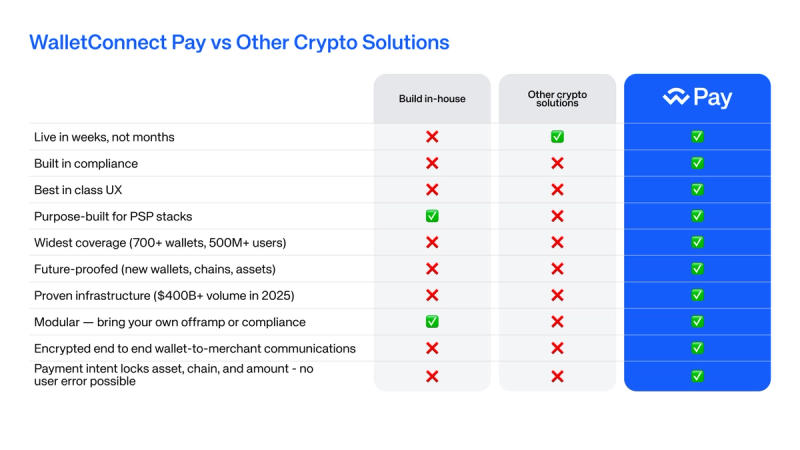
Building stablecoin and crypto payment infrastructure from scratch means owning: multi-chain wallet connectivity, real-time fiat conversion, compliance tooling, settlement infrastructure, and merchant-facing UX. It takes months, requires scarce specialist expertise, and produces point-in-time coverage of a market that's moving fast.
The more relevant question is where to draw the boundary. PSPs don't build their own card networks. They don't operate digital wallet infrastructure. They integrate with specialists at the infrastructure layer and surface the capability to merchants. Crypto and stablecoin payment infrastructure follow the same logic.
What to look for in a partner:
- Wallet coverage- how many wallets and chains? Narrow coverage means merchants lose buyers; any payment flow supporting only one stablecoin misses a significant segment of users
- Compliance architecture- is it built in, or does it push compliance burden to the PSP?
- Settlement flexibility- can merchants choose between stablecoin settlement and fiat conversion?
- Integration model- API-first, white-label, or embedded? The right answer depends on how the PSP wants to position the capability
- Live transaction volume- is this running in production at scale, or still at the proof-of-concept stage?
The AI payments angle
There's a forward-looking dimension most PSPs are also considering: agentic payments.
AI agents are beginning to handle purchases on behalf of users. The person sets preferences once, including preferred payment method, spending limits, preferred currency, and the agent executes. No checkout page. No confirmation screen.
Most payment infrastructure wasn't designed for this. Card networks were built around physical terminals and human approval at each step. Stablecoin rails are programmable money with commerce features built in. An agent can hold a wallet, move value directly, and settle in the same primitive that the software already uses for everything else.
WalletConnect Pay is API-first and stablecoin-native, which means an AI agent can trigger a payment the same way a human would, except there's no UI required. Compliance checks, including sanctions screening and Travel Rule, run automatically at the protocol level. The agent doesn't need to manage compliance; the infrastructure handles it.
Your merchants will have customers using AI shopping agents within the next 12–24 months. The PSPs integrating compliant stablecoin infrastructure now are the ones who will be ready when that wave arrives.
Frequently asked questions
Do PSPs need to hold crypto to offer crypto payments?
No. Crypto payment infrastructure includes real-time conversion to fiat at the point of settlement. Merchants can accept crypto from customers without the PSP or merchant ever holding a crypto balance. The off-ramp is handled at the infrastructure level.
Is crypto payment infrastructure compliant with MiCA and other regulations?
Compliance depends on how the infrastructure is designed. WalletConnect Pay embeds Travel Rule compliance, sanctions screening, and blockchain analytics at the transaction level — satisfying the key requirements under MiCA, FATF R.16, and UK MLR 2017. PSPs remain the regulated intermediary and should conduct their own legal review, but the architecture is built to support that obligation.
How long does it take to integrate?
With an API-first integration, PSPs can typically move from agreement to live testing in weeks, not months. WalletConnect Pay is designed to plug into existing payment flows as an alternative payment method, requiring no changes to existing settlement or reconciliation infrastructure.
Which merchants are most likely to request crypto payments?
Demand is highest in gaming, digital goods, cross-border e-commerce, travel, and financial services. B2B transactions are a growing use case, particularly where stablecoin settlement offers cost advantages over SWIFT or correspondent banking. Geographically, demand is strongest in Southeast Asia, Latin America, MENA, and increasingly Europe post-MiCA.
What's the difference between crypto checkout and stablecoin settlement?
Crypto checkout is the buyer-facing capability — letting customers pay from their wallet at checkout. Stablecoin settlement is the merchant-facing capability — receiving payouts in USDC or USDT rather than fiat. Both are supported by WalletConnect Pay, and merchants can choose between them independently.
How many wallets does WalletConnect Pay actually reach?
WalletConnect's protocol connects to 700+ wallet providers, covering an estimated 500 million+ users across 195 countries. This includes mobile wallets, browser extension wallets, hardware wallets, and neobanks built on WalletConnect infrastructure. A single PSP integration surfaces the entire network.
The bottom line
PSPs don't need to become crypto companies. They need to offer crypto as a payment method in the same way they offer cards, digital wallets, and local payment methods. The infrastructure layer exists to make that practical.
The PSPs that integrate crypto payment infrastructure now are capturing new transaction volume, reducing merchant churn, and positioning ahead of a market shift that is already underway. Those waiting are losing ground to providers who aren't.
WalletConnect Pay is a stablecoin and crypto payment infrastructure for PSPs and acquirers — a single integration giving access to 500M+ wallet users, built-in compliance, and revenue on every transaction.