
Money movement in today’s context needs three things to function efficiently: 24/7 settlement, deep liquidity, and speed. The Arbitrum Platform delivers all three: $17B+ in secured value, $4B+ in stablecoin liquidity, and affordable fees that are currently under half a cent. WalletConnect is the infrastructure layer that lets businesses plug into Arbitrum's settlement rails without building custom integrations per chain, per stablecoin, or per corridor.
WalletConnect’s value proposition is clear - it’s a single point of access to reach 900M users and move money held across the largest network of wallets. One can accept crypto and stablecoins, carry out account top-ups, and settle. WalletConnect offers compliant money movement with any asset on any chain, wallet to wallet, institution, account, or bank.
The Arbitrum Platform is live, securing over 40% of all L2 liquidity, and the median transaction cost is less than a fraction of a cent. Here, we deep dive into how and why the Arbitrum Platform works alongside WalletConnect for money movement.
Why Arbitrum is Fit for Digital Asset Movement and Payments
Arbitrum One is the enterprise-grade network powering round-the-clock settlement and stablecoin liquidity, and the backbone most enterprises trust to move money at scale.
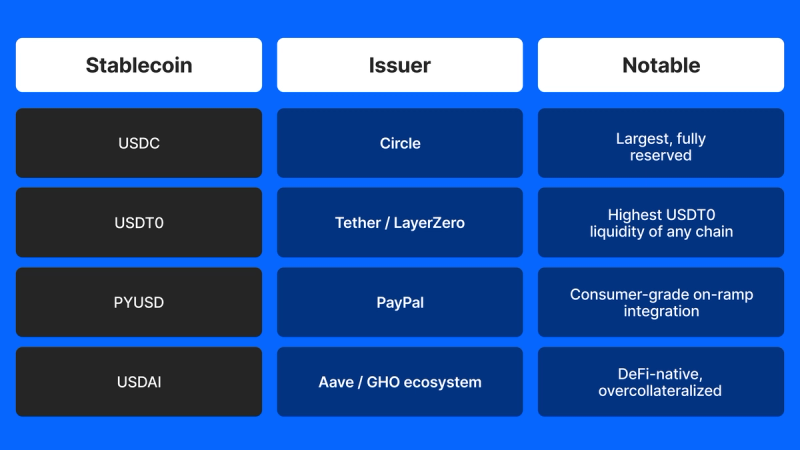
Built on Ethereum's battle-tested security with a fraction of the gas cost, Arbitrum has become one of the default rails of the industry. Its open infrastructure means USDC, USDT0, PYUSD, MXNB, MYRC, and EURe all settle on the same network, at the same speed, for the same low cost, giving fintechs a single, reliable foundation for multi-currency payments without compromise.
The trifecta: liquid, fast, low-cost
Numbers are only meaningful when they connect to a real-world outcome. On Arbitrum, every core metric maps directly to a payment use case.
Total Value Secured: ~$17 billion is the largest of any Ethereum L2 (growthepie). A settlement network is only as trustworthy as the economic weight behind it. $17B in secured value means deep collateral, active validators, and the kind of institutional confidence that comes from market proof, not marketing.
Median transaction fee: ~$0.0035. Sub-cent fees are the unlock for micropayments. At $0.0035 per transaction, tipping a content creator $0.50, splitting a $3 coffee, or paying per-minute for a streaming service all become economically viable on Arbitrum.
Block time: 250 milliseconds. Point-of-sale checkout requires payment confirmation before the customer pockets their phone and walks away. At 250ms, Arbitrum confirms faster than a contactless card tap clears.
Stablecoin Liquidity
Where the money already lives
Infrastructure only matters if the money is already there. On Arbitrum, it is.
Stablecoins on Arbitrum carry a market cap of approximately $4 billion, processing a monthly average volume of $63 billion in 2026. That liquidity depth means payment apps can settle large transactions without significant slippage, a requirement for businesses handling payroll runs, cross-border transfers, or enterprise treasury flows.
Top-4 USD Stablecoins on Arbitrum
Top-3 International Stablecoins on Arbitrum
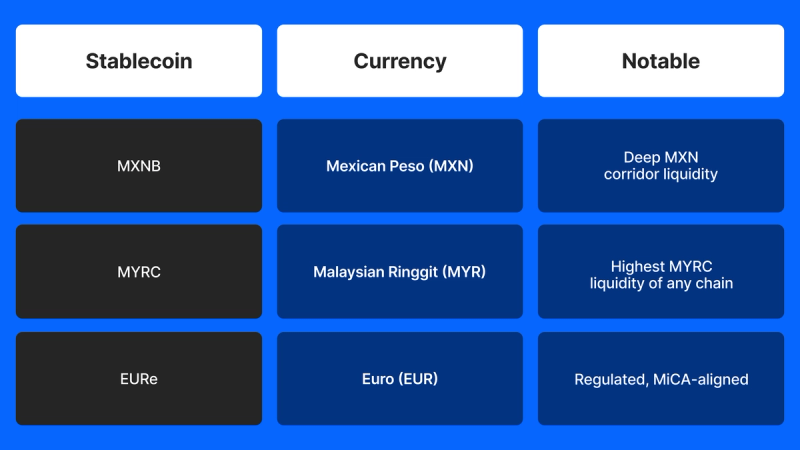
The international stablecoin depth is significant because cross-border money movements and remittances fail not because the technology doesn't exist, but because the exit liquidity doesn't. When someone sends money from the US to Mexico, the last mile which entails converting to a local-currency asset the recipient can actually spend, has historically required expensive correspondent banking. MXNB on Arbitrum collapses that cost to near zero. MYRC does the same for Southeast Asia. EURe for Europe. The corridor infrastructure is already here.
Defi & Payment Apps Built on Arbitrum powering DeFi
The most telling signal for any infrastructure play is who builds on it. Nearly 1,000 applications have chosen to build on Arbitrum, with a growing cohort of payment-native applications choosing the platform to settle transactions. Not as an experiment, but as production infrastructure.
Wallets & Consumer Finance
- Bleap is a mobile-first spending and savings app leveraging Arbitrum for low-cost consumer payments.
- RedotPay is a crypto-funded prepaid card and wallet, settling on Arbitrum to provide instant global card-spend capability.
Payroll & Business Payments
- Rise is a cross-border payroll platform for remote and global teams, using Arbitrum to pay contractors in stablecoins with same-day settlement across corridors.
Peer-to-Peer & Commerce
- Peanut is a payment link protocol enabling simple stablecoin transfers and payment requests via URL, built on Arbitrum.
- Fiat24 is a Swiss-regulated digital bank connecting traditional banking to on-chain settlement, using Arbitrum as its primary Layer 2.
Each of these applications is solving a different payment problem, but they are all reaching for the same foundation: a settlement network that is fast enough, cheap enough, and liquid enough to support real products for real users. WalletConnect is how they access Arbitrum's rails: Deposit for onramp flows, Payout for cross-border disbursement, Checkout and POS for merchant acceptance, without rebuilding that infrastructure from scratch.
Global Fintechs Settling on Arbitrum
Beyond crypto-native builders, the institutions that already run global money movements have made their own moves onto Arbitrum. This is not a future roadmap. These are live deployments from names every money movement professional recognizes.
Card Networks & Settlement
- Mastercard has integrated Arbitrum into its multi-token network initiative, enabling settlement-layer programmability for card issuers.
- Visa Direct (via Transak) is leveraging Arbitrum-native stablecoin flows to accelerate cross-border Visa Direct disbursements.
Neobanks & Super Apps
- Cash App supports USDC on Arbitrum, giving millions of US consumers a path from fiat to on-chain dollars. With over 50 million active accounts, Cash App represents one of the largest consumer-facing deployments of on-chain dollar infrastructure in the US market.
Consumer Applications
- Venmo & PayPal have PayPal's PYUSD active on Arbitrum, extending their consumer reach into on-chain settlement.
Commerce
- Shopify merchants can accept digital asset movement settling on Arbitrum, closing the loop between e-commerce checkout and blockchain-native settlement.
Infrastructure & Treasury
- Stripe has built stablecoin payout infrastructure with Arbitrum support, allowing platforms to disburse in USDC at near-zero cost.
- Transak operates onramp and offramp infrastructure on Arbitrum, bridging fiat and stablecoins for both consumer apps and institutional treasury flows.
The common thread is that these organizations chose Arbitrum due to settlement speed, liquidity depth, cost structure, and ecosystem maturity.
For any companies looking to leverage Arbitrum. WalletConnect offers a suite of products that can cater to various needs.
WalletConnect - The Connectivity Network for Arbitrum Settlement
Liquidity and speed mean nothing without integration
Arbitrum's metrics are compelling with real liquidity and live apps. None of that value reaches a PSP, acquirer, neobank, or wallet that has not built the integration to access it.
That integration problem is exactly what WalletConnect solves as an end-to-end stablecoin and crypto payments product built on the largest network of digital wallets, integrating into existing PSP and merchant stacks through a single, future-proof integration.
WalletConnect’s product suite maps directly onto the payments stack:
Checkout is the e-commerce and merchant acceptance module. Merchants using Shopify-style flows can accept stablecoin payments at checkout without requiring customers to understand wallets or chains. WalletConnect handles the connection between the consumer's wallet and the merchant's Arbitrum settlement address, abstracting complexity out of the purchase flow.
Acceptance Accept stablecoin payments from the largest network of wallets and funding sources, and receive in stablecoin or fiat, through one APM-style integration that fits directly into your existing payment and compliance stack.
- On / Off-ramps: Accept stablecoin payments and receive it the way you want: as stablecoin to a wallet, or as fiat to a bank.
- Onchain swaps: Customers can pay with any digital asset while you receive the asset you want, with conversion handled behind the scenes.
- CEX integrations: Accept payments directly from exchange accounts — unlocking the hundreds of billions in funds held on exchanges across millions of retail customers.
- Cashback: Customers earn cashback in $WCT on every purchase, giving them a clear reason to choose stablecoins at checkout.
Account Top-ups Fund user accounts compliantly with any asset on any chain, from across the largest network of wallets and funding sources through a single integration
- CEX integrations: Fund user accounts directly from their exchange accounts — unlocking the hundreds of billions in funds held on exchanges across millions of users.
- Cashback: Users earn cashback in $WCT for moving stablecoin value onto your platform
What WalletConnect offers is a shortcut through crypto's fragmentation problem. Through one integration, businesses can reach 900 million users across the largest wallet network in existence, and actually move their money. Funds can flow in any direction: in from customers, out to recipients, into balances, or through to final settlement. With built-in compliance, wallets, institutions, accounts or banks can move any asset on any chain to any endpoint.
→ Explore WalletConnect for Payments Businesses