
Stablecoins have moved well beyond their origins as a trading instrument inside crypto markets. Today, they represent one of the fastest-growing forms of digital money in circulation—and increasingly, in everyday retail.
The global circulating supply of stablecoins now exceeds $300 billion, having grown by nearly $100 billion in 2025 alone. Annual on-chain transaction volume reached approximately $27.6 trillion in 2024 and over 46 trillion in 2025, though a significant share reflects automated and non-consumer activity. Even on an adjusted basis, organic stablecoin activity is growing fast. Visa's own onchain analytics dashboard recorded 47 million monthly active stablecoin users as of early 2025.
Yet when stablecoins are discussed as a retail payment method—particularly for in-store purchases—the conversation often relies on assumptions inherited from the legacy card network era. Consumer research and global payment trends suggest that several of those assumptions are overdue for reconsideration.
Misconception #1: Crypto Payments Will Mostly Happen Through Cards
The crypto-linked debit card is currently the dominant mental model for spending stablecoins in retail. It's an intuitive bridge—and consumers are genuinely open to it. But this model smuggles the legacy payment system under the hood.
When a consumer spends from a crypto-linked card, the digital asset is typically converted to fiat and then routed through the traditional card network. From the merchant's perspective, nothing has changed: they receive the same net proceeds as any other card transaction, on the same settlement timeline, net of the same interchange fees. None of the structural advantages of stablecoins—speed, cost, programmability—are realized.
A more direct model exists: wallet-to-merchant payments, where value moves from a consumer's wallet straight to the merchant's payment provider without touching the card network at all. This removes card network intermediaries, compresses settlement times, and increases the amount the merchant actually receives. It also creates the conditions for genuine payment flow innovation—something missed by the card network model.
Misconception #2: Merchants Would Need to Understand Blockchains
Merchants accepting card payments today don't need to understand the intricacies of card authorization networks, clearing systems, or settlement cycles. That complexity happens behind the scenes—merchants simply receive confirmation and net sale proceeds.
Stablecoin payments can and should work the same way. The merchant receives confirmation that a payment has been completed and receives the net sales proceeds. The blockchain interaction is invisible. The challenge isn't educating merchants about blockchains; it's designing payment experiences where they never need to think about them at all. The infrastructure should abstract away the complexity—just as card networks did.
Misconception #3: Merchants Would Need New POS Devices
A common concern is that accepting stablecoins would require new checkout hardware. In practice, most modern POS terminals are software platforms, not fixed-function devices. The Android-based terminals now common across retail run operating systems capable of supporting new payment methods through software updates or applications—no hardware swap required.
This is the same mechanism that has already delivered several payment innovations:
• Mobile wallet acceptance (Apple Pay, Google Pay)
• QR-based payment systems (Alipay, WeChat Pay, Pix)
• Buy-now-pay-later at the terminal (Klarna, Afterpay)
• Alternative payment methods such as UPI, iDEAL, Faster Payments
• Multi-currency and cross-border acceptance without additional hardware
Stablecoin payments are now integrating into checkouts the same way. In January 2026, Ingenico—the global POS leader with over 40 million terminals deployed globally—launched a Digital Currency Application in partnership with WalletConnect Pay, enabling its Android-based terminals to accept stablecoin payments across more than 700 compatible wallets. No new hardware required.
Misconception #4: QR Payments Don't Work in Retail
QR payments may feel unfamiliar in some Western markets, but at global scale they are already one of the most widely used forms of retail payment—and some of the most successful payment networks in history are built on them.
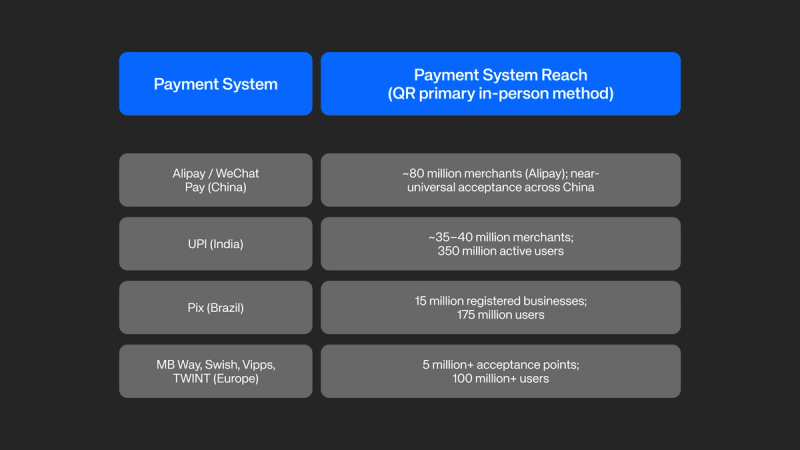
While each also supports other interaction types, QR code scanning is the primary in-person payment method across most of these systems. Hundreds of millions of consumers routinely pay merchants by scanning QR codes from their mobile wallets. What may feel novel in some regions is entirely typical in immensely populated places like Mumbai, São Paulo, and Shanghai.
Misconception #5: NFC Tap-to-Pay Isn't Possible with Stablecoin Payments
Early crypto payment implementations leaned heavily on QR codes and deep links. That history is often read as proof that stablecoins can't support the tap-to-pay experience that consumers in many markets now expect. It isn't.
NFC is a communication protocol, not a card-network feature. It simply enables a device to exchange information with a payment terminal. Once a wallet and terminal can talk over NFC, the underlying settlement can vary, ranging from card transactions and bank transfers to blockchain-based payments. The protocol doesn't care.
WalletConnect Pay is developing exactly this capability—enabling consumers to authorise a stablecoin payment directly from their crypto wallet by tapping their phone on a compatible terminal. The merchant receives confirmation; the wallet handles the authorisation; the blockchain settles the transaction. QR was the first interaction model for wallet payments in physical retail. It won't be the last.
Misconception #6: There Isn't Much Consumer Demand to Spend Stablecoins
Stablecoins are sometimes framed primarily as a means to engage in speculative trading activities. Consumer data tells a more nuanced story.
A YouGov survey of 4,658 stablecoin holders across 15 countries, commissioned by payments firm BVNK in late 2025, found:
• 39% of respondents receive income in stablecoins—for this group, stablecoins represent around 35% of annual earnings on average
• Three-quarters of those paid in stablecoins say the capability improved their ability to do business internationally
• 27% already use stablecoins to pay for everyday goods and services
• 42% want to use stablecoins for major purchases—but only 28% currently can, constrained by merchant acceptance rather than consumer intent
• 52% of crypto holders have bought something specifically because a merchant accepted stablecoins, rising to 60% in emerging markets
A separate Motley Fool survey of 2,000 U.S. adults found that half of American consumers would consider using stablecoins for everyday purchases, rising to 71% among Gen Z and 60% among millennials.
The pattern is consistent: demand to spend stablecoins exceeds the supply of places to spend them. The bottleneck is on the merchant side, not the consumer side. What has been missing until recently is the connective infrastructure between wallets and merchant payment systems.
Misconception #7: Stablecoin Payments Can't Be Compliant
For payments companies and merchants alike, compliance is the elephant in the room. Accepting an asset that moves on a public blockchain from a retail buyer’s mobile wallet raises understandable questions: How do you screen for sanctions? Who handles Travel Rule obligations? What happens to ‘Know Your Business’ requirements? Without clear answers, compliance uncertainty becomes a reason to wait.
A compliant stablecoin payment infrastructure is now emerging. The key is the architecture: a well-designed stablecoin payment compliance layer separates the technical connectivity function from regulated financial services, a connection across the regulatory perimeter.
WalletConnect Pay is built around this principle. WCP does not custody funds, transmit funds, or convert assets—it serves as the technical connection layer between the consumer wallet, the merchant's wallet, and regulated settlement partners. The regulated activities—crypto-to-fiat conversion, fiat settlement—are performed by licensed back-end partners.
Compliance has been a foundational design principle of WCP from inception, not a retrofit. The system incorporates:
• Sanctions screening: real-time screening can be applied at the earliest point in the payment flow—before any assets leave the retail buyer’s wallet
• Travel Rule: Retail buyer information is collected before the payment is enabled, associates it with the wallet address, and captures a digital signature verifying wallet control—designed to support compliance with Travel Rule requirements (e.g., EU Transfer of Funds Regulation), subject to implementation by regulated partners. This structured data may be passed to regulated partners to support their Travel Rule obligations, without requiring them to build their own capture infrastructure.
• KYB: Know Your Business due diligence is required before any merchant goes live. No merchant processes payments without verification. Enhanced due diligence is applied in higher-risk cases.
• Compliant Stablecoins: The system is configurable to accept only permitted assets in that jurisdiction—for example, MiCA-compliant stablecoins in EEA markets.
The compliance question for stablecoin payments is not whether it can be done. It is whether the payment infrastructure has been built properly from the ground up. That distinction matters.
Bridging Wallets and Merchants
If stablecoins are to function as everyday payment instruments, consumer wallets and merchant checkout environments need a reliable, standards-based way to communicate with each other. That infrastructure now exists.
WalletConnect Pay connects digital wallets directly to merchant checkout—both online and at physical point-of-sale terminals—without routing through a card network. The consumer authorises the transaction inside their wallet. The merchant receives confirmation and can choose to settle in stablecoins or convert to local currency through their existing payment provider. No new hardware. No custody requirement for the merchant. No change to their acquirer relationship. And built-in compliance from the first transaction.
The Real Transition
Payment systems rarely change all at once. Cards will persist. Bank transfers will persist. But the consumer's digital wallet—not a plastic card—is becoming the primary interface through which payments are initiated. Stablecoins fit naturally into this evolution because they allow value to move across the internet as easily as information does.
The question was never whether stablecoins would reach the physical checkout. It was who would build the infrastructure to get them there. That question has been answered by WalletConnect Pay.
Sources: BVNK / YouGov Stablecoin Utility Report 2026 (n=4,658, 15 countries); Motley Fool Stablecoin Usage and Trends Survey 2025 (n=2,000 U.S. adults); CEX.io Stablecoin Landscape 2024; Visa Onchain Analytics Dashboard; Ingenico / WalletConnect Pay press release, January 2026; WalletConnect Pay Compliance Overview, 2026.