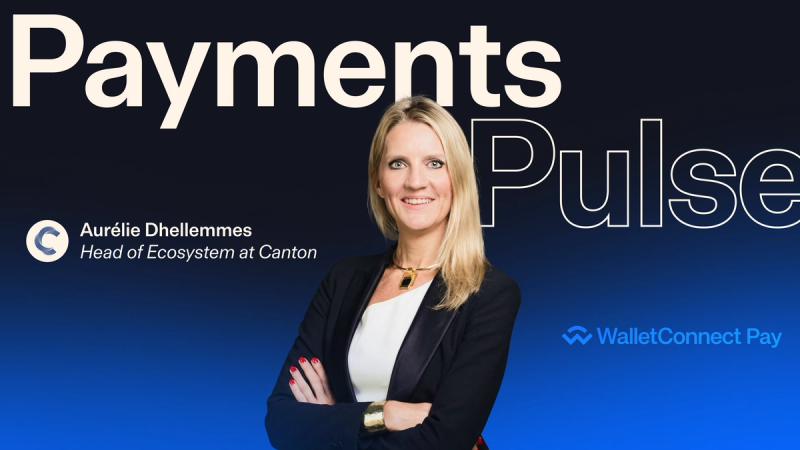

Canton Network's Head of Growth, Aurélie Dhellemmes, joined WalletConnect's Payments Pulse talk show to discuss why institutional blockchain adoption has taken longer than expected, what Canton is doing differently, and how the partnership with WalletConnect is helping close the gap between institutional rails and global distribution.
Aurélie brings 20 years across finance, tech, and crypto, including six years leading markets and partnerships at Ripple across APAC. In this conversation, she covers the core design flaw that held early blockchains back from institutional use, why composability matters more than interoperability, and what a world of 24/7 programmable collateral actually looks like in practice.
She also speaks to the WalletConnect partnership directly, explaining how Canton's institutional-grade infrastructure and WalletConnect's connectivity layer, spanning 700+ wallets and 55 million users, combine to unlock real scale without introducing additional custody or security risk.
Transcript
Dayana Aleksandrova: Welcome to another episode of the Payments Pulse, WalletConnect's talk show where we discuss traditional digital finance, payment rails, and stablecoins. Today we have Aurélie Dhellemmes, Head of Growth at the Canton Network. Aurélie, welcome to the show.
Aurélie Dhellemmes: Thank you, Dayana. Thank you for having me.
Dayana Aleksandrova: We're so excited to have you. We have a lot to talk about, but before we dive in, tell us a little bit about yourself. What did you do before Canton? What is your background?
Aurélie Dhellemmes: I have 20 years between finance, tech and crypto. The first part was network architecture — programming routers at IBM, certified Cisco engineer, very much hardcore engineering. Through my MBA I managed to switch to front office roles: Deutsche Bank in effect structuring in Singapore, then Bank of New York. I switched to crypto seven years ago and spent six years at Ripple, leading the markets team in APAC and then the MVP of partnerships. I moved to Canton and Digital Asset last year and I'm very happy with the move.
Dayana Aleksandrova: Incredible. That is such a compelling career trajectory. You have seen everything, from traditional finance through to digital assets. We talk a lot about institutions when it comes to Canton. In your opinion, why is there so much discussion about institutional adoption but we have not seen it at the scale we want yet?
Aurélie Dhellemmes: That's a great question. There's always been this "when are institutions coming?" and we feel the inflection point right now. To give you a number: Broadridge alone is doing $400 billion of volume daily on Canton. When you look at the crypto market daily, it's volatile, but roughly $100 billion per day on average over recent weeks. Broadridge alone is doing four times that on Canton, and that's only scratching the surface of the institutional work being done.
The question is why now and why it didn't happen before. I think the blocker was mostly a design mismatch, not a technology gap. Earlier blockchains were designed for a very different world: full transparency, one shared state, everyone seeing everything. That works for anonymous systems, but institutional finance doesn't work like that. We engage with banks that are under significant fiduciary responsibility. They are required to protect client assets and information, and they cannot get that wrong — the regulatory consequences, financial penalties, and loss of trust are substantial.
Asking those institutions to run on fully transparent infrastructure is like asking them to execute on a public live stream. Digital Asset, the company behind the Canton Network, has been in existence for 12 years and has spent that time engaging with institutions to understand and build from scratch. Privacy is built in, configurable. For institutions, privacy is not just a feature; it is a condition for participation. A fund risks being front-run if they're building a position and the market can see it. Margin movements, if visible, can see pricing move against you. Payroll is another example — companies running payroll on chain cannot afford to have salaries exposed. DTCC is tokenising US treasuries on Canton. Visa is building towards on-chain settlement on Canton. Neither can operate on a fully transparent network. That's why the hesitation was never about interest — it was always about the design requirements.
Dayana Aleksandrova: That is such a clear answer and it covers several of my follow-up questions. We saw DeFi begin with a radical desire for full on-chain transparency. But as soon as banks enter the picture, there is information that is strictly private by regulatory necessity. My next question is about fragmentation. We have seen it in both traditional finance and decentralised finance. How important is it to solve fragmentation between custodians and platforms, and what is Canton's position on that?
Aurélie Dhellemmes: I love this topic. You're right on fragmentation, and the killer use case for blockchain for me is composability. That is very different from interoperability. Interoperability is a loaded word — when you introduce bridges into the flow, you add cost, you add hacking risk, and you often lose the possibility of privacy. Composability is about having one asset operate across an entire workflow between different applications.
To give you a concrete example: treasury teams want to be able to make pay-ins and pay-outs on weekends. Right now, if they want to make a pay-out on a Sunday, they need to lock capital on the Friday and it stays locked for two days — dead capital earning no yield. The intention on Canton is that they get access to tokenised money market funds (iBengie is live on Canton already), and then programmatically, when it's needed, transfer that into a tokenised deposit and pay out. Being able to compose an asset across different applications is the real use case of blockchain. Add configurable privacy and atomicity to that, and that is where the big wins are.
Dayana Aleksandrova: You're so right. It's not just interoperability but composability. Now some of the missing pieces for Canton have been user onboarding and distribution. WalletConnect and Canton recently partnered to work on exactly those two things. What outcomes have you seen and what is the importance of this partnership from your perspective?
Aurélie Dhellemmes: It's very foundational. I've followed WalletConnect and the work that Jess, the CEO, has done with the team for a long time. I think it's almost a partnership made in heaven. On one side you have strong assets and institutional adoption. On the other, a very strong connectivity layer. WalletConnect has more than 700 wallets, 55 million users, and a growing certified custodian network. It bridges the two worlds.
An institution can connect through WalletConnect's wallets and soon the custody setup, and that unlocks 24/7 collateral mobility, access to private assets, and on-chain payments. On the other side, builders on Canton get access to hundreds of wallets, tens of thousands of apps, and millions of users. What I also appreciate is that this comes without additional risk — WalletConnect never touches funds or private keys. It is a secure connectivity layer with end-to-end encryption, with full control remaining with the institution. Canton brings the institutional rails and WalletConnect brings the global distribution layer. That is how you unlock real scale.
Dayana Aleksandrova: You summed that up so well. One thing I always highlight with WalletConnect Pay is that it's a single integration, and it ensures that the vendor, the PSP, maintains compliance — the funds are always under control, always within regulation. Our final question is your outlook on the on-chain economy. Where do you think the future of decentralised finance and stablecoins is heading in the next 12 months to two years?
Aurélie Dhellemmes: I love this question. Let me ask you one back: why do we need cash sitting in a bank account today? It earns close to zero yield for most of us. We keep it there because we know we need it — for a restaurant, to buy something. But the vision, and we are not far from it, is the ability 24/7 to put those assets to work in yielding instruments: tokenised money market funds, DTCC tokenised treasuries, tokenised equities. Being able to unlock that atomically and instantaneously when it's needed, so you maximise working capital.
I give that individual example as a metaphor for institutions and all the untapped collateral out there. More than 60% of collateral is untapped because of inefficiencies — cutoff times, weekends, settlement delays. Some treasurers we work with tell us that during intercompany transfers, for 24 to 48 hours they don't know where the cash is. The ability to unlock capital 24/7, atomically, programmatically, in a composable way, with configurable privacy — that is genuinely compelling.
One other thing worth mentioning: a lot of people are unsure whether Canton is private or public. The best metaphor I have is the internet. The internet is a public network. On that network you have applications, and those applications have configurable privacy. A banking app has strict privacy requirements. A news site doesn't require any permissioning. People sometimes struggle to understand how you get composability while maintaining privacy. When I was in Singapore, my bank account was private and my utility bills were private, but they could still operate together — my bills were paid automatically. Private applications can still interoperate and compose with each other. Canton works the same way. That is what has made it compelling to institutions, and that is what the future of on-chain finance looks like.
Dayana Aleksandrova: I am looking forward to that. 24/7 money that works for you. Thank you so much, Aurélie, for being a guest on Payments Pulse.
Aurélie Dhellemmes: Thank you, Dayana.