
Stablecoins have been growing quietly in the background for years. The numbers are no longer small: over $300 billion in stablecoins outstanding, $33 trillion in transactions processed in 2024, year-on-year transaction growth running above 70 percent. And yet, for all of that momentum, stablecoins still haven't made the leap into everyday life. Most people have never spent one. Most merchants don't accept them. The rails exist, the technology works, and the demand is real. So what's actually in the way?
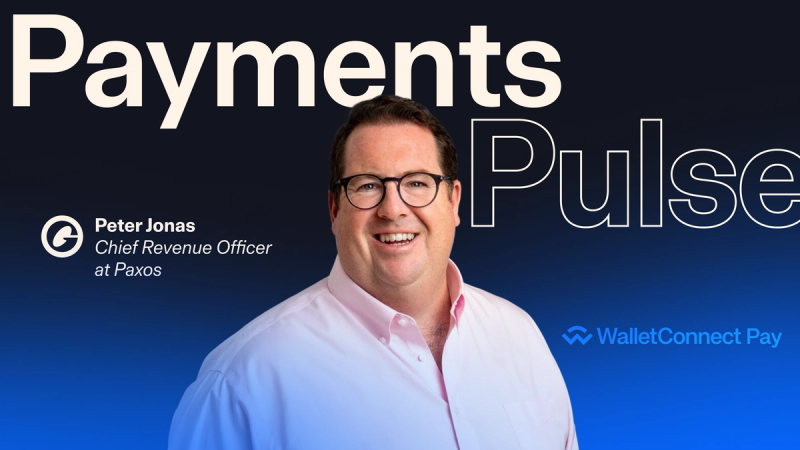
That's the question at the centre of this episode of the Payments Pulse. Our guest is Peter Jonas, Chief Revenue Officer at Paxos, the regulated blockchain infrastructure company that has been in this space since 2012, before Ethereum existed, and that issues USDG, the stablecoin at the heart of the Global Dollar Network. Peter's career spans some of the most consequential platform moments of the last two decades: building the games business and then the mobile app advertising business at Facebook, launching products at Uber, scaling Compass from a few hundred to sixteen thousand people. He got into crypto as an investor in 2016 and has been watching the space converge on something real ever since.
What comes through in this conversation is a very specific thesis about why stablecoins are different from every other crypto narrative. The product market fit is already there. That's not the debate. The debate is about distribution and utility, and why those two things, more than any smart contract or regulatory structure, are what determine whether a network actually scales. Peter has seen this pattern before: at Facebook with mobile, at Uber with ride-hailing, at Compass with real estate technology. The technology is the table stakes. The network effects are where things get non-linear.
That's also why the recent integration of USDG with WalletConnect Pay matters. USDG is now available to transact anywhere WalletConnect Pay is accepted, putting it in front of a network of 750-plus wallets through a single integration. For Peter, it's not a partnership announcement so much as a distribution unlock. The kind of moment, he argues, that doesn't move adoption linearly. It tips it.
The conversation also covers the design of the Global Dollar Network itself, a 135-plus member ecosystem that includes Kraken, OKX, Robinhood, and Mastercard, and why its fundamental bet is that no single issuer should capture all the value a network creates. Rewards flow back to the participants who generate them. It's a thesis about fairness in infrastructure, and it's the reason Peter believes USDG has a structural advantage over stablecoins built to serve a single company's balance sheet.
Transcript
Dayana Aleksandrova: Welcome to the Payments Pulse, WalletConnect's talk show where we talk everything payments, including decentralised finance, traditional finance, and how the two are starting to work hand in hand. Today with us, we have a very special guest. Please welcome Peter Jonas, the Chief Revenue Officer at Paxos. Peter, welcome to the show.
Peter Jonas: Hey Dayana, thanks for having me. It's great to be here.
Dayana Aleksandrova: Thanks so much for being here. Now we ask all of our guests the same first question: what were you doing before your current role and how did you land at Paxos?
Peter Jonas: I'll take you through a bit of my journey. Most recently I started a company called Third Wave, a venture-backed company focused on ad tech inside of crypto. Before that I had a fairly winding journey through technology companies. I was President of Compass, where I ran the West region and watched it grow from a couple of hundred people to sixteen thousand by the time I left. Before that I was at Uber, where I launched a handful of businesses. And before that I was at Facebook, where I started the games business and eventually the mobile app ads business, both of which became pretty substantial. That mobile experience is a big part of why I got so excited about crypto. We saw a massive platform shift happening with mobile before mobile app advertising was even a category. I see the same thing now with crypto. Being at Paxos, helping lead the growth of an organisation that has been regulatory-first since 2012 and is focused on the segment of crypto with the clearest product market fit, that's why I came here.
Dayana Aleksandrova: It sounds like you're a real OG. And for anyone who hasn't seen our announcement, USDG is now live on WalletConnect Pay. USDG is issued by Paxos, and we'll get into that shortly. But first: stablecoins have been around for a long time. The conversation is really picking up now, but there's something that keeps coming up. Stablecoins are theoretically great, low fees, quick settlement, all the right properties, and yet people still aren't using them as real money. What's still the challenge, and how might Paxos and WalletConnect Pay help solve it?
Peter Jonas: We're excited to be partners and I hope we can solve it together. Stablecoins are doing well: $300-plus billion outstanding, transactions growing 70-plus percent year-on-year, $33 trillion in movement. But that still pales in comparison to the scale of the global market. Fiat is 400 times bigger. Visa and Mastercard transaction volumes are multiples of what we're seeing. The opportunity is enormous. And the opportunity isn't just institutional payments. It's the payments that affect each and every one of us day to day. When I think about driving mainstream adoption, it really comes down to building stablecoin payments into everyday flow. Consumers don't want a different way to pay. They want the same way, but better: cheaper, using the assets they already hold. The choke point hasn't been demand. The demand is there. It's been the ability of existing players to drive that adoption within the current construct. That's why WalletConnect Pay is such a meaningful unlock. We're not reinventing the wheel. We're just giving people better options to do what they've always done. And these adoption trends, as I've seen from experience, are not linear. Integrations like this create the conditions for a non-linear explosion. At some point we're going to hit a tipping point with this kind of utility, and it's going to unlock the growth that all of us have been waiting years to see.
Dayana Aleksandrova: That's such an important point. Don't reinvent the wheel, just give people a better version of what they already use. Now USDG is issued by Paxos and distributed through the Global Dollar Network. What was the core problem you were trying to solve from day one? Why was there a need to create it?
Peter Jonas: The thesis that underlies it is what I find most compelling. The market cap at around three billion is encouraging. The partner list, Kraken, OKX, Robinhood, Mastercard and many more, is compelling. But what really gives me conviction is the network design itself. This is built for the network, and rewards go back to the network. When you look at how networks get built, none of them succeed without delivering value to the players who are contributing. So if a network isn't being built by one single player, why should one player capture all of the benefit? The Global Dollar Network has 135-plus participants. That's not just meaningful because of the distribution and the fact that a huge number of players care about the asset. It also levels the playing field. Every participant, whether they joined a year ago or signed up today, has the same opportunity to deliver value to their users and earn rewards from doing so. It's not held centrally and doled out in special deals where leverage dictates who gets what. The value flows back to those who create it.
Dayana Aleksandrova: That's really encouraging for anyone wondering if it's too late to join. If you're coming in with equal opportunity, that's a real motivator. And when it comes to infrastructure and distribution, a lot is already solved. But why was the connectivity piece, reaching users, still missing? That's really where WalletConnect comes in.
Peter Jonas: Distribution and utility are kingmakers. No matter how great the technology, no matter how strong the regulatory structure or the operations, without those two things nothing scales. This is why people build on platforms like Apple and Google. It's why when I was at Facebook we launched thousands of games applications and those developers made serious money, because the distribution matters. Getting in front of users drives adoption. And then utility is the other piece that WalletConnect brings: not just the reach, but the depth of the ecosystem, the partnerships, the way WalletConnect is embedded across so many points in the stack. Smart contracts are hard, regulation is hard, operations is hard, but those are known paths. Distribution and utility have a little bit of magic in them. Working with a partner like WalletConnect is a no-brainer for us.
Dayana Aleksandrova: You might have the greatest product in the world, but if nobody sees it, it doesn't matter. Now, one of the big positives of stablecoins is composability, but they also often come with regulatory ambiguity, questions about compliance, uncertainty about who to turn to when something goes wrong. How does USDG reconcile the technical ability for composability with the trust and compliance piece?
Peter Jonas: I think this is a bit of a false dichotomy. They don't need to be in opposition. Compliance lives at the issuance layer. USDG is MAS regulated, Monetary Authority of Singapore, and Paxos handles all of that. We've been in this since 2012, we were here before Ethereum, our systems are built for this, and we've been regulatory-first even when it wasn't commercially advantageous. That compliance apparatus builds trust, and trust is a key element of the flywheel. Meanwhile, distribution stays fully open: any chain, any wallet, any partner. There really isn't a trade-off. These are two separate concerns that can be solved independently. The network wasn't designed to serve the issuer's purposes. It was designed to serve the major partners who are out there getting USDG to their customers. Once you separate the issuance layer from the distribution layer, you see that composability and compliance are not in conflict at all.
Dayana Aleksandrova: I think that will make a lot of people feel a lot better about this. And with our recent announcement, USDG is now available to transact anywhere WalletConnect Pay is accepted. What does that unlock for USDG that wasn't possible before?
Peter Jonas: It comes back to distribution and utility. WalletConnect is the perfect partner for exactly those two things. The ability to reach all of WalletConnect's customers, the integrations and partnerships you've built, all of that has a major multiplier effect on the asset's distribution and utility. We're not just getting into WalletConnect directly. We're getting into all of the point-of-sale partners you have across the world. That's a real boon for us.
Dayana Aleksandrova: Love to hear that. Final question: a look into the future. How do you see the on-chain economy evolve, and what is the role of Paxos, the Global Dollar Network, and USDG in it?
Peter Jonas: I think the world evolves to a place where stablecoins, whether known or unknown to the end user, become the foundation of the entire financial system. Most of that activity will end up abstracted away. People will just be using dollars. But the impact will be profound. You'll see a democratisation of access to the US dollar that doesn't exist today. For a huge portion of the world, access to dollar-denominated value is not a given, and stablecoins will be a key driver of changing that. I also think you'll see democratisation of access to the risk-free rate. Even in more affluent parts of America, people don't necessarily get full access to it. Over time, stablecoins will offer that to the global south in a way that creates genuine economic value. The financial system will get replatformed onto blockchain. And the stablecoin that wins, we believe, will be one that is regulated and therefore trusted, built by a group rather than a single actor, and designed to share value back to its network partners. We hope that's us. But it does feel, as the market matures, like an obvious outcome. The pressure will go to giving both control and value to the people who actually create it for the network.
Dayana Aleksandrova: Absolutely bullish on that, and it's a future we can all hope for. Peter, thank you so much for being a guest on the Payments Pulse.
Peter Jonas: Thrilled to be here. Thank you so much. I really enjoy the podcast, so it's kind of fun to actually be one of the guests.