

Stablecoin payments have crossed the infrastructure threshold.
This report brings together WalletConnect network data and Polygon ecosystem intelligence to document the state of stablecoin payments in 2026, where the volume is, who is driving it, and what comes next. It is a co-authored perspective from two infrastructure providers who sit at the intersection of wallet connectivity and blockchain settlement.
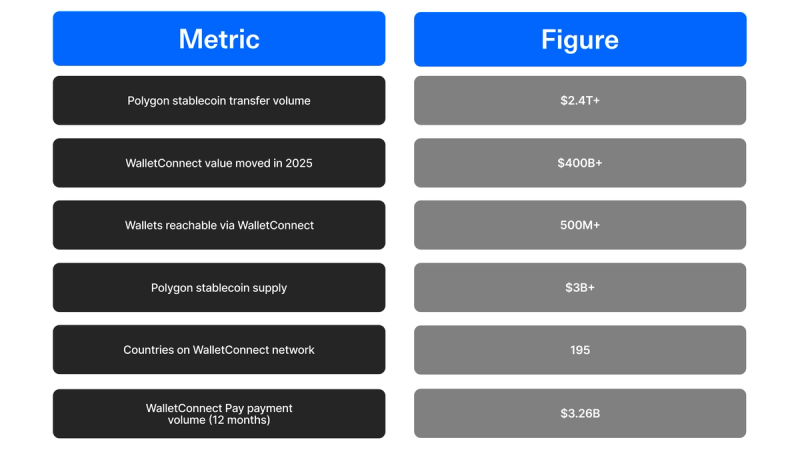
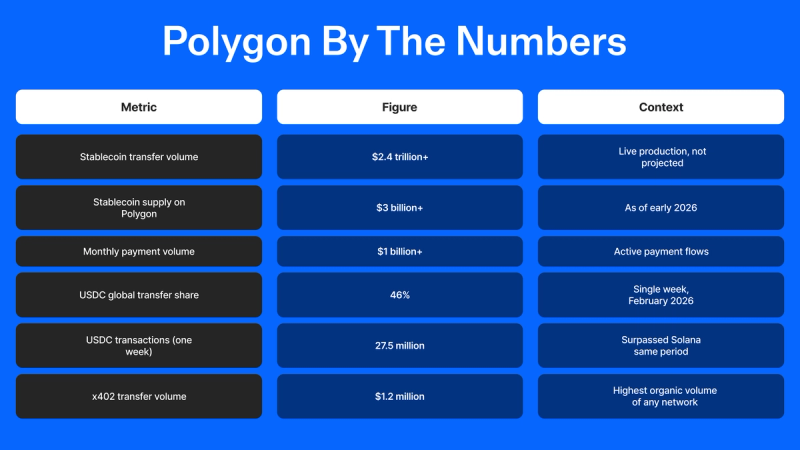
WalletConnect is the infrastructure powering over 500 million wallets across 700+ providers and all major chains. Polygon is the settlement layer that has processed over $2.4 trillion in stablecoin transfer volume, live in production with Revolut, Stripe, Tazapay, Mastercard, and more.
Polygon: The Open Money Stack
Polygon Labs is a global blockchain payments company building infrastructure to move money instantly, reliably, and at internet scale. Its mission: move all money onchain.
After nine years and trillions of dollars processed, the team's conclusion is clear: the bottleneck in stablecoin payments isn't blockchain rails. It's everything surrounding them, wallets, compliance, orchestration, and on/off-ramps. The Open Money Stack is Polygon's answer: a single integration layer for stablecoin payments that works seamlessly with existing systems, enabling low fees, 24/7 global settlement, and infrastructure built to scale.
Legacy financial systems were built for a different era. While data travels at the speed of light, money is still stuck waiting in line. Polygon was founded to change that. The vision is simple but transformative: make money move as freely as information does on the internet.
“Stablecoin rails are ready. What's been missing is a way to connect them to the wallets, compliance frameworks, and existing systems that institutions already use. The Open Money Stack closes that gap, and partners like WalletConnect are essential to making it seamless for the people and businesses who actually move money every day.”
— Marc Boiron, CEO, Polygon Labs
How WalletConnect Powers Polygon
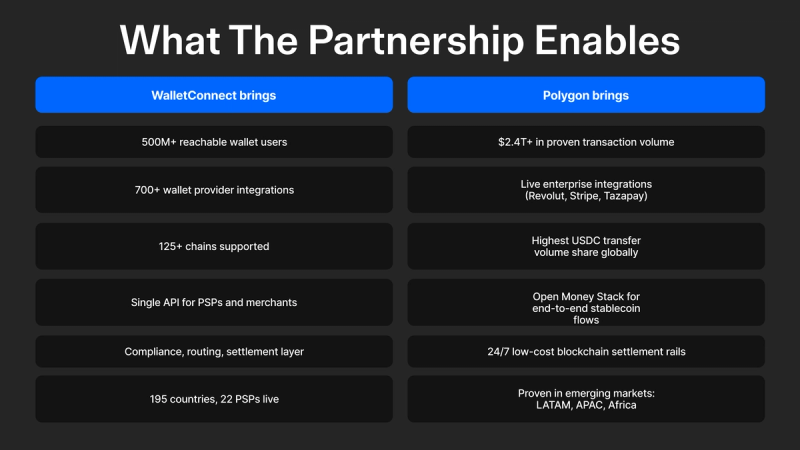
WalletConnect has been a long-standing partner to Polygon, providing distribution and connectivity across a broad network of wallets, centralized exchanges, and decentralized applications. Through this partnership, Polygon has been able to reach more users and integrate more deeply within the wider crypto ecosystem.
WalletConnect has played a key role in onboarding wallets and apps to Polygon by providing seamless integration support for POL and Polygon-powered stablecoin use cases across a wide ecosystem of organizations, crypto platforms, and beyond. Both teams are aligned on expanding this collaboration with the goal of strengthening Polygon's presence within the payments space.
"The future of payments isn't just onchain, it's connected. By combining WalletConnect's global wallet network with Polygon's Open Money Stack, we're enabling developers and payment providers to build truly seamless stablecoin experiences that work across ecosystems, geographies, and platforms."
Jess Houlgrave, CEO, WalletConnect
WalletConnect Pay: The End-to-End Solution
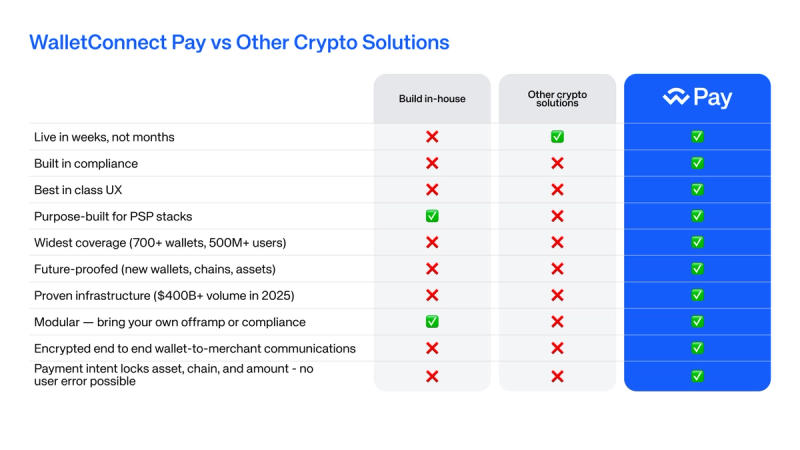
Built on WalletConnect's infrastructure and network, WalletConnect Pay is the single integration for PSPs and merchants to accept stablecoins and crypto, compliant, with instant settlement, and a reach of 500+ million wallets.
WalletConnect Pay is not a separate crypto product. It integrates as an alternative payment method alongside cards and bank transfer within existing checkout and POS flows. The merchant sees a payment. The user sees a confirmation. The PSP earns interchange. WalletConnect handles everything underneath.
The demand is real
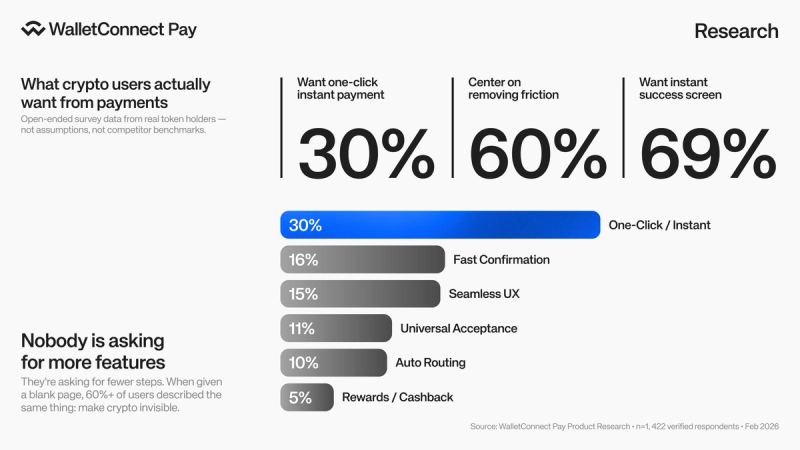
WalletConnect surveyed 1,422 active crypto users and found:
- 96% of crypto holders want to pay with crypto, but can't find enough places to spend
- 525% growth in crypto card spending in 2025, demand signal, not anomaly
- 15–25% higher average order value from crypto customers vs. card
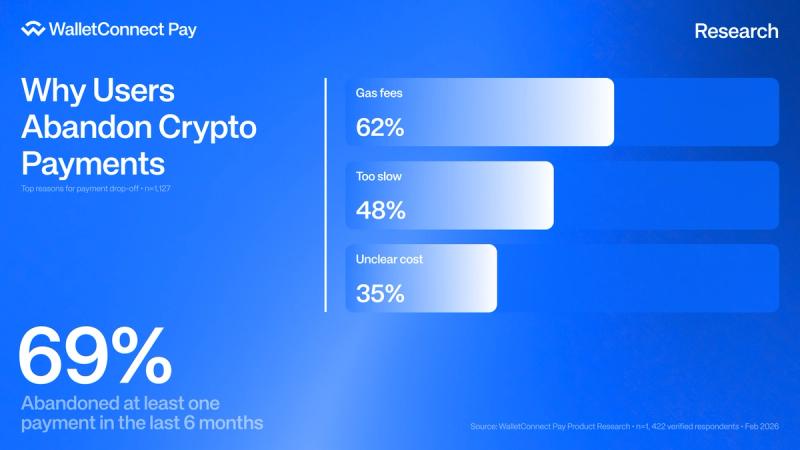
- 69% have abandoned at least one crypto payment in the last 6 months
The top reasons for abandonment:
What users actually want
When given a blank page, 60%+ of users described the same thing: make crypto invisible. The priority ranking:
WalletConnect Pay: One integration = Access to 500+ Million Users
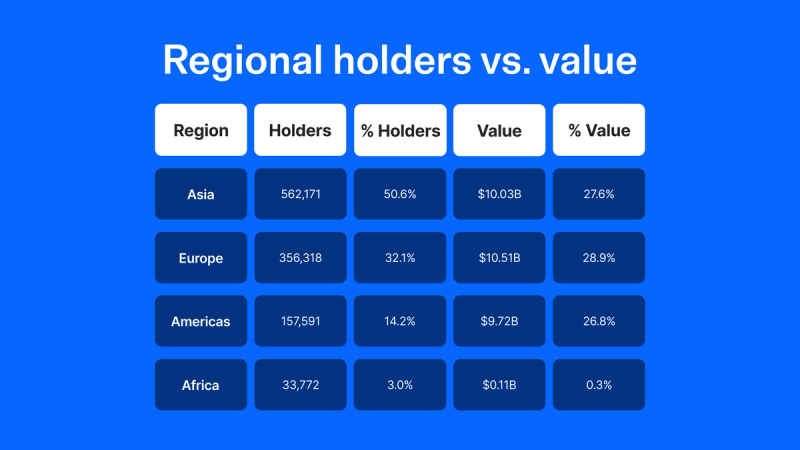
WalletConnect Network holdings
Data from 1.11 million wallets that have interacted with WalletConnect:
- 1.11 million wallets hold $36.3B in stablecoins
- Average balance: $32,704. Median balance: $10.41
- 79.2% of wallets hold less than $100
- Top 0.4% of wallets (4,434 wallets with $100K+) hold 97.9% of all value
USDC leads. USDT complements. Local stablecoins are emerging.
USDC is the clear leader in stablecoin activity on Polygon. In a single week in February 2026, Polygon recorded 27.5 million USDC transactions, surpassing Solana's 22 million over the same period. That same week, the network processed 102.8 million USDC transfers, representing a 46% share of global USDC transfer volume and 2.6x the activity of the next largest chain.
WalletConnect has seen the same pattern. In the week of 16 March, the WalletConnect network saw over $4.38 billion in USDC flow through the network, one of the highest single-asset volumes recorded.
Polygon has been a driving force behind real payment activity. Over 38% of WalletConnect Pay users preferred Polygon for payments, higher than Arbitrum and Solana. With low and predictable gas fees, most payments on Polygon cost less than a penny. When users pay via MetaMask or BitGet Wallet, gas fees are often sponsored entirely, making crypto payments genuinely free for the end user.
USDT plays an important complementary role, particularly for cross-chain activity and emerging market remittances. Polygon supports a broader stablecoin ecosystem including DAI and others.
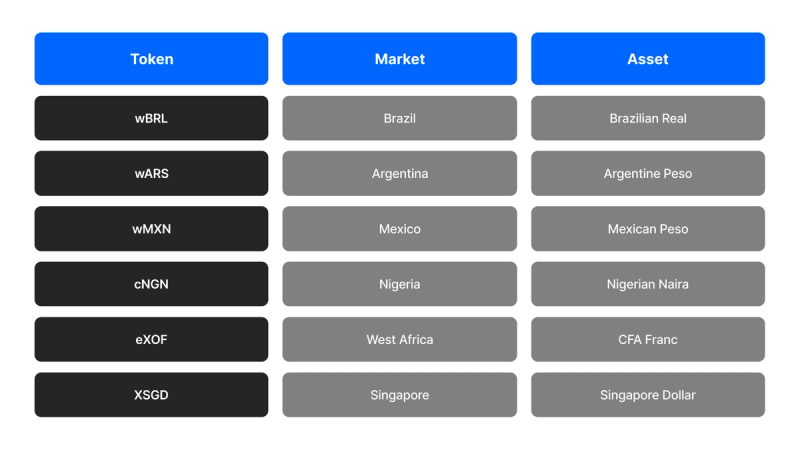
Local stablecoins are gaining traction
Regional data shows growing demand for local-currency stablecoins, with Polygon consistently appearing as a leading chain:
Regional patterns
Latin America consistently leads in local stablecoin transaction share. Asia-Pacific ranks second with steady activity. Africa is smaller but growing, with a noticeable acceleration in late 2025 and early 2026. Monthly transaction counts across these markets have climbed to approximately 1 million, with Polygon appearing as a leading chain across market cap, transfer volume, and transaction count.
“As we mark one year since our arrival in Bolivia, the alliance with Honda Autobol reflects the growth we are seeing and supporting within the country’s fintech ecosystem. The participation of global players like Polygon and the integration with an industry such as automotive show how this development is accelerating. We are introducing financial solutions into services where these experiences did not previously exist, modernizing the way people interact with them and responding to a growing demand for more efficient options,”
-said Lucas Posada, CEO and co-founder of Takenos.
From Token Transfers to Financial Infrastructure
Payments on Polygon have moved well beyond simple token transfers. The focus in 2026 is on removing the remaining friction: the compliance layer, the on/off-ramp experience, wallet infrastructure, and the ability to move value across chains without users thinking about it.
Cross-border & B2B payments
Stablecoin rails offer materially better economics than legacy correspondent banking. Remittance companies are moving cross-border flows onchain. Card issuers are settling in stablecoins. Across the globe, $46+ trillion in annualized stablecoin transaction volume tells the infrastructure story, but real payment volumes from real companies are what matter.
Invisible consumer infrastructure
Neobanks are embedding Polygon as the underlying settlement layer without end users ever knowing they are interacting with a blockchain. The infrastructure is becoming invisible, which is exactly where it needs to be for mainstream adoption.
Institutional deepening
More institutional participation in DeFi primitives for treasury management and yield. Increasing overlap between what was traditionally DeFi and what enterprises now recognize as useful financial tooling.
Current production integrations include Polymarket, Mastercard, Revolut, Stripe, and Tazapay, among others. The full ecosystem spans thousands of projects across payments, DeFi, gaming, and enterprise finance.
What we are seeing instead is a gradual replacement of the underlying rails. First, at the backend, where users do not notice. Then, at the edges, where the benefits become impossible to ignore. Eventually, the old system does not disappear. It just becomes irrelevant. Revolut crossing $1.2 billion on Polygon is not the finish line. It is an early signal that this replacement is already underway. The most important part is not the number itself. It is what the number represents. Real users. Real volume. Real businesses.
-Aishwary, Global Head of Payments & RWA at Polygon
The demand environment for stablecoin payments has never been stronger, and it is increasingly coming from outside crypto-native contexts. Enterprises, fintechs, PSPs, and neobanks are recognizing that stablecoin rails offer materially better economics than legacy infrastructure. WalletConnect and Polygon are aligned on what needs to happen next: reducing fragmentation, embedding compliance, and making the user experience invisible.
Together, they bring the network reach (WalletConnect) and the settlement layer (Polygon) that stablecoin payments at scale require.
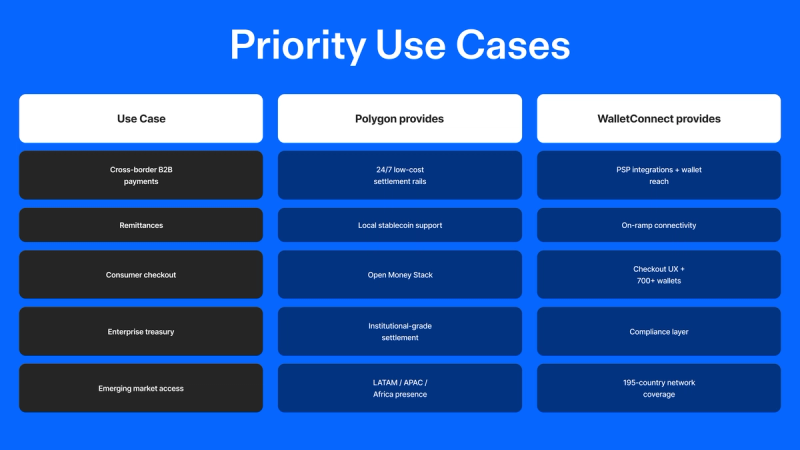
The question is no longer whether stablecoin payments work. The infrastructure is live. The regulatory frameworks are crystallizing. The demand is real and documented.
The question is how fast the industry moves from evaluation to execution, and which infrastructure providers are ready to support that transition at scale. Polygon has processed trillions. WalletConnect connects half a billion wallets. Together, these two networks represent the most direct path from a user's wallet to a merchant's checkout, on any chain, with any asset, anywhere in the world.
Polygon is not just building the go-to blockchain for global payments. Polygon is building the financial internet, with WalletConnect as the connectivity layer that brings every wallet in the world along for the journey.
"When we talk about the future of payments, we tend to talk about technology. But the real shift happening right now isn't technical, it's structural. The infrastructure exists. The regulatory clarity is arriving. The demand from users is documented and real. What's changing is that institutions, payment providers, and merchants are finally moving from watching to building.
WalletConnect's role in this has always been connectivity, making it possible for any wallet to reach any application, on any chain, without friction. What WalletConnect Pay represents is the same principle applied to commerce: any user, any asset, any merchant, anywhere in the world. Polygon makes that possible at scale. Their settlement layer, their track record with enterprise partners, and their presence in the emerging markets where stablecoin payments matter most, these are what turn connectivity into commerce.
Together, we're not building a product. We're building the infrastructure layer that the financial internet runs on.
The question isn't whether stablecoin payments will become mainstream. The data answers that. The question is who builds the experience that gets us there, and whether the industry moves fast enough to meet the demand that already exists. We intend to."
-Jess Houlgrave, CEO, WalletConnect
Lets Talk Stablecoin Payments
Data sources: WalletConnect Network Data (Feb 2025–Jan 2026) · WalletConnect Survey n=1,422, Feb 2026 · WalletConnect Stablecoin Onchain Analysis (1.11M wallets, March 2026) · Polygon Labs production data, March 2026 · Visa Onchain Analytics