

We designed WalletConnect Pay around a simple question: what if the payment system rewarded everyone involved, instead of extracting value from merchants to pay everyone else?
Today, card payments involve layers of intermediaries - card networks, multiple banks, processors and more - each taking a cut. Merchants end up paying ~2.5-3.5% on every transaction. These rates are seldom negotiable.
Crypto cards made spending crypto as easy as tap-to-pay and that's genuinely valuable (I personally have my favourite cards that I use regularly). However, they didn't change the underlying economics. They still run on Visa/Mastercard rails, so merchants still pay the same fees. As a user, I get cashback rewards, but conversion fees often eat into them. Personally, I also have to pay an annual fee to unlock better reward tiers so the cashback isn't actually as rewarding at the end of the day.
TLDR? The UX improved. The economics didn't.
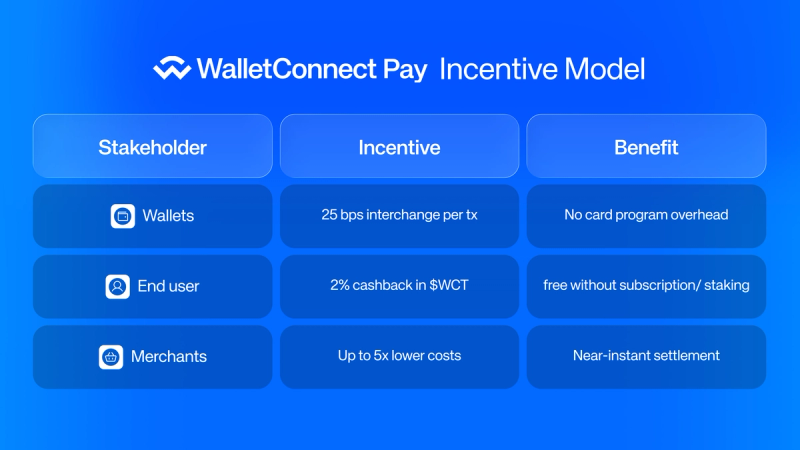
WalletConnect Pay balances incentives across the entire payment stack - keeping rewards attractive for everyone while maintaining sustainable economics.
Wallets
- Earn 25 bps interchange on every transaction
- No need to juggle high recurring overheads with a card program
- Single integration, immediate global rollout
End Users
- Proposed starting at 2% cashback in $WCT for launch reward
- Free to use
- Gas-abstracted payments
Compare: Crypto card cashback averages 1-4%, but often requires staking $500-$40K+ for top tiers, or paying monthly/annual card fees.
Merchants
- Up to 5× lower costs than traditional card rails
- Near-instant settlement
Compare: Card processing costs merchants 2.5-3.5% per transaction and ~1-3 days to settle. Crypto cards change nothing since they still run on Visa/Mastercard rails.
PSPs
What about PSPs and acquirers? Won't they lose out? Why would they enable WalletConnect Pay? Quick answer: they can also earn interchange, and they compete to win and retain merchants. What’s most crucial for them is that WalletConnect Pay fits into their existing workflows and compliance frameworks so it is easy to enable no stack rebuild required.
How the Economics Work
The key unlock here stems from WalletConnect Pay being a crypto-native rail.
Why crypto rails cost less:
Fewer intermediaries. Traditional cross-border payments pass through multiple banks, each taking a cut. Blockchain payments move directly from wallet to merchant.
Fees aren't percentage-based. On card networks, fees scale with transaction size. On blockchain, a $10 and $10,000 payment cost the same to process. The larger the payment, the greater the savings.
No chargebacks. Users explicitly authorize every payment, and blockchain transactions are final. This removes the reversal risk that adds cost and complexity to card payments.
With a crypto-native rail, that stack collapses. Payments move directly from wallet to merchant. Fewer parties taking a cut means the savings can be redistributed: lower fees for merchants, interchange for wallets, and cashback for users - all while fitting the same workflows (receipts, refunds, reconciliation, compliance) and thus deployable at scale.
This is how we balance incentives across the stack while keeping them attractive. It’s not about subsidizing one party at the expense of another - it’s about a more efficient rail that creates enough value to reward everyone.